
A parent can sit at the kitchen table and hear the same sentence in three different ways: a loved one says it wasn't that bad, a partner says they'll handle it tomorrow, and a sibling says someone has to keep the peace. In that moment, the family isn't looking for theory. They're looking for something steady enough to hold onto when the conversation starts to spin.
That's where the three C's can help. In addiction family work, the phrase is usually summed up as: I didn't cause it, I can't cure it, and I can't control it, a shift meant to move families out of self-blame and enabling and toward boundaries and self-care. For a family in the middle of confusion, that simple frame can lower the emotional temperature enough to think clearly again.
A Family Moment You Might Recognize
A son answers his mother's call after a fight, and he can tell within one sentence that she's been drinking. He listens, tries to sound calm, and starts guessing what he should say differently next time so the night won't end in another blowup. By the end of the call, he's carrying her pain, his own fear, and the old hope that if he says the perfect thing, everything will settle down.
That same pattern shows up in other homes. A spouse checks cabinets and trash cans for signs of hidden drinking. A sibling gets asked to drive, cover, or explain away a loved one's behavior at a wedding, then goes home feeling resentful and helpless. In each case, the family member is trying to love someone without losing themselves, and that's exactly where the confusion starts.
The promise of the three C's is not that the family can fix addiction by understanding it. The promise is smaller, and in some ways stronger. It gives people a way to stop taking responsibility for what they never controlled in the first place, so they can start making clear choices about what happens next.
Practical rule: when a family member feels responsible for every relapse, every lie, and every consequence, the home usually gets noisier, not safer.
For families that are also trying to understand recovery as a wider process, a helpful companion is this guide to mental health recovery. It pairs well with the family side of this conversation because recovery rarely affects only one person.
What the Three C's Mean in Addiction
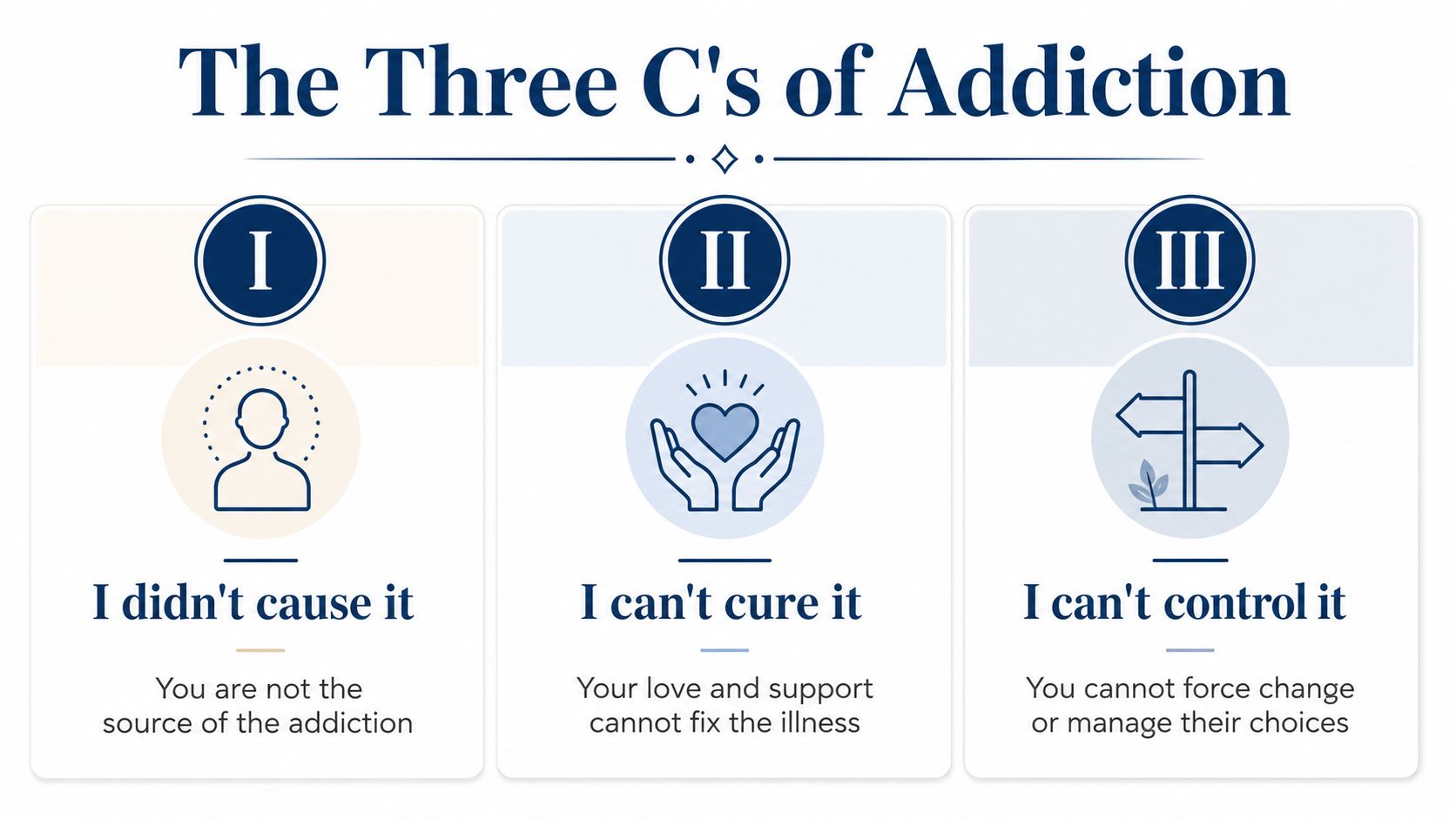
The first C is about blame
I didn't cause it means the addiction did not start because a spouse was too strict, a parent was too soft, or a sibling missed one warning sign. A family member can speak openly about conflict, hurt, or missed opportunities without carrying the whole origin story. In a hard conversation, that can sound like, “I can talk about what happened in our home, but I am not the source of the addiction.”
This C is about stopping misplaced guilt so the family can see the situation more clearly. A person still has to respond to broken trust, unsafe behavior, and boundaries that protect the home. The point is to leave the illness and the loved one's choices where they belong, while still facing what needs to happen next.
The second C is about fixing
I can't cure it means love, patience, and sacrifice can matter greatly without becoming a treatment plan. A mother can pray, a partner can encourage, and a brother can stay connected, but none of them can make sobriety happen by force. A simple script is, “I love you, and I am not pretending I can heal this for you.”
This C brings relief because it clears away a job the family was never meant to do. Once a family stops trying to do a clinician's work, it can put energy into its own stability, which usually makes the home steadier for everyone. For readers who want language for that shift, the same idea shows up in the article on helping versus enabling.
The third C is about control
I can't control it means no one can manage another person's drinking, drug use, moods, or promises through enough checking, pleading, or rescuing. Those repeated efforts often leave the family exhausted while the addiction keeps changing shape. A calmer script is, “I can set my boundary, but I can't make your choices for you.”
Boundary sentence: “I care about you, and I won't argue about your use when you're intoxicated.”
The three sentences work together because they separate responsibility from rescue. That is the core of the framework, and it is why families often feel relief when they stop treating every crisis like a test they failed. If a family needs help deciding what support looks like next, the guide to mental health recovery can help frame the next conversation.
Where the Three C's Came From and Why They Work
The phrase the three C's became so familiar in family recovery spaces because it matches a wider shift in how addiction is understood. Modern causal inference and evidence-based treatment standards in addiction care were formalized through clinical trial traditions in the 20th century, with random assignment becoming a central method for isolating treatment effects in human and social science research. That history matters because it marks a move away from guesswork and blame toward careful testing, clearer roles, and more reliable help. Source on the development of causal inference and treatment standards
Why blame-based thinking breaks families
Older moralized approaches often treated addiction as a failure of character, which left relatives trying to shame, argue, or supervise someone into change. That usually deepened secrecy and made the family feel responsible for outcomes they could never fully control. The three C's work because they interrupt that cycle and put the emotional weight back where it belongs, on boundaries, support, and professional care.
The framework also fits what families already know in daily life. People can love someone, disagree with them, and still not be able to change them. When a family accepts that truth, it stops using every conversation as a referendum on its worth.
Why the framework stays useful
The three C's are not a cure. They are a stabilizing tool. Families use them when they need to step out of panic, stop overfunctioning, and make choices that protect their sleep, finances, safety, and sanity while a loved one considers treatment.
That's why the model is strongest when it sits alongside real care, not in place of it. A family can say the right words and still need admissions help, medical support, or a treatment setting that gives everyone a clearer path forward. The framework gives language to the moment before action, which is often the hardest moment in the house.
Turning Each C Into Boundaries and Self-Care
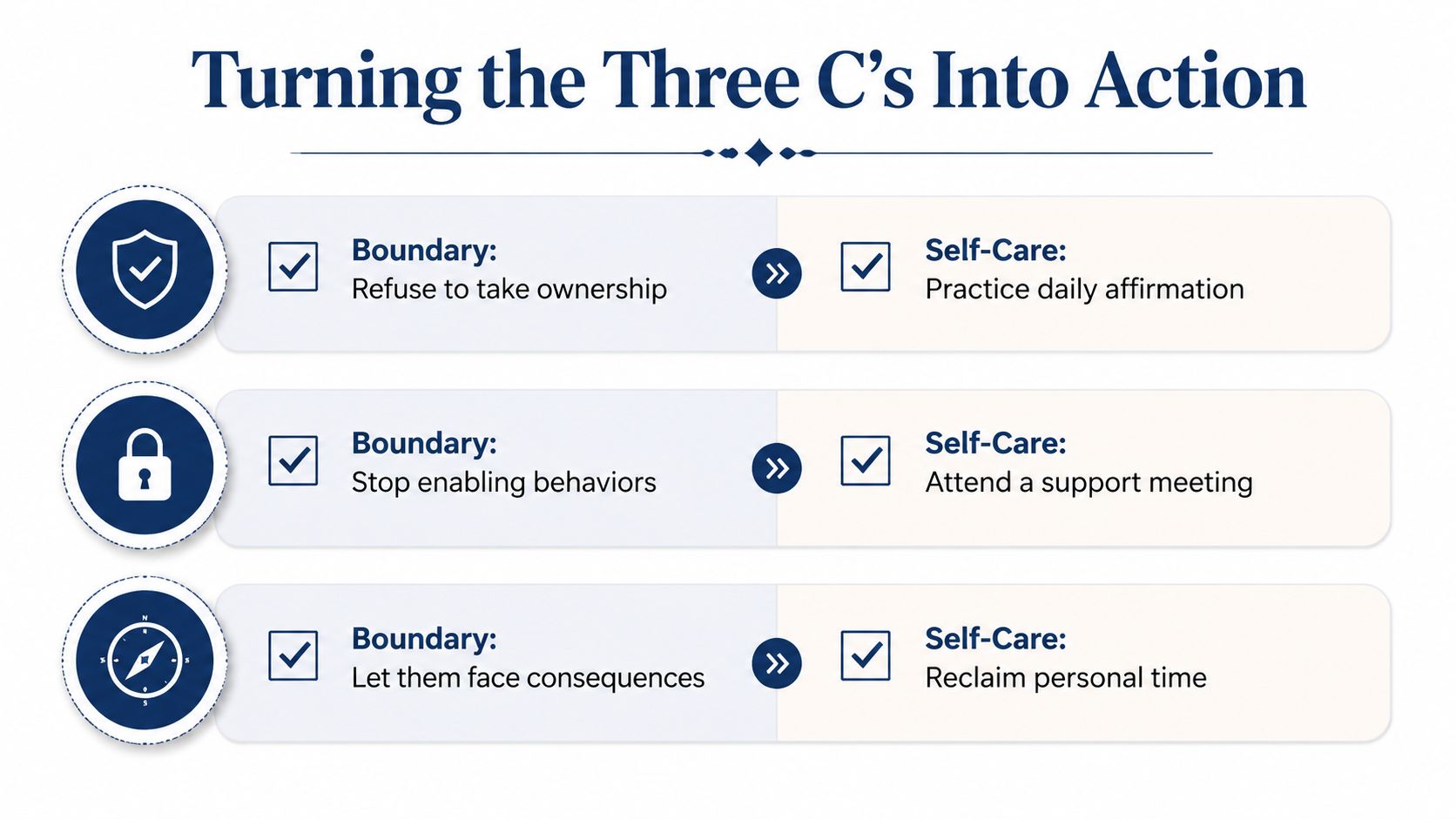
Start with what the family member will stop carrying
When I didn't cause it lands in a real home, it usually becomes a refusal to accept the role of scapegoat. A daughter can say, “I'm willing to talk about what hurts here, but I'm not taking blame for the addiction itself.” That boundary matters because shame often pushes families into silence, and silence tends to protect the illness.
The matching self-care step is simple and concrete. A family member can talk with a therapist, attend a support meeting, or write down the one thing they keep blaming themselves for and set it aside for review later. If that feels too abstract, the first action can be as small as getting enough sleep before the next difficult conversation.
When I can't cure it becomes real, it usually sounds like stepping out of monitoring behavior that never fixed anything. The family member stops checking every cup, every receipt, and every promise for hidden clues. A useful line is, “I'm not the person who can repair this, and I'm done pretending that more surveillance will do it.”
Replace rescue with a calm limit
The self-care companion here is often routine. Eat at normal times. Go to bed at the same hour. Keep one part of the day predictable. Families underestimate how much recovery conversations improve when the person speaking is rested, fed, and not running on adrenaline.
For I can't control it, the boundary becomes the point where the family stops chasing the loved one's choices. That may sound like, “If you're intoxicated, I'm ending the call,” or, “I'm not covering for missed obligations anymore.” Calm repetition matters more than a dramatic ultimatum, because ultimatums often turn into standoffs while steady limits create structure.
Helpful distinction: enabling tries to prevent consequences, supporting tells the truth and stays humane.
The self-care move here is to reclaim time that addiction has been stealing. Take a walk without the phone. Sit through dinner without waiting for the next crisis. Protect one hour that belongs to the family member alone. For Vernon families looking for nearby counseling support, support for Vernon families can be a useful local step when the household needs outside steadiness.
What the Three C's Look Like in Real Families
A mother of a young adult with opioid use notices the same pattern every Friday. The apartment is quiet, then the messages stop, then fear takes over. She sets one boundary, no money sent after midnight, and she keeps a friend informed so she's not carrying the worry alone. The self-care move is just as important, because she starts leaving the house for a walk instead of sitting by the window waiting for the phone to ring.
A spouse living with a high-functioning drinker looks polished from the outside and worn down from the inside. She stops covering for missed social commitments and decides not to explain his behavior at family events. Her self-care is ordinary but real, she restores bedtime, drinks water before bed, and stops staying up to wait for him to come home.
An adult sibling of someone in early recovery faces a different temptation, the urge to manage every detail so nothing goes wrong. He wants to remind, correct, and rescue all at once. Instead, he says, “I'm glad you're in treatment, and I'll support the plan you're following,” then he sets aside one evening each week for his own life so recovery doesn't become his whole identity.

The point of these stories isn't to show perfect outcomes. The point is that families practice the three C's in pieces, in ordinary moments, while the loved one may still be using, still be ambivalent, or still be learning how to live differently. The framework holds even when the other person isn't ready yet.
Connecting the Three C's to Levels of Care
A family call often starts with one practical question, what kind of care fits right now? If withdrawal could be unsafe, medical detox is usually the first stop, because the body has to be steady before deeper recovery work can begin. If the person is still using and needs structure, residential care can provide a protected setting with daily support, clear routines, and fewer chances for the crisis to spill across the whole home.
The three C's help families name what they cannot control, but they also point to the next decision. For families trying to make sense of the path ahead, the levels of care overview turns clinical language into a plain sequence of steps. Still Water Wellness Group provides care on its Lake Forest, Orange County campus from medical detox through sober living, with PHP and IOP as step-down options. It also offers 24/7 admissions, confidential consultations, and acceptance of most major insurance plans. If a family member faces an emergency that requires quick logistical support, the step-by-step jail release guide can help them handle that side of the crisis while the treatment path unfolds.
What families can ask during the first call
The first call does not have to sound polished. It only needs to be honest. Families can ask whether detox is needed first, whether dual-diagnosis support is available for concerns like PTSD, depression, anxiety, bipolar disorder, or eating disorders, and how family involvement works during treatment.
It helps to ask what daily life in care looks like. Still Water Wellness Group describes treatment that combines evidence-based therapy with supports such as yoga, art therapy, nature hikes, and breathwork. For some families, that blend makes it easier for a loved one to stay engaged long enough to practice new habits. For others, the main relief is simpler, the first conversation can stay private and focused.
A treatment plan should also match the level of strain at home. A person who needs close monitoring may begin in detox or residential care, while someone who is medically stable but still needs structure may fit better in PHP or IOP. Families do not have to decide that part alone. The right question is not, “How do we fix everything today?” It is, “What level of care fits the situation we are living with right now?”
When the home feels stuck, family members need a clear next step, a place to ask questions, and permission to stop carrying the whole burden by themselves. The three C's make room for that shift. They show where responsibility ends, where support can begin, and when a conversation about treatment is no longer a vague hope but a concrete decision.
A Short Family Checklist and When to Call
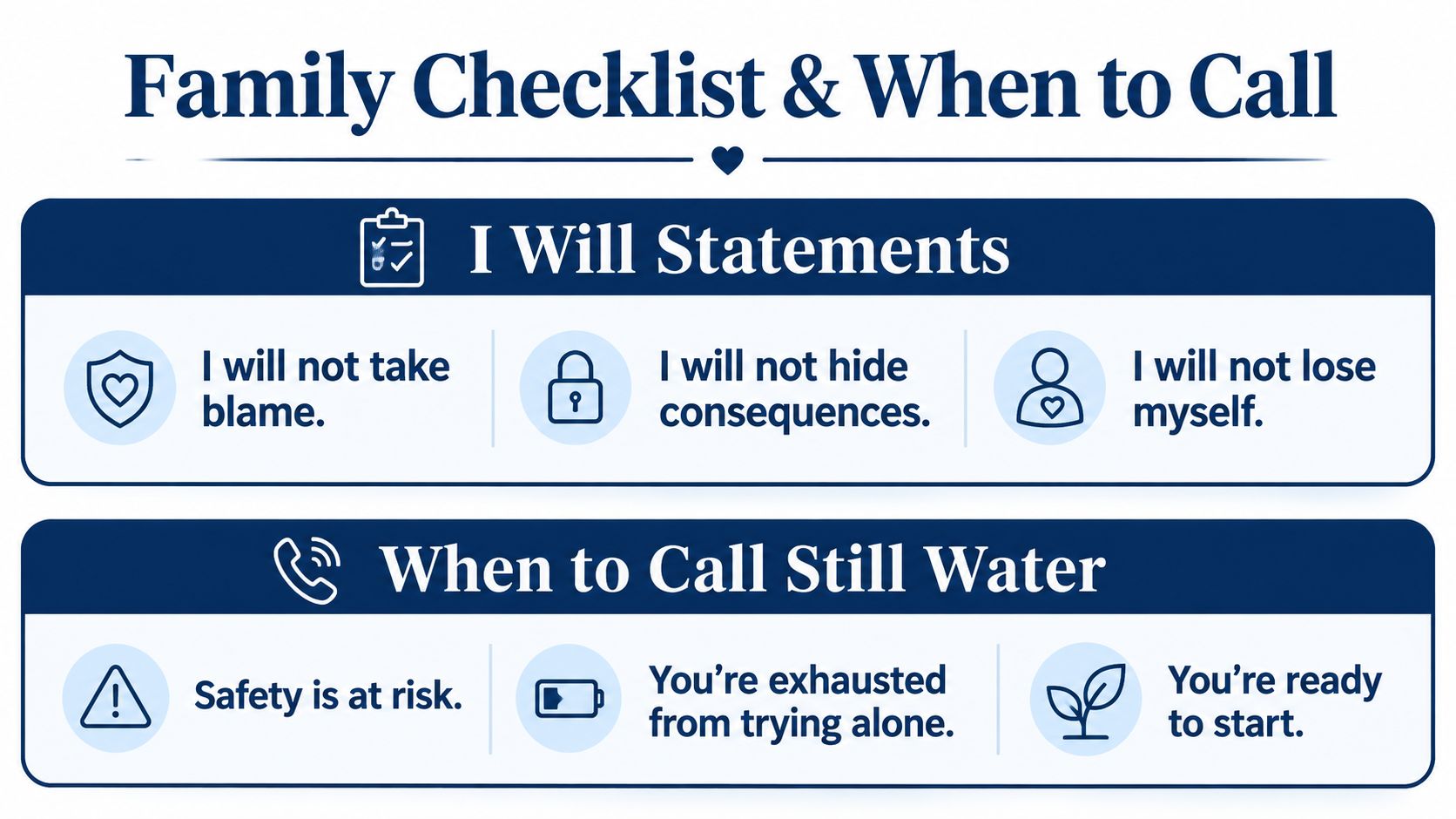
I Will
- I will not take blame for the addiction itself.
- I will not hide consequences that need to be seen.
- I will not lose myself while trying to hold everyone else together.
When to call
- Safety is at risk.
- You're exhausted from trying alone.
- You're ready to start.
If any of those fit, a confidential conversation can be the next steady step. Still Water Wellness Group offers 24/7 admissions, confidential consultations, most major insurance plans accepted, and a full continuum of care from medical detox through sober living in Lake Forest, Orange County. For families who want a gentle way to begin, the article on how to talk to a family member about checking into residential drug treatment can help frame the first conversation.
Still Water Wellness Group offers a full continuum of care for addiction and co-occurring mental health needs, and that makes it a practical next step when the three C's have helped a family see the problem more clearly. If the home is ready for confidential support, call (866) 450-0391 or visit Still Water Wellness Group to ask about admissions, insurance verification, and the right level of care.