At 11:30 p.m., the phone rings again. A son says he needs money for rent. A spouse says the car was towed and work will be lost without help. A sister swears this time is different, and all she needs is one more rescue. The family member on the other end already knows the sick feeling that follows. If the money is sent, it may keep the chaos going. If it isn't, something bad might happen.
That is the trap. Families facing addiction aren't choosing between caring and not caring. They're usually choosing between short-term relief and real help. Those aren't the same thing.
The line between helping vs enabling feels blurry when love, fear, guilt, and exhaustion all show up at once. It gets even harder when the person struggling knows exactly which words will elicit sympathy. Still, the truth stays the same. Support that protects addiction is harmful, even when it's done with love. Support that pushes a person toward accountability and treatment often feels harsher in the moment, but it's the only kind of help that gives recovery a chance.
The Agonizing Choice Between Helping and Hurting
A mother pays her adult daughter's phone bill because she doesn't want her unreachable. A husband calls his wife's employer and says she's sick when she is intoxicated. A brother gives cash for groceries because he can't stand the thought of his sibling going hungry. None of these people wake up trying to make addiction worse. They act because watching someone they love suffer feels unbearable.
That's why this subject hurts so much. Enabling rarely looks cruel. It looks compassionate, loyal, and protective. It often looks like what a good parent, partner, or friend is supposed to do.
But addiction uses that instinct. It turns kindness into cover. It teaches the family to solve emergencies while the person using avoids the consequences that might force change. Over time, the family becomes part of the system that keeps the addiction alive.
Sometimes the harder response is the only honest form of love.
The family member reading this likely isn't cold or selfish. More often, that person is overwhelmed, sleep-deprived, and terrified of making the wrong move. That fear leads many families to keep doing what's familiar. They keep lending, rescuing, explaining, and absorbing damage. Then they wonder why nothing changes.
The answer is brutal but clear. If an action makes it easier for someone to keep using, it isn't help. If an action moves someone toward treatment, accountability, and recovery, it is.
That distinction gives families something they desperately need. A standard. Not a mood, not a guess, not a guilt-driven reaction. A standard.
What Is the Real Difference Between Helping and Enabling
The clearest definition comes from the American Psychological Association description of enabling and helping. According to the American Psychological Association (APA), enabling is a process where an individual contributes to the continuation of maladaptive behaviors like substance abuse by mitigating the natural consequences of those actions. This is distinct from helping, which supports a person in taking ownership of their recovery.
What helping actually does
Helping supports recovery work. It doesn't erase the result of harmful choices. It gives a person tools, access, structure, and encouragement so that person can do the hard part.
Examples of helping include:
- Treatment support. Offering a ride to an assessment or helping verify insurance for rehab.
- Recovery-focused accountability. Agreeing to pay directly for treatment or therapy instead of handing over cash.
- Honest communication. Saying the addiction is harming the family and that change is required.
- Boundary-based support. Allowing someone to stay connected emotionally while refusing to fund or hide substance use.
Helping respects the person's ability to participate in recovery. It says, in effect, "Support is available, but the work belongs to the person struggling."
What enabling really looks like
Enabling removes pressure. It cushions the consequences of using. It often solves a crisis the addicted person created and should be facing.
Common examples include:
- Providing unearned money
- Paying debts caused by using
- Calling employers with excuses
- Hiring lawyers to clean up repeat damage
- Doing responsibilities the person could do but refuses to do
Those behaviors don't heal anything. They delay accountability.
Practical rule: If the action protects the addiction from consequences, it's enabling. If it supports treatment and responsibility, it's helping.
Families often get confused because both helping and enabling can feel caring. The difference isn't the emotion behind the act. The difference is the result. One supports recovery. The other supports avoidance.
A Practical Comparison of Helping vs Enabling Actions
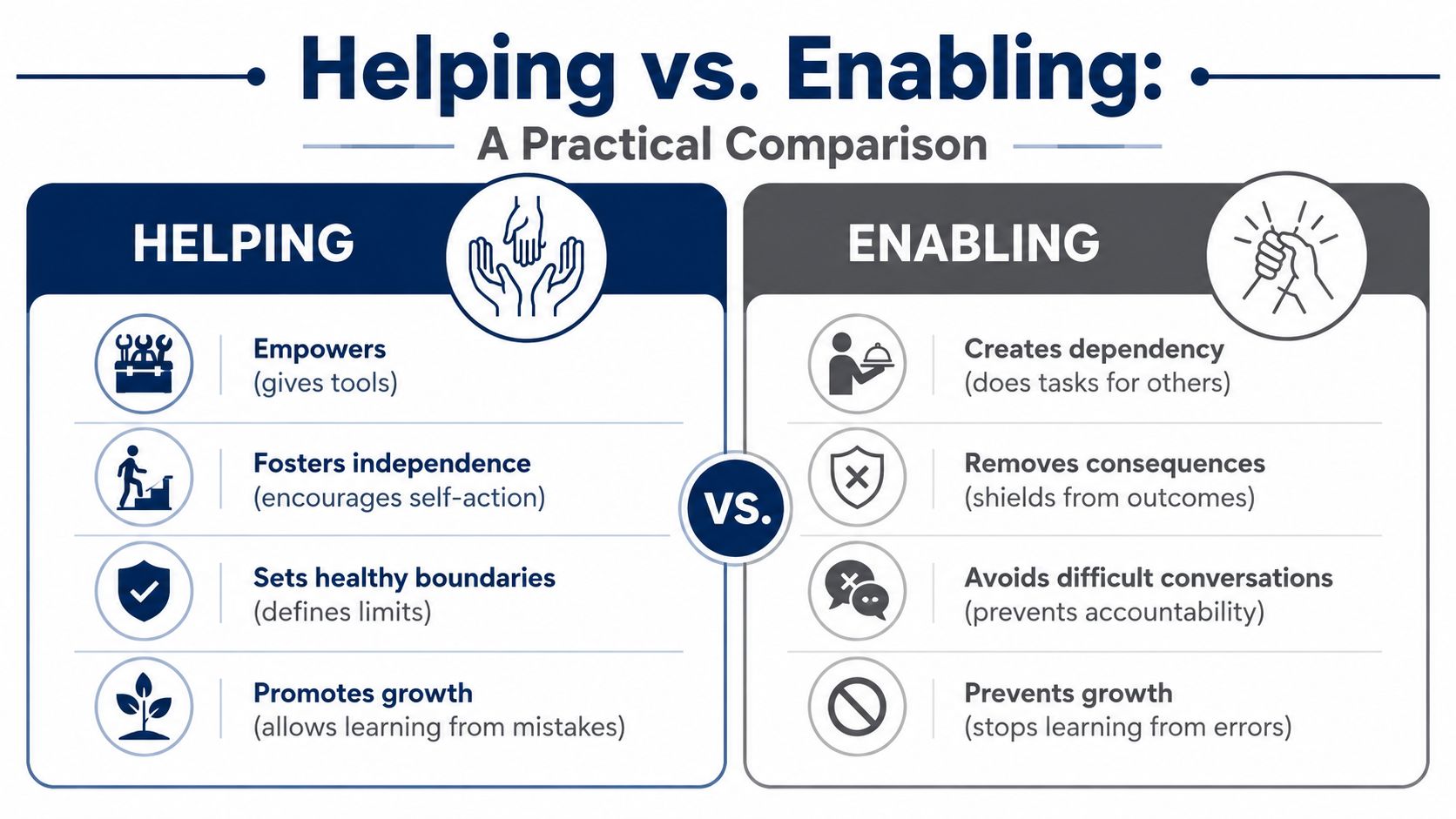
The fastest way to judge an action is to stop focusing on intent and start focusing on outcome. Many enabling behaviors come from love. That doesn't make them useful.
| Area | Helping | Enabling |
|---|---|---|
| Primary aim | Supports recovery and responsibility | Reduces tension, guilt, or immediate crisis |
| Effect on consequences | Allows natural consequences to remain in place | Shields the person from consequences |
| Money | Pays directly for treatment, transportation to care, or recovery needs with accountability | Gives cash for rent, food, gas, or "emergencies" with no structure |
| Communication | Tells the truth about the addiction | Lies, covers, minimizes, or makes excuses |
| Daily responsibilities | Encourages the person to handle their own tasks | Takes over bills, chores, childcare, work calls, or legal cleanup |
| Boundaries | Clear and enforced | Flexible, emotional, and easily reversed |
| Likely long-term result | Greater ownership and movement toward care | Greater dependence and continued use |
Why enabling keeps addiction comfortable
The behavioral piece matters. From a behavioral psychology perspective, enabling functions as negative reinforcement that increases substance use by removing consequences. In contrast, helping aligns with positive reinforcement, where support is contingent upon positive recovery behaviors, which empirically empowers the individual to take responsibility.
That means a family can accidentally train the addiction. If missed rent gets covered, if lies are cleaned up, if legal messes disappear, the person learns something dangerous. Using still hurts, but someone else will absorb part of the impact.
A simple test for real life
Families can use one hard question: Does this action make recovery more likely, or does it make continued use easier?
A few examples make the difference clearer:
- Driving someone to therapy after they've agreed to go is helping.
- Giving gas money after repeated promises and no treatment follow-through is usually enabling.
- Paying a treatment center directly can be helping.
- Paying treatment while also covering rent, food, and all daily expenses indefinitely often protects the person from having to change the rest of life around recovery.
That last situation matters because families often create a mixed message. They fund treatment, then keep cushioning everything else. The person hears, "Get help if you want, but nothing has to change." That's not support. That's a soft landing for addiction.
Common Signs You Might Be Enabling Addiction
Most families don't identify enabling in one dramatic moment. They notice it after months or years of patterns that keep repeating. The behavior often sounds reasonable when taken one item at a time. The full pattern tells the truth.
A blunt self-check
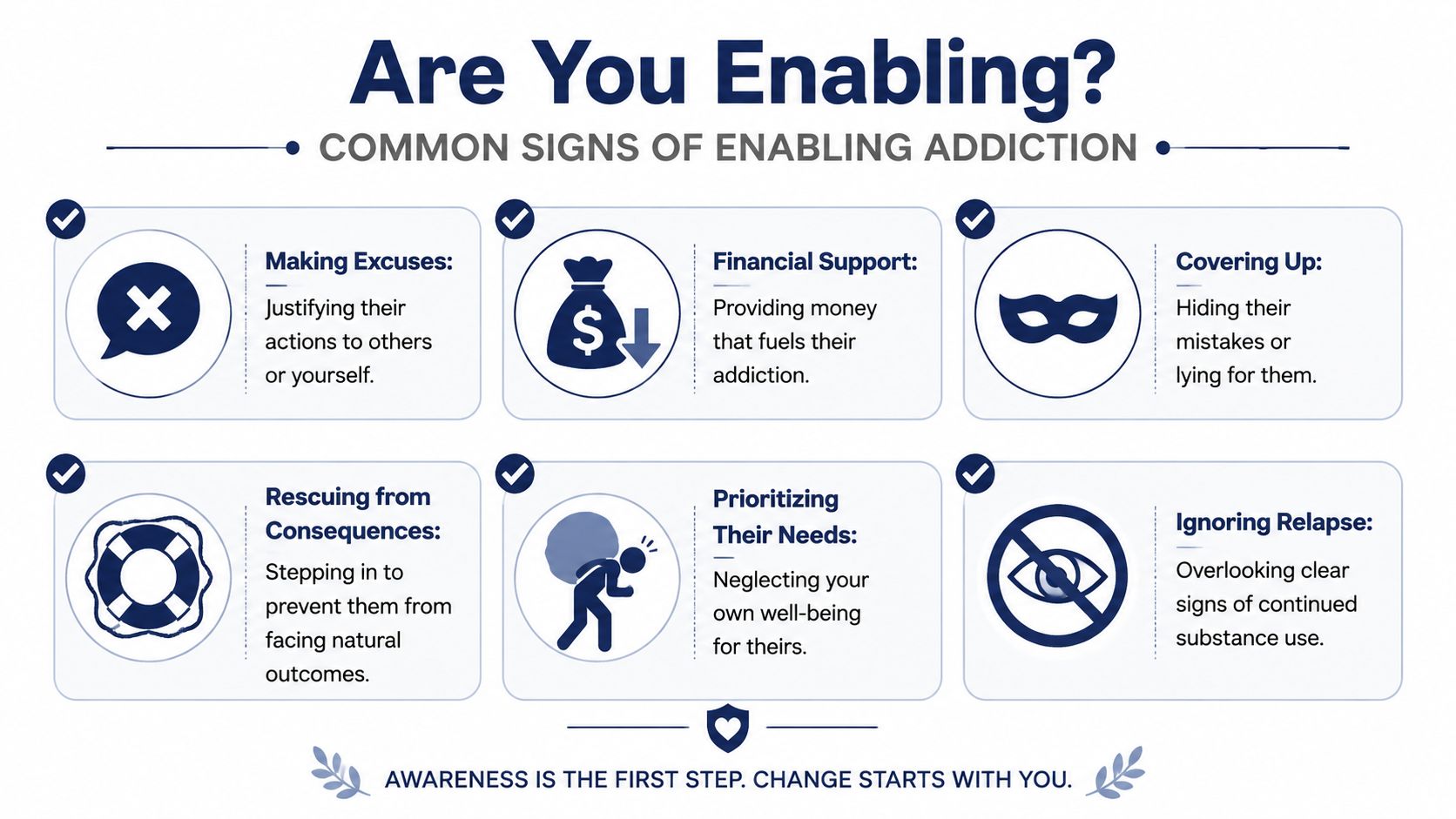
A family member may be enabling if any of these are happening regularly:
- Excuses are being made. Telling relatives, employers, or children that the person is "just stressed" or "going through something."
- Money keeps changing hands. Cash is given despite strong suspicion it isn't being used as promised.
- Responsibilities are being absorbed. Bills, chores, parenting duties, or appointments get handled to keep life from falling apart.
- The peace is being protected at any cost. The addiction isn't confronted because the fallout feels too exhausting.
- Relapse signs are being ignored. Missing medication, disappearing, slurred speech, secrecy, or obvious intoxication gets brushed aside.
- The family system revolves around the addicted person. Everyone else adjusts while the person using faces fewer demands.
One useful next step is learning to identify the behavior directly. This guide on how to identify drug abuse in a family member can help families connect denial, secrecy, and repeated crises to what they're seeing at home.
The emotional signs matter too
Enabling isn't only about money or excuses. It's also visible in the emotional climate of the family.
Common internal signals include:
- Walking on eggshells because honesty might trigger rage, tears, or manipulation
- Feeling responsible for whether the person uses, relapses, works, or calms down
- Believing constant rescue proves love
- Neglecting personal health, sleep, finances, or safety while focusing on the addicted person
If the family keeps getting weaker while the addiction keeps getting stronger, the current approach isn't helping.
Guilt tends to distort judgment. A parent may think, "If something terrible happens tonight, how could help be refused?" But that question often hides the bigger one. How many terrible things have already been prolonged because consequences kept getting interrupted?
Recognizing enabling isn't about blame. It's about accuracy. Families can't change a pattern they refuse to name.
How to Set Boundaries and Start Helping Effectively
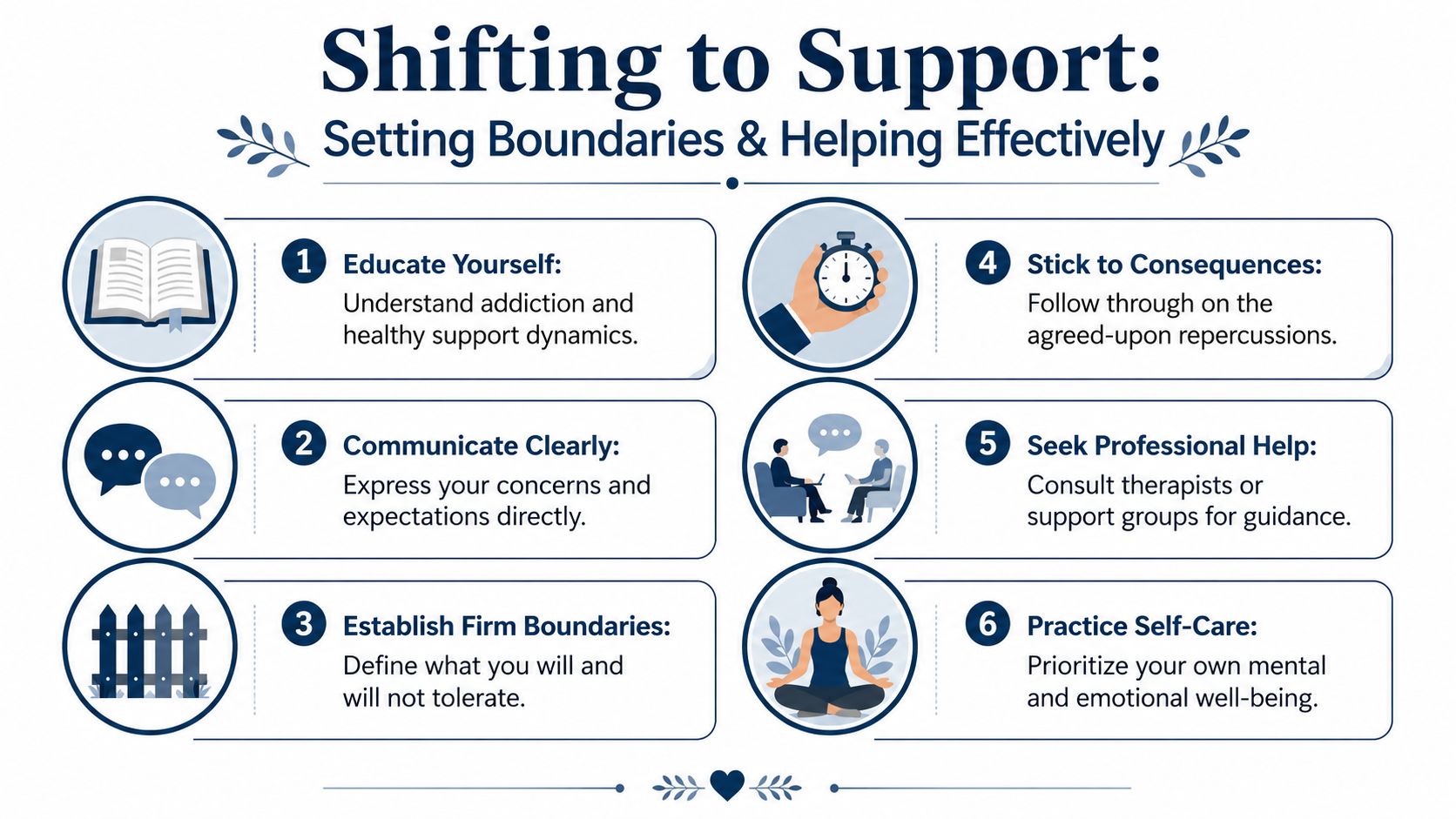
Boundaries aren't punishments. They're rules that stop a family from participating in the addiction. Without them, every conversation turns into chaos, bargaining, and fear-based decisions.
What a real boundary sounds like
A boundary must be clear, specific, and enforceable. It can't be vague. It can't depend on the addicted person agreeing that it's fair.
Useful scripts include:
- Money boundary. "Cash won't be given anymore. Treatment options can be researched and paid directly."
- Housing boundary. "Living in the home requires sobriety, honesty, and participation in treatment recommendations."
- Communication boundary. "Conversations will end when yelling, threats, or manipulation begin."
- Crisis boundary. "Legal, work, and financial consequences won't be cleaned up anymore."
Shorter is better. Overexplaining usually opens the door to argument.
"Love is still present. Rescue is what ends."
The cultural pressure families don't talk about enough
Some families don't just struggle with guilt. They struggle with identity. In high-expectation homes and cultures built around loyalty, duty, and protecting the family name, boundary-setting can feel like betrayal. That pressure is real. According to reporting on family-first cultural pressures and enabling, 68% of Asian-American families in addiction treatment delayed intervention due to fear of shaming the family, which directly correlates with higher enabling rates.
That doesn't mean those values are wrong. It means they need translation inside recovery. Duty doesn't require financing self-destruction. Protecting the family doesn't mean hiding addiction until it gets worse.
For families under cultural pressure: A healthy script is, "This boundary isn't abandonment. It's the family's decision to stop protecting the addiction."
Boundary skills also need to be taught long before a crisis. Parents who want healthier family patterns overall may find value in resources on teaching kids healthy boundaries, especially when younger siblings or children are watching how adults handle chaos, guilt, and conflict.
The financial trap called hybrid funding
One of the most confusing situations is paying for treatment while still covering all daily living costs outside of treatment. Families often think that's balanced support. In many cases, it isn't.
If treatment is funded but rent, food, phone bills, transportation, and repeated rescue money continue with no accountability, the addicted person may never have to connect recovery with adult responsibility. The money says "get better." The rest of the arrangement says "nothing else has to change."
A better approach is simple:
- Pay providers directly, not the addicted person.
- Tie support to recovery actions, such as admission, attendance, discharge planning, or sober housing rules.
- Stop open-ended survival subsidies that allow addiction to continue between treatment efforts.
- Tell the truth once, then enforce it.
Families don't need harsher words. They need firmer actions.
Steps to Guide Your Loved One Toward Treatment
Once enabling stops, the family needs somewhere to direct that energy. The answer isn't endless arguing. It's movement toward care.
Start with structure, not emotion
A family should decide in advance what kind of help will be offered. That means researching treatment options, understanding whether detox may be needed, and looking for care that can address both substance use and mental health when both are present.
When the conversation happens, it should be concrete:
- Choose the moment carefully. Talk when the person is as sober and calm as possible.
- State the problem plainly. Name the drinking or drug use and the damage it's causing.
- Present options immediately. Have admissions numbers, insurance details, and transportation ideas ready.
- Stay out of debate. The family doesn't need to prove the addiction in court.
- Follow through. If treatment is refused, the previously stated boundaries remain.
For families needing language that works in real conversations, this article on how to convince someone to go to rehab can help frame the discussion without pleading, threatening, or collapsing into old patterns.
Why professional support matters
Families often try to carry recovery on willpower alone. That usually burns everyone out. Clinical data shows that recovery support services designed to avoid enabling are highly effective at engaging people in care. A randomized study found that individuals working with a peer counselor had fewer crisis events, hospitalizations, and substance use episodes compared to those receiving case management alone.
That matters because addiction isn't a motivation problem alone. It's a treatment problem. A loved one may need detox, therapy, psychiatric care, relapse-prevention planning, and a step-down path after residential care. Families can't provide that at the kitchen table.
When a direct conversation isn't enough
Some situations need more than one family talk.
Professional guidance may be especially useful when:
- The person denies obvious substance use
- There are co-occurring mental health symptoms
- The home environment has become unsafe
- Every conversation turns manipulative or explosive
- The family can't agree on boundaries
The family doesn't need to wait for a catastrophe. Early action is better than one more emergency.
Find Support at Still Water Wellness Group Today
Families in Orange County often reach a point where love alone isn't enough and guesswork has failed. That's the moment to choose a treatment team that understands both sides of the crisis. The addiction itself, and the family patterns that have grown around it.
Still Water Wellness Group serves adults and families looking for a real path forward in Lake Forest and across Orange County. Care includes medical detox, residential treatment, partial hospitalization, intensive outpatient treatment, sober living support, and dual-diagnosis care for people facing both addiction and mental health conditions. That full continuum matters because recovery rarely succeeds when treatment is fragmented.
Families also need a place where their role is directly addressed. A strong program doesn't just stabilize the person using. It helps loved ones stop rescuing, start setting boundaries, and support recovery without feeding the problem. That shift is often the turning point.
Those exploring care can review addiction treatment options at Still Water Wellness Group to understand the levels of support available. The goal isn't to shame a family for what it's done under pressure. The goal is to replace panic-driven help with treatment-based help.
Waiting for one more crisis usually means getting more of the same. Decisive action gives the family a different outcome to work toward. A calmer home. Clearer boundaries. A real chance at recovery.
Still Water Wellness Group offers compassionate, confidential support for families who are done confusing rescue with recovery. Admissions are available 24/7, and the team can help with treatment questions, next steps, and insurance verification. Call Still Water Wellness Group now at (866) 450-0391 to speak with an admissions specialist and help a loved one move from chaos toward treatment.