Some families start searching for help after one frightening night. Others get there slowly, after months of broken promises, arguments, missed work, or the quiet dread of waiting for the next call. A spouse notices the hiding. A parent sees the mood swings. An adult child realizes every conversation now revolves around alcohol, pills, or drugs.
That moment can feel disorienting. The person they love may still insist everything is under control. At the same time, daily life has become harder to manage, trust feels shaky, and home no longer feels calm or predictable.
In that space, one question comes up fast: what is inpatient rehab, and is it the right next step?
In plain terms, inpatient rehab is a treatment setting where a person lives on-site for a period of time and receives structured care throughout the day. It removes the person from the environment that may be feeding the addiction and replaces it with support, routine, accountability, and treatment. For many families, that structure is what finally creates enough stability for healing to begin.
The Moment You Realize Something Has to Change
A common pattern looks like this. Someone says they'll cut back next week. Then next week becomes next month. They miss another family event, show up impaired, disappear for hours, or swing between apology and defensiveness. Loved ones start adjusting their own lives around the addiction.
That's often the point when a family stops asking whether the problem is “serious enough” and starts asking what kind of help works.
Inpatient rehab can sound intimidating at first. Many people picture a cold hospital floor or imagine a punishment-based setting. In reality, it's better understood as a protected place to step out of chaos. The person isn't left to “figure it out” alone. Staff guide the day, monitor safety, and help rebuild basic stability.
Why this moment matters
When substance use has taken over daily life, waiting for the “perfect time” usually keeps the cycle going. A higher level of care may be worth considering when:
- Home has become unsafe or unstable
- Attempts to stop haven't lasted
- Mental health symptoms are making recovery harder
- The person needs distance from triggers, routines, or access to substances
Sometimes the most loving decision a family can make is choosing more structure, not more waiting.
For worried families in Orange County, the first helpful step usually isn't making every decision at once. It's understanding what inpatient rehab is, what daily life looks like, and how the process moves from admission to aftercare.
What Is Inpatient Rehab A Structured Path to Healing
What is inpatient rehab? It's a live-in treatment program that gives a person a full day of support, therapy, supervision, and recovery-focused structure. In substance use treatment, people often use the terms inpatient rehab and residential treatment interchangeably when talking about staying at a facility and receiving around-the-clock care.
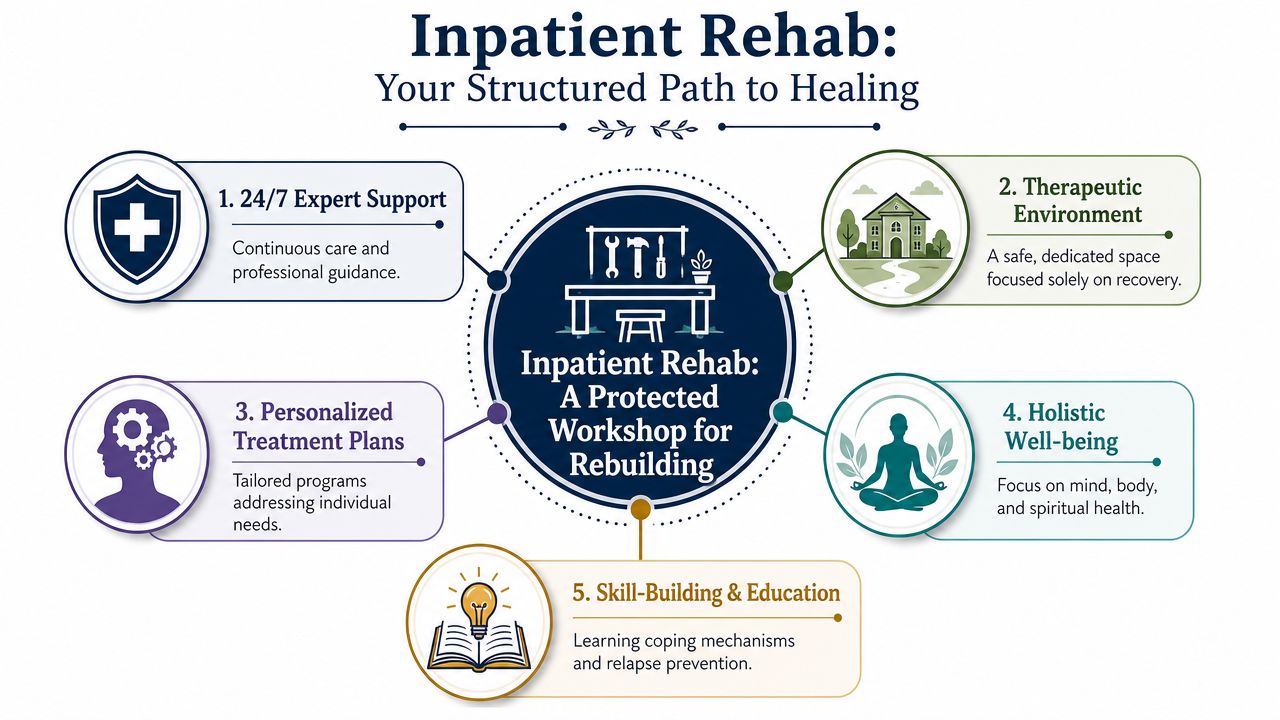
A simple way to think about it is this: inpatient rehab is like a protected workshop for rebuilding. If someone tries to repair a damaged foundation while the ground keeps shifting, the work won't hold. In the same way, recovery is harder when the person goes home each night to the same stress, access, relationships, or routines that keep the addiction active.
What makes it different
Inpatient rehab is more than a place to sleep. It usually includes:
- A structured daily schedule with therapy, recovery education, and wellness activities
- Continuous support from clinical and support staff
- Distance from triggers such as access to substances, conflict, or enabling dynamics
- A personalized treatment plan that addresses substance use, mental health, behavior patterns, and discharge planning
National treatment data also helps explain why inpatient care is treated as a higher level of need. In SAMHSA's 2020 National Survey of Substance Abuse Treatment Services, 24% of facilities offered residential treatment, 5% offered hospital inpatient care, and 82% offered some form of outpatient care, according to national substance use treatment statistics. That tells families something important. Inpatient rehab isn't the default setting for everyone. It's a more specialized level of care for people who need more support and supervision than outpatient treatment can provide.
Not just symptom control
Families sometimes assume inpatient treatment is only about getting through withdrawal. Detox can be part of the process, but rehab goes further. It focuses on what happens after immediate crisis passes: learning coping skills, understanding triggers, repairing thinking patterns, and building a realistic plan for life after treatment.
Many programs also include whole-person care. For readers exploring effective holistic approaches for addiction, it can help to know that residential treatment often combines clinical therapy with practices that support stress regulation, emotional awareness, and physical recovery.
Inpatient vs Outpatient Services Choosing Your Level of Care
The biggest difference is simple. Inpatient rehab changes the person's environment. Outpatient care asks the person to recover while staying in it.
Neither level of care is automatically “better.” The right choice depends on safety, severity, relapse risk, mental health needs, and what the home environment is like day to day.
Inpatient vs. Outpatient Rehab at a Glance
| Feature | Inpatient (Residential) Rehab | Outpatient Rehab (PHP/IOP) |
|---|---|---|
| Living situation | Person stays at the treatment facility | Person lives at home or in supportive housing |
| Daily structure | Highly structured from morning through evening | Structured treatment hours, with more unsupervised time |
| Support level | Continuous staff support and monitoring | Regular clinical support during scheduled sessions |
| Exposure to triggers | Reduced, because the person is removed from the usual environment | Higher, because the person returns to everyday stressors after treatment hours |
| Best fit | People needing a higher level of stability, supervision, or separation from daily triggers | People who are stable enough to practice recovery skills while living outside the facility |
| Independence | Less day-to-day independence at first, more external structure | More independence, which can help if the person is ready for it |
| Family role | Often coordinated through family sessions, updates, and discharge planning | Often easier to include alongside work, school, or family responsibilities |
When inpatient care usually makes more sense
Residential treatment may be the stronger fit when a person keeps returning to use despite sincere efforts to stop. It can also help when cravings, impulsive behavior, untreated mental health symptoms, or a chaotic home environment make progress difficult.
A person might also need inpatient care if family members have become the main safety net and everyone is exhausted. In those situations, more structure often protects both the individual and the household.
Practical rule: If a person can't stay safe, can't stay sober at home, or can't fully engage in treatment without constant interruption, a live-in level of care may be the safer starting point.
When outpatient may fit better
Outpatient treatment can work well when the person has stable housing, dependable support, and enough internal stability to attend treatment consistently without needing overnight care. It can also serve as a step-down level after inpatient rehab.
Some families compare these options side by side before making a decision. A closer breakdown is available in this guide to inpatient vs outpatient rehab.
Who Benefits Most from Residential Treatment
Not everyone needs residential care. But some people clearly benefit from the extra structure.
A good candidate often isn't just someone with “bad habits.” It's someone whose substance use has started to overtake judgment, relationships, health, or basic daily functioning. In those cases, trying to recover in the same environment can keep the cycle going.

People who often need more structure
Residential treatment may be especially helpful for:
- Adults with severe or long-standing substance use who struggle to stop without intensive support
- People who have relapsed after outpatient treatment and need a more contained setting
- Those living in triggering homes where substances are available or conflict is constant
- People leaving detox who are medically stable but not ready to manage recovery on their own
- Adults with dual diagnosis needs who are dealing with both addiction and mental health symptoms
Why dual diagnosis changes the picture
A dual diagnosis means a person has a substance use disorder and a mental health condition at the same time. That may include depression, anxiety, PTSD, bipolar disorder, or another psychiatric concern.
The two problems often feed each other. A person may drink to quiet panic, use pills to sleep, or use stimulants to push through depression. Then the substance use makes mood, sleep, thinking, and emotional regulation worse.
In a residential setting, treatment can address both issues in one coordinated plan instead of treating them as separate problems.
When addiction and mental health are tangled together, progress usually depends on treating both at the same time.
Families also tend to overlook one factor that matters a lot: the ability to pause. Residential treatment gives the person room to step out of daily demands long enough to stabilize, reflect, and practice new skills before returning to ordinary life.
A Glimpse into Daily Life at an Inpatient Facility
One of the biggest fears families have is not knowing what happens after admission. The unknown can feel worse than the truth.
Daily life in inpatient rehab is structured, but it isn't meant to feel harsh or mechanical. The schedule exists because recovery usually goes better when the day has rhythm, purpose, and support.
The first phase
For some people, treatment begins with detox or close monitoring during early withdrawal. That part focuses on comfort, safety, and stabilization. Once the person is ready, the routine shifts toward therapy, education, wellness, and planning for the next stage of care.
In medical rehabilitation settings, inpatient care is defined by high therapy intensity. Patients are generally expected to participate in at least 3 hours of therapy per day in a setting with 24-hour medical monitoring, according to Wake Forest Baptist inpatient rehabilitation guidance. While addiction treatment schedules vary by program, the broader point is useful for families: inpatient care is designed to be active, structured, and clinically focused, not passive.
What a typical day may include
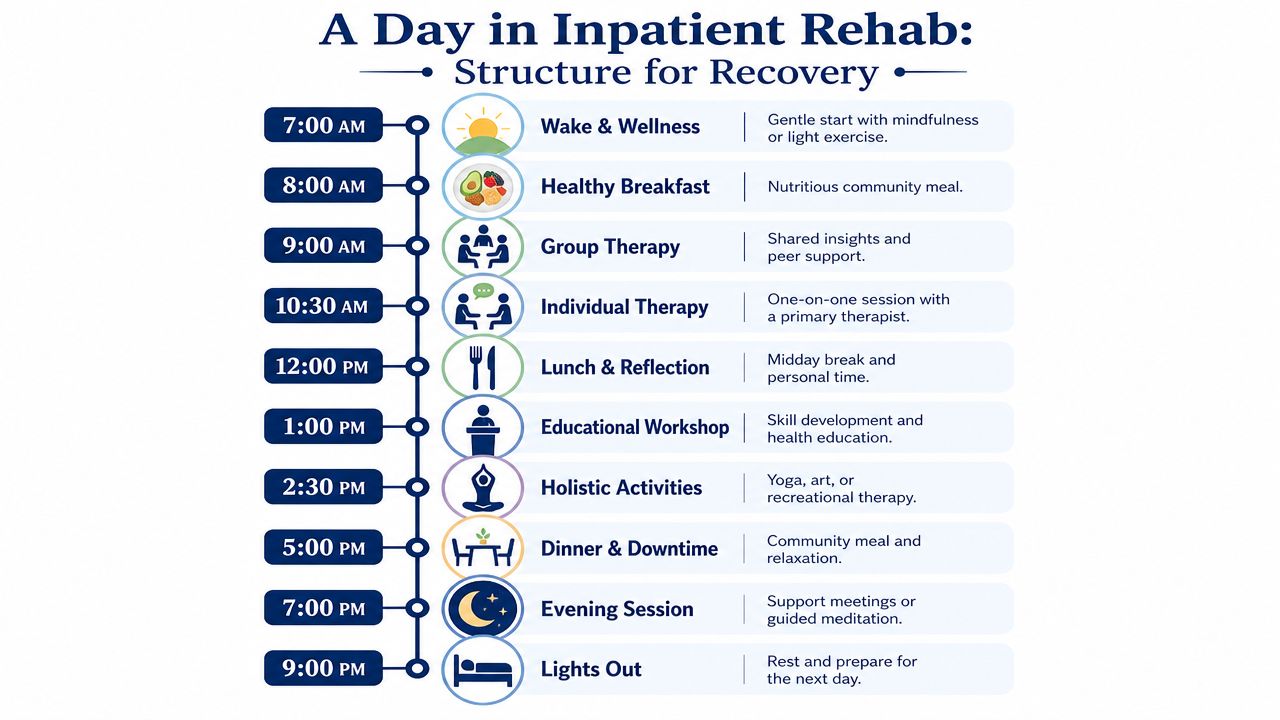
A residential schedule often includes a mix of clinical and restorative activities such as:
- Morning check-ins to set intention, assess mood, and prepare for the day
- Group therapy where clients work on triggers, communication, honesty, boundaries, and relapse prevention
- Individual counseling focused on personal history, patterns, trauma, motivation, and goals
- Educational sessions on addiction, the brain, coping skills, emotional regulation, and recovery planning
- Wellness activities like mindfulness, movement, art, journaling, or nature-based reflection
- Evening support that helps clients slow down, process the day, and settle into a routine
What families often notice
The first few days can feel awkward for the client. That's normal. Sleep may be off. Emotions may swing. Resistance may show up. Then the structure starts doing its work.
Meals become regular. The nervous system settles. The person starts talking more openly. They begin to see patterns that weren't obvious in the middle of active use.
For families wondering about the day-to-day experience in more detail, this overview of what drug rehab is like can make the process feel more concrete.
Navigating Your Treatment Journey From Admission to Aftercare
The treatment journey usually starts with a phone call. For many families, that call happens after hours, in the middle of a crisis, or after one final incident that makes it clear the current situation can't continue.
The first conversation is typically practical and calm. An admissions team asks about substance use, mental health concerns, safety issues, prior treatment, medications, and insurance. The goal isn't to judge. It's to figure out what level of care fits the person's current needs.
Step one through admission
The early process often looks like this:
Confidential phone screening
Staff gather basic information about the person's condition, current use, and immediate needs.Insurance verification and logistics
Coverage, benefits, and possible next steps are reviewed. Families also ask about arrival, what to bring, and what the first day may look like.Clinical review
The team determines whether detox, residential treatment, or another level of care is the safest match.Arrival and intake
Once admitted, the client completes assessments, settles in, and begins the treatment plan.
How long does inpatient rehab last
This is one of the most common questions, and it's also where families often get misleading answers. There isn't one fixed timeline that fits every person.
According to guidance on inpatient rehab length of stay and continuum planning, the idea of a fixed “30 to 90 day” stay is a common misconception. Effective treatment planning ties length of stay to functional goals and then transitions the person to step-down support such as outpatient care or sober living.
That makes practical sense. One person may stabilize quickly but still need strong relapse-prevention planning. Another may need more time because trauma, anxiety, depression, or family instability is still getting in the way.
The right question usually isn't “How many days?” It's “What needs to be in place before this person can leave with a real chance of staying well?”
What happens after inpatient care
The healthiest view of residential treatment is that it's the beginning of a recovery continuum, not the final step.
After inpatient care, a person may move into:
- Partial Hospitalization Program care when they still need significant treatment during the day
- Intensive Outpatient care when they're ready for more independence with regular therapy support
- Sober living when they need a recovery-focused living environment during transition
- Ongoing therapy and psychiatric care for relapse prevention and mental health stability
Language can also affect access to care. For clients and families who are more comfortable speaking in another language, resources on therapy for addiction in multiple languages can help them think through what culturally and linguistically responsive support may look like during aftercare.
The point of aftercare planning
Discharge planning starts before discharge day. Staff usually help the client think through transportation, housing, follow-up appointments, support meetings, daily routine, medication continuity, and family boundaries.
Without that bridge, people often leave treatment motivated but unprepared. With it, they leave with a map.
Start Your Recovery in Orange County at Still Water Wellness
Orange County can offer something many people need at the start of recovery: a setting that feels calmer than the life they've been living. For someone entering treatment, a more peaceful environment can make it easier to slow down, sleep, reflect, and stay engaged in care.
For families searching locally, residential rehab in Orange County is one option to explore when a loved one needs live-in treatment, support through the day, and a path into ongoing care after discharge. Still Water Wellness Group provides treatment in Lake Forest with access to detox, residential treatment, step-down programming, dual-diagnosis support, and aftercare planning within Orange County.
Why the setting and continuity matter
A residential program works best when it doesn't treat rehab as an isolated event. The person needs safety, therapy, practical life planning, and a clear next step once they leave.
That focus on transition matters because inpatient rehab is built to help people return to community life. In major healthcare systems, the average risk-adjusted successful discharge-to-community rate from inpatient rehabilitation facilities was 65.5%, according to rehabilitation facility statistics on discharge outcomes. For families, that reinforces a hopeful point. The purpose of this level of care is movement toward stability and everyday functioning, not permanent separation from normal life.
A confidential admissions call can help clarify whether residential treatment is appropriate now, what insurance may cover, and what the next safe step should be. Families who are ready to talk can call (866) 450-0391.
Frequently Asked Questions About Inpatient Rehab
What should a person bring to inpatient rehab
Most programs recommend simple, practical items. Comfortable clothing, toiletries, identification, insurance information, prescribed medications in their original packaging if requested, and a few personal essentials are usually enough. It's usually better to leave valuables at home.
Are phones allowed
That depends on the program. Some facilities allow limited phone use at certain times. Others restrict devices early in treatment so clients can focus and settle in. Families should ask about phone policies before admission so expectations are clear.
Can family visit or take part in treatment
Many programs involve families in some way. That may include scheduled calls, family sessions, educational support, or discharge planning. Timing varies because the client may need a short adjustment period before outside contact increases.
Is rehab private
Yes. Treatment programs are expected to protect patient privacy. Staff generally can't share information without the client's consent except in specific situations allowed by law. Families often feel less anxious once they know privacy rules are in place.
What if the person is unsure about going
Ambivalence is common. A person doesn't have to feel fully confident before treatment begins. Many admissions happen when someone is willing to take the next safe step, not because every fear has disappeared.
What if the family still has questions
That's normal too. Most families need help understanding levels of care, insurance, arrival timing, and what to expect in the first few days.
Have more questions? Our team is here to help. Call us 24/7 at (866) 450-0391.
Still Water Wellness Group helps adults and families in Orange County explore detox, residential treatment, step-down care, and aftercare planning in a confidential setting. To talk through options, verify insurance, or ask what level of care may fit, call (866) 450-0391 or visit Still Water Wellness Group.