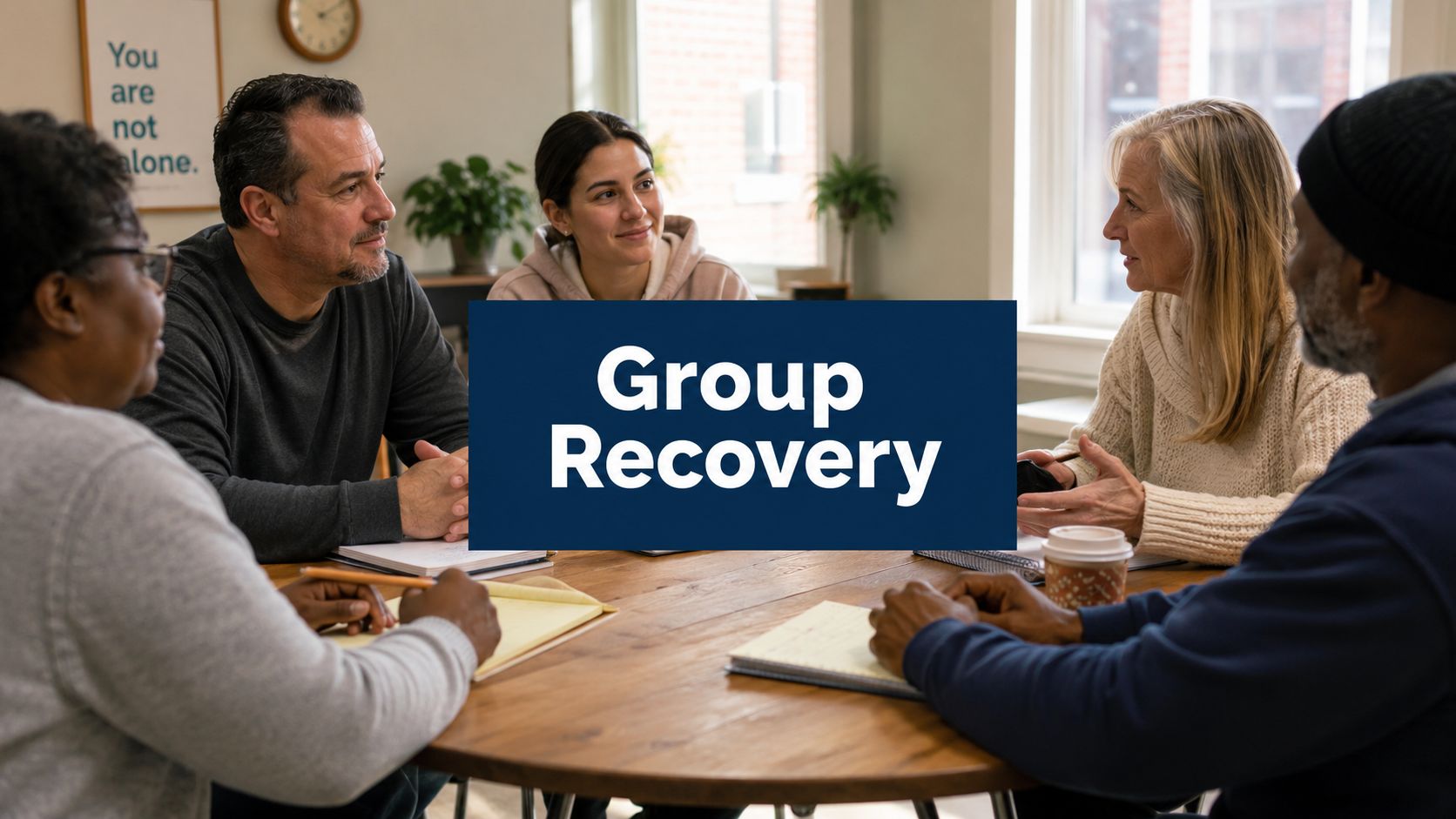
Building a Foundation for Sustainable Recovery
A lot of people reading this are in the same hard place. They've left detox or residential care, or they're trying to hold onto progress in PHP, IOP, sober living, or outpatient treatment, and they can already feel how quickly stress, isolation, and old routines can creep back in. Sobriety can feel fragile when cravings show up, relationships get tense, or a familiar trigger hits without warning.
That's why relapse prevention can't rest on motivation alone. People need practice. They need structure, repetition, and a place to test new responses before they're standing in a real-world high-risk moment. Group work provides that environment. It turns vague advice like “reach out for support” or “use coping skills” into something people can rehearse.
That need is urgent. Relapse rates for addiction closely mirror those of other chronic diseases, with 40% to 60% of individuals with substance use disorders experiencing relapse, according to the National Institute on Drug Abuse as summarized by Hazelden Betty Ford. Structured group activities matter because they build peer support, accountability, and concrete coping strategies that clients can carry into daily life.
The activities below are more than a simple list. Each one includes a facilitator's lens, practical adaptations for dual-diagnosis clients, and ways to use the approach across different levels of care. For clients, families, and treatment professionals, these are some of the most useful relapse prevention group activities for building lasting sobriety.
1. Cognitive Behavioral Therapy (CBT) Relapse Prevention Groups

CBT groups work because they don't stay abstract for long. Participants learn to identify the chain between a trigger, an automatic thought, an emotional reaction, and the behavior that follows. In substance use treatment, that often means catching thoughts like “I already ruined the day” or “one drink will calm me down” before they turn into action.
These groups are strongest when they stay structured. A facilitator starts with trigger awareness, uses worksheets or thought records, and moves toward scenario-based discussion and role-play. That progression matters. Throwing clients into complex relapse scenarios too early usually leads to shutdown, defensiveness, or superficial answers.
What facilitators should focus on
A strong CBT relapse prevention group usually asks members to do three things repeatedly: name the trigger, challenge the thought, and replace it with a response they can use. That's different from merely “venting” in a circle. Support matters, but support without skill-building often feels good in the room and falls apart outside it.
For clients in PHP, more repetition and in-session coaching usually helps. For clients in IOP, the work often needs to connect directly to work stress, family conflict, court requirements, or re-entry into social environments where substances are present.
- Start simple: Begin with common triggers such as conflict, loneliness, boredom, shame, and cravings before moving into layered interpersonal situations.
- Use written tools: Worksheets, thought logs, and homework reinforce what clients practiced in session.
- Invite peer feedback: Group members often spot distorted thinking faster in others, which helps normalize the process.
Practical rule: Don't ask clients to “think better.” Ask them to identify one thought that raised risk and write one replacement thought they'd actually say under pressure.
For dual-diagnosis groups, CBT needs pacing. A client with PTSD, severe anxiety, or depression may need more grounding before digging into trigger material. A trauma-informed structure often pairs well with psychoeducation and the kind of cognitive work described in demystifying cognitive behavioral therapy.
2. Mindfulness and Meditation-Based Relapse Prevention

Mindfulness-based relapse prevention helps clients notice an urge without immediately obeying it. That sounds simple, but it's a major shift for people who are used to reacting fast to discomfort. The work is less about “emptying the mind” and more about building tolerance for internal states that used to trigger substance use.
Facilitators often get better results when they keep the opening practice short and predictable. A 5 to 10 minute guided meditation using body scan or mindful breathing is recommended before moving into more complex skills work. That opening lowers physiological arousal and makes the room more workable.
What works and what backfires
Mindfulness groups tend to go well when the facilitator stays concrete. Clients can practice urge surfing, body scanning, paced breathing, or simple sensory grounding. They tend to go poorly when the room gets overly philosophical or when clients are pushed into long silent meditations before they've built trust in the process.
For PHP, mindfulness may be woven into a daily rhythm. In IOP, it often works best as a repeatable tool clients can use in a car before work, on a lunch break, or after an argument at home.
A practical group sequence often looks like this:
- Open with guided breathing: Keep it brief and structured so clients know what to expect.
- Name body cues: Ask members where cravings show up physically, such as chest tightness, restlessness, or stomach discomfort.
- Practice urge surfing: Let clients describe the urge as a wave that rises, peaks, and shifts.
Some dual-diagnosis clients need adaptations. Trauma-sensitive mindfulness may mean allowing eyes open, offering seated options, avoiding unexpected silence, and giving permission to step out if internal focus becomes overwhelming.
Some clients don't need a deeper meditation. They need a safer one.
When mindfulness is done well, it gives people a pause between feeling and acting. That pause is often where sobriety is protected.
3. Motivational Interviewing Group Sessions
Motivational interviewing groups are especially useful when a client says two opposite things in the same breath. “I want to stay sober” and “I still don't know if I'm ready to give everything up” can both be true. MI makes room for that ambivalence without turning the group into a debate.
This style works because it doesn't rely on confrontation. The facilitator listens for change talk, reflects discrepancies between stated values and current behavior, and helps members hear themselves more clearly. In a strong MI group, clients don't get lectured into recovery. They develop their own reasons to protect it.
How a facilitator keeps the room honest
MI groups fall apart when the leader becomes too directive. If the room starts sounding like advice piled on top of resistance, clients either argue or perform compliance. Neither response creates durable change.
In PHP, MI can help clients transition from externally driven treatment to personal ownership. In IOP, it often helps people reconnect sober goals to parenting, employment, legal obligations, health, and relationships.
Useful interventions include:
- Reflective listening: Repeat and refine what a client says so they can hear the ambivalence more clearly.
- Values exploration: Ask how current behavior lines up with the life the client says they want.
- Commitment language: Reinforce even small statements of readiness, especially when they're specific.
A facilitator might ask, “What matters more to you right now, getting through tonight sober or proving you can handle it alone?” That question doesn't shame the client. It clarifies the choice.
For clinicians wanting a clear overview of the approach, Still Water Wellness Group's explanation of motivational interviewing therapy gives a useful frame for how collaboration and autonomy work in practice.
The best MI groups don't push harder. They listen better, then sharpen what the client is already starting to say.
4. Experiential and Adventure-Based Relapse Prevention Activities

Some clients understand relapse prevention perfectly in a therapy room and still can't apply it when stress hits. Experiential groups address that gap by getting people into movement, creativity, or real-world challenge. Nature hikes, art therapy, recovery-oriented movement sessions, and service-based outings all create chances to practice regulation and connection outside a chair-and-circle format.
Because not everyone learns best through talk, varied approaches are essential. Some clients open up while walking. Others can identify grief, anger, or shame through art long before they can name it aloud. Experiential work often lowers resistance in clients who feel overexposed or exhausted by verbal processing.
Facilitator guidance for real-world application
An activity by itself isn't the intervention. The clinical value comes from the debrief. A hike becomes relapse prevention when the facilitator asks what happened when someone got frustrated, withdrawn, competitive, or overwhelmed, and how that pattern shows up in recovery.
For PHP groups, experiential work often supports emotional regulation and community-building. In IOP, it can help clients practice sober recreation and reconnect with parts of life that don't revolve around substances.
- Match the activity to the group: Don't force high-energy challenges on clients who need lower stimulation or more predictability.
- Debrief immediately: Ask what members noticed in their body, mood, choices, and interactions.
- Tie it back to relapse risk: Help clients connect frustration tolerance, isolation, avoidance, or impulsivity to substance use patterns.
Creative expression can be especially effective for people carrying trauma, but pacing matters. Activities such as art or journaling should offer choice and containment. A poorly framed exercise can leave a client emotionally opened up without enough support to settle back down.
In Southern California settings, programs often integrate outdoor work because the environment supports it. Nature-based activities near Saddleback Mountain or the coast can offer a calmer setting for reflection, but the same principle applies anywhere. The activity should build coping, not just fill time.
5. Peer-Led Support and Accountability Groups
Peer-led groups bring something professional treatment alone can't fully replicate. They give clients direct contact with people who've lived through cravings, setbacks, relapse risk, shame, and rebuilding. That lived credibility often lowers defensiveness quickly.
Peer support is also part of what effective relapse prevention frameworks consistently include. A Recovery Research Institute overview of standard relapse prevention notes five core strategies, including therapy, medication, monitoring, peer support networks, and emerging interventions. That doesn't mean peer groups replace clinical care. It means they're one of the pillars that keep recovery active after formal treatment hours end.
What makes peer accountability useful
Not all peer-led groups are equal. The helpful ones have boundaries, role clarity, and some oversight. The unhelpful ones drift into advice-giving, rescuing, war stories, or informal hierarchy where one member becomes the expert on everyone else's recovery.
For clients stepping down from PHP or IOP, peer groups help bridge the gap between treatment structure and community life. They're especially valuable when evenings, weekends, and unstructured hours start opening up.
Strong peer-led formats often include:
- Shared check-ins: Members report cravings, stressors, or wins without pressure to perform.
- Recovery modeling: People further along in sobriety show what consistency looks like, not perfection.
- Mutual accountability: Members notice absence, isolation, and behavior changes early.
Evidence for peer support as a standalone intervention is still limited, but its role inside a broader recovery plan is hard to ignore. Programs that combine peer connection with therapy, monitoring, and skills work tend to give clients a sturdier net than any single modality alone.
A peer group helps most when members don't try to be each other's therapist. They show up, tell the truth, and stay connected.
6. Skills Training and Scenario-Based Role-Play Groups
Role-play groups are where relapse prevention becomes behavioral instead of theoretical. A client can describe a boundary beautifully and still freeze when an old friend offers pills, a partner starts a fight, or a family gathering turns chaotic. Practicing those moments in session closes that gap.
These groups work best when the scenarios are realistic and progressive. A facilitator starts with lower-intensity situations, then builds toward more personal and emotionally charged triggers. Clients practice refusal skills, assertive communication, emotional regulation, problem-solving, and stress management in a setting where mistakes don't cost them their sobriety.
How to run role-play without making the room shut down
The first mistake is starting too hard. If the first role-play is the client's most painful relapse trigger, many people will dissociate, joke, or refuse. The second mistake is letting the group become theatrical instead of instructional.
A better format is to identify one narrow target, script the opening lines, run a short scene, pause, and coach. Then repeat it until the response sounds natural.
Examples that tend to translate well into daily life include:
- Refusal practice: Saying no to alcohol or drugs without overexplaining.
- Conflict regulation: Staying grounded during criticism, blame, or family pressure.
- Support activation: Calling a sponsor, therapist, house manager, or sober friend before the situation escalates.
Oxford Treatment's guidance on group activities highlights CBT-based skills building, mindfulness, creative expression, weekly check-ins, journaling or apps for progress tracking, and monthly stress management workshops as practical parts of relapse prevention across levels of care. That same principle applies here. Repetition matters more than performance.
For dual-diagnosis clients, role-play needs containment. A trauma-informed facilitator checks whether the scenario is activating, allows opt-outs, and debriefs both emotional and physical responses. If a client leaves role-play feeling flooded, the exercise was too much or moved too fast.
7. Dual-Diagnosis Relapse Prevention Groups
When substance use and mental health symptoms feed each other, standard relapse prevention isn't enough. A client may know their triggers and still relapse because panic, trauma symptoms, depression, mania, or disordered eating behaviors overwhelm their coping capacity. Dual-diagnosis groups address that overlap directly.
This is not a niche issue. A 2024 NIDA-related discussion summarized by Valley Hospital notes that 50% of individuals with substance use disorders also have PTSD, while only 12% of relapse prevention programs incorporate trauma-sensitive modifications. That gap matters in real clinical work. An exercise that helps one client can destabilize another if trauma responses aren't considered.
Trauma-informed adaptations that actually help
For clients with PTSD, anxiety, bipolar disorder, depression, or eating disorders, relapse prevention groups need more than added psychoeducation. They need different pacing, clearer consent, and more attention to activation.
A trauma-informed dual-diagnosis group often includes:
- Mood and symptom tracking: Clients learn how sleep disruption, panic, dissociation, hopelessness, or agitation affect relapse risk.
- Modified processing: Exercises like writing to a younger self or exploring fear may need tighter limits or alternative prompts.
- Safety planning: The group addresses suicidality, overdose risk, medication adherence, and support activation together.
A PHP dual-diagnosis group may focus more on stabilization, symptom recognition, and immediate coping. An IOP group can push further into community triggers, relationship stress, work functioning, and medication follow-through.
Treatment centers that offer integrated care are often better positioned to do this well because therapists, psychiatric providers, and case managers can align around the same risk picture. For readers looking at integrated care options, this overview of dual-diagnosis treatment centers in California explains how co-occurring conditions are addressed alongside substance use.
Trauma-informed relapse prevention doesn't mean avoiding all difficult material. It means dosing it carefully enough that clients can stay present and use what they learn.
8. Relapse Prevention Planning and Action-Oriented Groups
A written relapse prevention plan gives clients something concrete to use when judgment drops and stress rises. That matters because insight often disappears first in high-risk moments. What remains useful is a simple plan with names, steps, and immediate actions.
Planning groups work best when they build the document in pieces instead of asking clients to complete it all at once. One session might focus on triggers. Another identifies warning signs. Another covers coping responses, emergency contacts, and what to do after a slip. When clients review plans with peers, blind spots often become obvious.
What belongs in the plan
A strong plan isn't just a list of triggers. It should include what the client will do, who they'll contact, and what they'll avoid when risk rises. Orlando Recovery's aftercare guidance emphasizes that relapse prevention training should include a personalized crisis plan covering high-risk situations, cravings, negative emotions, and emergency urges.
The best group plans usually include:
- Warning signs: Isolation, irritability, skipped meetings, cravings, secrecy, or romanticizing past use.
- Immediate responses: Leave the environment, call a support person, attend a meeting, use grounding skills, or ask for medication support when appropriate.
- Protective structure: Daily schedule, recovery contacts, therapy appointments, sober housing expectations, and follow-up care.
For clients in PHP, the plan often starts as a staff-supported worksheet. In IOP and aftercare, it should become portable and practical. Digitized copies, phone notes, printed cards, and scheduled plan reviews all help.
Action-oriented groups also work well when they tie sober decisions to values. Work, parenting, health, housing, and relationships often motivate follow-through more than vague promises to “do better.” Still Water Wellness Group discusses related exercises and planning tools in its article on recovery group activities, and some clients also benefit from trauma-informed counseling support such as Interactive Counselling's Vernon services.
Relapse Prevention Groups: 8-Point Comparison
| Approach | Implementation complexity | Resource requirements | Expected outcomes | Ideal use cases | Key advantages |
|---|---|---|---|---|---|
| Cognitive Behavioral Therapy (CBT) Relapse Prevention Groups | Moderate, structured curriculum, requires clinical fidelity | Trained CBT facilitators, worksheets, session time, homework practice | Reduced relapse risk; improved coping, reduced anxiety/depression | Adults with SUD and co-occurring mental health conditions | Evidence-based; practical tools targeting thoughts/behaviors |
| Mindfulness and Meditation-Based Relapse Prevention | Low–Moderate, simple practices but requires habit building | MBRP-trained instructors, quiet space, guided recordings | Better urge management, stress reduction, increased self-awareness | Clients preferring holistic approaches; anxiety or PTSD | Low-cost, accessible; enhances emotional regulation |
| Motivational Interviewing Group Sessions | Moderate, skillful, non-confrontational facilitation needed | MI-trained facilitators, group format, minimal materials | Increased intrinsic motivation, reduced resistance, greater engagement | Ambivalent or resistant clients; PHP/IOP settings | Builds motivation and autonomy; reduces defensiveness |
| Experiential and Adventure-Based Activities | High, logistical planning, safety and liability protocols | Outdoor sites, trained staff, equipment, higher budget | Greater self-efficacy, engagement, trauma-informed healing, stronger bonds | Trauma survivors, residential programs, kinesthetic learners | Engages whole person; memorable learning; builds community |
| Peer-Led Support and Accountability Groups | Low–Moderate, training and oversight of peers required | Trained peer leaders, supervision, meeting space | Ongoing social support, increased belonging, sustained recovery | Transitioning to sober living, aftercare, IOP graduates | Scalable and cost-effective; strong role-modeling effects |
| Skills Training and Scenario-Based Role-Play Groups | Moderate, curriculum design and skilled facilitation required | Facilitators, realistic scenarios, recording or feedback tools | Measurable skill gains: refusal, communication, stress management | Early recovery, clients with identifiable skill deficits | Direct practice with immediate feedback; transferable skills |
| Dual-Diagnosis Relapse Prevention Groups | High, integrated clinical expertise and careful protocols | Clinicians trained in addiction + mental health, psychiatric consults, crisis plans | Reduced relapse driven by mental illness; improved psychiatric stability | Clients with co-occurring psychiatric disorders and SUD | Integrates mental health and addiction care; addresses root causes |
| Relapse Prevention Planning and Action-Oriented Groups | Moderate, structured planning, regular review and follow-up | Facilitators, templates/worksheets, time for individualized planning | Concrete written plans, greater preparedness and accountability | Those stepping down levels of care, preparing for sober living | Tangible, individualized plan; supports real-world implementation |
Find Your Path to Sustainable Sobriety in Orange County
Relapse prevention is not a single worksheet, one good therapy session, or a burst of motivation after treatment. It's an ongoing practice that asks clients to notice risk early, use support before crisis takes over, and keep building a life that can hold stress without returning to substance use. That's why effective relapse prevention group activities matter so much. They give people repeated chances to practice the exact skills recovery requires.
The structure matters. Arms Acres reports that approximately 40% to 60% of individuals relapse within 30 days following inpatient drug and alcohol treatment, and up to 85% experience relapse within the first year. Those numbers are a reminder that discharge is not the finish line. Clients need active follow-through, consistent group support, and relapse prevention work that continues across levels of care.
Programs also need enough duration to be clinically meaningful. A Healing US summary notes that standard relapse prevention protocols require 12 weekly sessions to be empirically supported, and it cites a 2025 review reporting that 68% of patients in programs shorter than 12 weeks relapsed within six months, compared with 31% in full-duration programs. For clinicians and families, that's a useful benchmark. Short, inconsistent, low-engagement groups usually don't give clients enough repetition to hold up under real-world pressure.
What tends to work is clear. CBT-based groups build cognitive awareness. Mindfulness helps clients pause instead of react. Motivational interviewing strengthens commitment. Peer groups reduce isolation. Role-play turns intention into action. Dual-diagnosis care addresses the mental health drivers that often sit underneath relapse risk. Written plans give clients a map to follow when they're overwhelmed.
Still Water Wellness Group in Lake Forest, CA, integrates these modalities into personalized treatment planning across detox, residential care, PHP, IOP, and sober living. Its dual-diagnosis services also address conditions such as PTSD, depression, anxiety, bipolar disorder, and eating disorders alongside substance use treatment, which is often essential for lasting stability.
For adults and families in Orange County looking for admissions guidance, relapse prevention support, or a full treatment plan, help is available. Call Still Water Wellness Group 24/7 for a confidential consultation at (866) 450-0391.
Still Water Wellness Group offers addiction treatment and relapse prevention support in Lake Forest, Orange County, with 24/7 admissions, personalized care, and a full continuum of services. Learn more or start a confidential conversation at Still Water Wellness Group.