A family often reaches this point exhausted. Detox is over, everyone feels relieved that the immediate crisis has passed, and then a new question lands hard: what happens when the person comes home tonight, tomorrow, or next week?
That question matters because detox clears substances from the body, but it doesn't teach someone how to stay steady when stress, cravings, conflict, boredom, or old routines return. Many families worry that leaving a highly supervised setting means losing momentum. That fear is understandable.
A php drug rehab program is often the level of care that answers this exact problem. It gives a person a full day of structured treatment, then lets them return home or to supportive housing at night. In simple terms, it creates a safe place to practice recovery in real life instead of only talking about it in theory.
Your Next Step After Detox Understanding the Path Forward
Consider a common situation. A loved one finishes detox, looks clearer than they have in months, and says they want to keep going. At the same time, everyone in the family knows how fragile early recovery can feel. One argument, one stressful drive home, one text from an old contact can shake confidence fast.
Often, individuals misunderstand the options. They assume there are only two choices: stay in a live-in program or go home and attend a few counseling sessions each week. In reality, treatment works best as a continuum of care, meaning support changes over time instead of stopping all at once.
A Partial Hospitalization Program, often shortened to PHP, sits in the middle of that path. It offers strong daily structure without requiring a residential stay. For someone who has completed detox and still needs close support, that can be the difference between feeling abandoned and feeling guided.
Early recovery usually doesn't need less care all at once. It needs the right care at the right time.
For worried families, PHP often brings relief because it answers two needs at once. The person gets hours of treatment during the day, and the treatment team can help them start applying recovery skills in everyday life. That means managing evenings, navigating phone calls, handling family stress, and learning how to get through ordinary moments without returning to substance use.
Some people enter PHP right after detox. Others step into it after residential treatment as they begin rebuilding independence. Either way, the core idea is the same. Recovery isn't just about getting stable in a protected setting. It's about learning how to stay stable outside of one.
What Exactly Is a PHP Drug Rehab Program
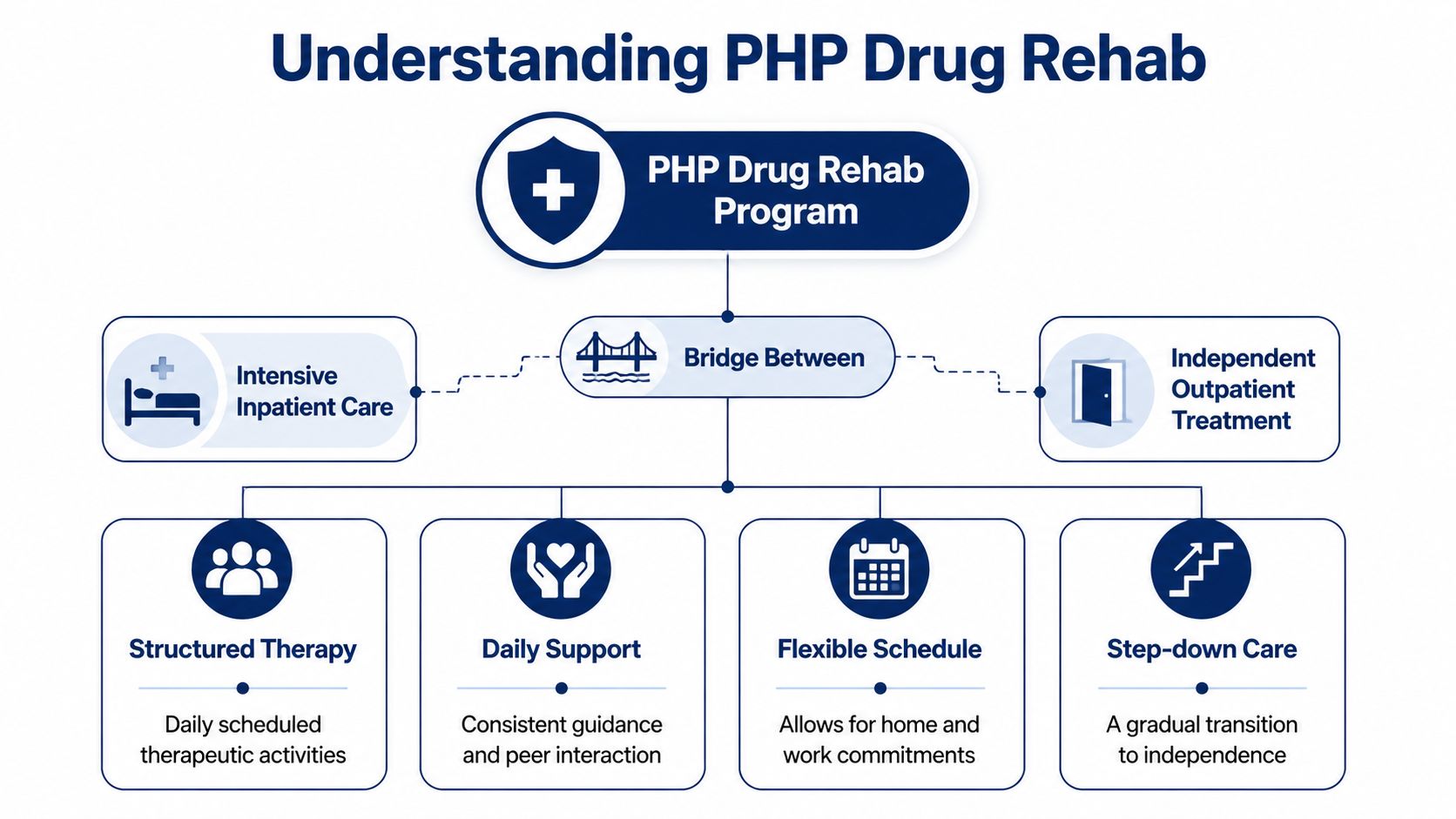
A php drug rehab program is best understood as a bridge. On one side is inpatient or residential treatment, where support is available around the clock. On the other side is outpatient life, where a person has more freedom and more exposure to daily triggers. PHP connects those two stages with structure, treatment, and accountability.
The basic schedule
PHP is more intensive than standard outpatient care. According to this overview of PHP day treatment, Partial Hospitalization Programs for drug rehabilitation deliver 6 hours of intensive, structured treatment daily, 5 days per week, and commonly include CBT, DBT, and MAT.
That schedule matters because early recovery usually benefits from repetition. When a person practices coping skills once a week, progress can feel slow and fragile. When they practice those skills across full treatment days, they have more chances to build routine, catch setbacks early, and get feedback before a lapse turns into a full relapse.
For readers comparing options, a closer look at levels of care in addiction treatment can help place PHP in context.
What happens during those hours
Families sometimes hear "partial hospitalization" and assume it means a hospital room or a highly medical environment. That's usually not what this level of care looks like. The term refers to the intensity of treatment, not to sleeping overnight in a hospital.
A PHP day often includes several kinds of support:
- Group therapy helps clients talk through cravings, triggers, communication problems, and relapse prevention with peers who understand the same struggle.
- Individual counseling gives space to work on personal history, grief, trauma, shame, and specific goals for recovery.
- Skill-building sessions focus on practical tools such as emotional regulation, stress tolerance, boundary setting, and planning for high-risk situations.
- Medication support may be included when a client needs help managing cravings, withdrawal symptoms, or a co-occurring mental health condition.
Why PHP is more than a schedule
The structure isn't there to keep people busy. It's there to help them stabilize. In early recovery, many people have trouble trusting their own judgment because addiction has disrupted sleep, routine, relationships, and decision-making. PHP creates a predictable rhythm so healing doesn't depend on willpower alone.
Practical rule: A strong PHP should help a person do two things at once. Stay safe in treatment, and practice recovery outside of treatment hours.
That second part is what makes PHP such an important step. A client can attend therapy all day, then return to an actual living environment where they have to manage dinner, downtime, family contact, transportation, and evening emotions. Those real-world experiences become part of treatment instead of hidden obstacles.
A Typical Day in a PHP in Orange County
Many families feel calmer once they can picture the day. A PHP schedule isn't random, and it isn't just sitting in a room talking for hours without direction. The day is usually planned with purpose so clients move between therapy, reflection, education, and skill practice.

Morning rhythm and check-in
A typical day often starts with arrival, a check-in, and a group session. Clients may talk about how they slept, whether cravings came up, how the previous evening went, and what emotional challenges they're carrying into the day. That simple routine gives the clinical team a way to notice warning signs early.
Morning groups often focus on core recovery topics such as trigger awareness, thought patterns, coping responses, and relapse prevention. If someone says they felt overwhelmed the night before, that experience doesn't get brushed aside. It becomes material for treatment that same day.
Some families find it helpful to compare this with a broader look at what drug rehab is like day to day, especially when a loved one is anxious about the unknown.
Midday therapy and connection
Later in the day, clients may meet individually with a therapist or case manager. This is often where deeper issues come into focus. One person may work on grief that fuels substance use. Another may work on panic, family conflict, or shame after past behavior.
Lunch and breaks matter too. Recovery isn't only built in formal sessions. It also grows in ordinary moments when clients practice conversation, patience, self-awareness, and healthy peer connection without using substances to cope.
A good PHP day doesn't just fill time. It helps clients test new skills in real interactions, then process what worked and what didn't.
Afternoon practice and planning
Afternoons may include educational groups, relapse prevention exercises, family-related work, or well-being activities such as yoga, art therapy, or mindfulness. These aren't extras for appearance. They can help clients slow down, reconnect with their bodies, and learn healthier ways to respond to stress.
By the end of the day, many clients leave with something concrete. That might be a plan for the evening, a coping strategy for a difficult phone call, or a commitment to avoid a specific trigger. In Orange County, that blend of structure and real-world practice can be especially helpful for people rebuilding recovery while staying connected to daily life.
How PHP Fits Into Your Recovery Journey
Recovery usually works better as a gradual step-down process than as a sudden drop from high support to low support. That's one reason PHP matters so much. It helps a person move forward without losing the safety and structure that made early stabilization possible.
According to this discussion of rehab success rates and duration of care, NIDA notes relapse rates for substance use disorders are between 40-60%, and programs lasting 90 days or more can improve long-term abstinence. That is why many treatment plans combine more than one level of care rather than treating discharge as the end of recovery work.
The step-down model in plain language
A person may begin with detox if withdrawal needs medical supervision. After that, some people need residential treatment, while others are appropriate for PHP. From PHP, many continue into IOP, which offers fewer hours and more independence, followed by ongoing aftercare, therapy, support groups, or sober living.
Each step asks the person to carry more recovery skills on their own. That isn't a weakness in the system. It's the point of the system.
For families trying to support a loved one between appointments and program transitions, resources that improve patient outcomes with education can also help reinforce understanding, consistency, and follow-through.
Comparing levels of addiction treatment care
| Level of Care | Time Commitment | Housing | Best For |
|---|---|---|---|
| Residential | Full-day and overnight treatment | Client lives at the facility | People who need 24/7 supervision and a highly protected environment |
| PHP | Full treatment days during the week | Client returns home or to supportive housing at night | People who need strong daily structure without overnight residential care |
| IOP | Fewer treatment hours than PHP | Client lives at home or in supportive housing | People who are more stable and ready for increased independence |
Why PHP is the practice ground
The biggest misunderstanding about PHP is that some people see it as "not enough" because it isn't residential. In many cases, it's exactly the right amount of care because it exposes the person to real life while still giving them same-day support.
A client in PHP might leave treatment and deal with traffic, family tension, loneliness, or the temptation to isolate. Then they return the next day and process those events with clinicians and peers. That creates a feedback loop. Real life reveals the challenge, and treatment helps build the response.
For many adults, that's where durable recovery starts to take shape. Not in total isolation from the world, but in repeated, guided contact with it.
Treating the Whole Person with Dual Diagnosis and MAT
Substance use problems rarely exist in a vacuum. Many people who need addiction treatment are also struggling with anxiety, depression, trauma, mood instability, or another mental health concern. When both are present, clinicians often call it dual diagnosis.
That term can sound technical, but the idea is simple. If a person drinks to quiet panic, uses drugs to numb trauma, or spirals emotionally after stopping substances, treatment has to address both the addiction and the mental health symptoms at the same time. Otherwise, one problem can keep reigniting the other.
What dual diagnosis care looks like in PHP
In a strong PHP, a client doesn't have to choose between addiction treatment and mental health treatment. The program can integrate both into the same plan. Therapy may address cravings and relapse triggers while also working on trauma responses, depressive thinking, or severe anxiety.
Symptoms often overlap. A loved one may look "unmotivated" when they are depressed. They may seem "angry" when they are frightened or overwhelmed. They may relapse not because treatment failed, but because untreated mental health symptoms kept pushing them back toward substances.
Families who want a clearer picture of this combined approach can review dual diagnosis treatment for substance use and mental health.
What MAT means and what it doesn't mean
Medication-Assisted Treatment, or MAT, is another term families often misunderstand. MAT uses approved medications along with counseling and behavioral treatment to support recovery, especially for opioid and alcohol use disorders.
MAT doesn't replace therapy. It doesn't remove personal responsibility. It can help reduce cravings, ease ongoing withdrawal symptoms, and create enough stability for someone to engage in treatment instead of spending every day fighting intense physical urges.
According to this review of PHP support for addiction recovery, PHP participation can reduce relapse risk by 40-50%, and the same source notes that 50% of SUD patients may also have a co-occurring mental health condition such as anxiety, depression, or PTSD. That combination helps explain why integrated care matters so much.
When mental health symptoms and substance use keep feeding each other, treating only one side usually leaves the person vulnerable.
Why this whole-person approach gives families hope
A person isn't "too complicated" because they need addiction care, trauma support, and medication evaluation at the same time. That complexity is common in treatment. PHP can be a strong setting for it because clients receive repeated contact, close observation, and frequent chances to adjust the plan as needs become clearer.
For many families, that brings a different kind of hope. Not the hope that recovery will be instant, but the hope that treatment finally matches what the person is dealing with.
How to Choose the Right PHP for Your Needs
Choosing a php drug rehab program can feel overwhelming when emotions are high. Families are often trying to move quickly, verify insurance, and make a clinically sound decision at the same time. A simple checklist can make that process more manageable.

Questions worth asking on the first call
Not every program fits every person. The most helpful conversations usually focus less on marketing language and more on how the program operates.
- How is the person assessed before admission Ask how the team decides whether PHP is the right level of care, especially after detox or residential treatment.
- What therapies are included each week Look for clear answers about individual therapy, group work, relapse prevention, family support, and care for co-occurring mental health concerns.
- Can the program provide dual diagnosis care and MAT This is especially important if the person struggles with anxiety, depression, trauma, or opioid or alcohol use.
- What does discharge planning look like Strong programs prepare clients for the next step, not just the current one.
- How does insurance verification work Families should ask what is covered, what documentation is needed, and whether out-of-pocket costs are explained up front.
Why program fit matters
A person may need PHP because they aren't ready for the lower structure of IOP yet. That decision isn't about failure. It's about matching support to actual risk and actual daily functioning.
One future-dated claim appears in this 2025 report on PHP and dual-diagnosis outcomes, which states that PHP completion rates for opioid use disorder were 65-75% compared with 50% for IOP, and that 12-month sobriety rates were 20% higher in PHP for dual-diagnosis patients. Even with any study, families still need to ask whether the specific program in front of them can deliver the right services for the person they love.
A practical checklist for decision-making
Checklist: The right PHP should feel clinically clear, not confusing.
A family can ask whether the program offers:
- Licensed, qualified staff
- A defined weekly schedule
- Mental health support built into addiction care
- Medication management when appropriate
- Family involvement and aftercare planning
- Clear communication about insurance and admissions
One Orange County option is Still Water Wellness Group, which offers PHP as part of a continuum that also includes detox, residential treatment, IOP, MAT, and dual-diagnosis care. What matters most, though, is not choosing a name quickly. It is choosing a level of care that accurately fits the person's current needs.
Begin Your Recovery at Still Water Wellness Group
In California, the need for structured addiction care is significant. According to California substance use treatment data from SAMHSA, 5.6 million residents met SUD criteria in 2022-2023. That same context helps explain why PHP continues to serve as a critical bridge for people who need more than occasional outpatient counseling after detox.
For adults and families in Orange County, that bridge can offer something practical. It gives a person daytime clinical structure, then allows them to begin facing evening routines, family interactions, and real-life stress with support still in place. That is often where confidence starts to grow.
Still Water Wellness Group in Lake Forest provides access to that kind of structured, post-detox care within a broader continuum that can include detox, residential treatment, PHP, IOP, sober living, dual-diagnosis services, MAT, and integrative therapies. In a calm Southern California setting, treatment can focus not only on stopping substance use, but also on building routines, emotional stability, relapse prevention skills, and a workable plan for what comes next.
Families don't need to solve everything in one phone call. They usually just need a clear next step, honest guidance, and a confidential conversation about what level of care makes sense now. When support is matched well and continued long enough, recovery becomes easier to imagine and more realistic to sustain.
Still Water Wellness Group offers confidential admissions support, insurance verification, and guidance on whether PHP is the right next step after detox or residential care. Families and individuals looking for structured addiction treatment in Orange County can contact Still Water Wellness Group at (866) 450-0391 to discuss treatment options in a calm, private conversation.