Some readers arrive at the idea of 100 days without alcohol because they're exhausted. The drinking may still look functional from the outside, but the pattern is wearing them down. Mornings start with regret or shakiness. Evenings involve bargaining. Social plans revolve around access to alcohol, and sleep never feels like real rest.
Others are less worried about dependence and more concerned that alcohol has become too central. Either way, the question is similar: what would life feel like with a real break long enough to see meaningful change?
That question matters because 100 days is more than a challenge. It’s long enough for the body to move beyond the earliest disruption, long enough for the brain to begin settling into a different rhythm, and long enough for daily routines to stop orbiting around the next drink. It also reveals something important. If stopping feels unsafe, chaotic, or impossible to maintain, that usually points to a need for support, not a lack of willpower.
Imagining Your Life 100 Days From Now
A person at day zero often isn’t just thinking about alcohol. They’re thinking about everything alcohol affects. Work performance. Patience with family. The way anxiety spikes in the late afternoon. The private promise to “drink less tonight” that keeps getting broken.
At 100 days without alcohol, the picture is often very different. Many people report waking up without the fog, panic, and mental negotiation that used to frame the day. They feel more present in conversations. They stop losing time to recovery from the night before. The day becomes the day again, not a reaction to alcohol.
That shift matters because sobriety tends to become easier once it stops feeling like constant deprivation. A milestone like 100 days can mark the point where the habit of being sober starts to overtake the habit of drinking. That doesn’t mean every trigger disappears. It means the person now has proof that life can function, and often improve, without alcohol at the center.
Practical rule: Don’t treat 100 days as punishment. Treat it as a diagnostic window. It shows what alcohol has been costing and what recovery can return.
For some, this period confirms that a structured reset was enough. For others, it reveals a deeper problem with craving, withdrawal, mood instability, or relapse risk. Both outcomes are useful. Clarity is useful.
A helpful way to approach the next 100 days is simple:
- Pick a real start date. Vague plans rarely hold under stress.
- Tell one safe person. Accountability works better when it’s specific.
- Plan for evenings and weekends. Those hours expose routines that need replacing.
- Pay attention to patterns. Sleep, mood, appetite, irritability, and social anxiety all provide information.
The goal isn’t perfection. The goal is enough time away from alcohol to let the truth surface.
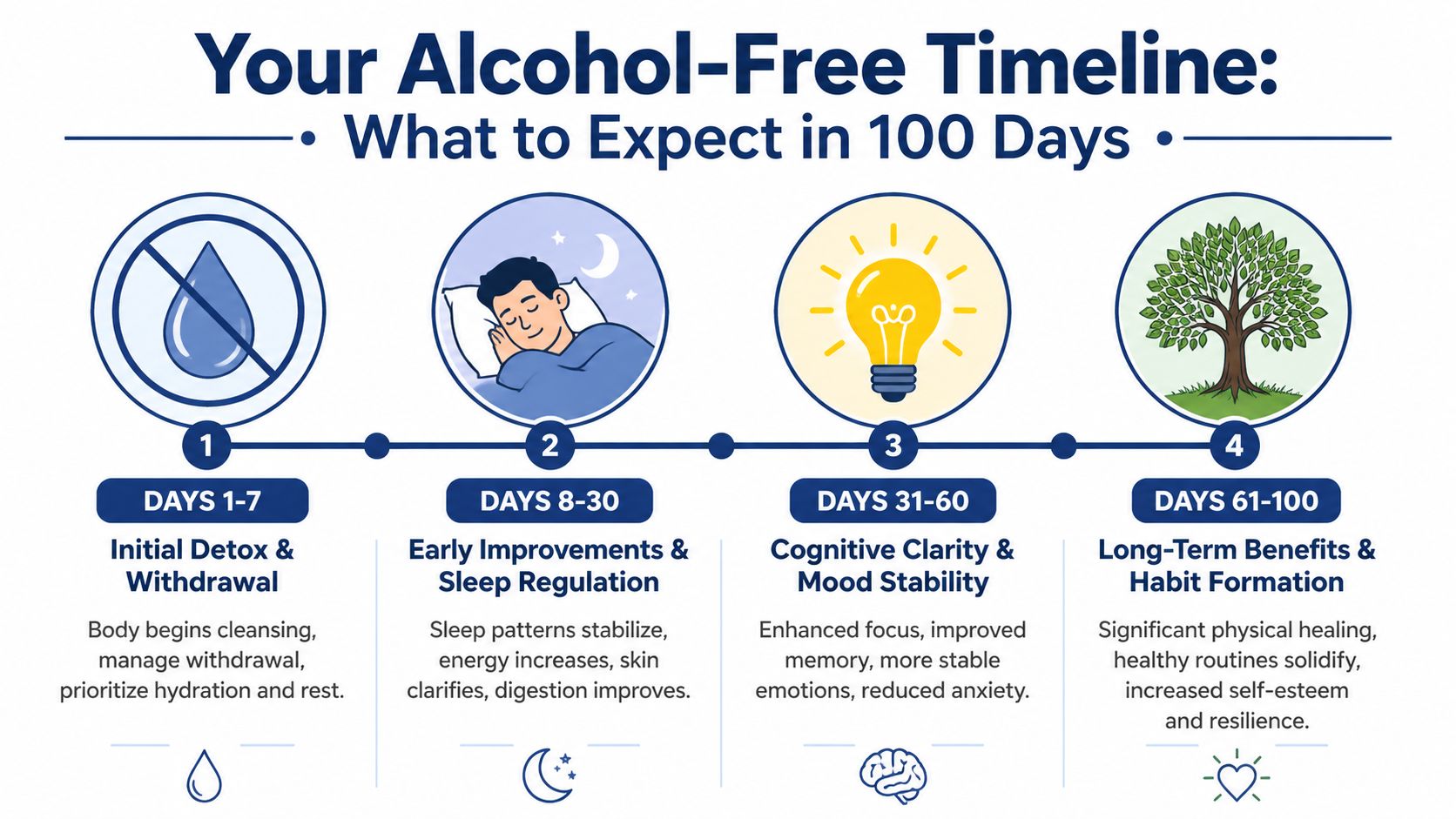
Your Alcohol-Free Timeline What to Expect in 100 Days
The first 100 days usually unfold in stages. Knowing the pattern helps people recognize progress, prepare for rough patches, and understand why support often matters more after the first physical symptoms fade.
Days 1 through 7
The first week is often the most physically unsettled. Sleep can get worse before it gets better. Anxiety can spike. Some people feel shaky, sweaty, nauseated, irritable, or emotionally raw. Others have milder symptoms, but even mild withdrawal can feel discouraging when someone expects immediate relief.
This period deserves respect. Anyone with a history of heavy daily drinking, prior withdrawal, seizures, or severe symptoms should not try to push through alone. A detailed alcohol withdrawal symptoms timeline can help clarify when medical care is appropriate.
Many people also spend this week trying to "fix" the aftermath quickly with hydration, supplements, intense workouts, or sauna heat therapy and hangovers. Some of those steps may help comfort. None of them replace proper assessment if withdrawal risk is high.
Day 30
By the one-month mark, the picture often changes. The body is usually more stable, and the person can start seeing what alcohol had been covering up. Energy may improve. Sleep may become more predictable. Mood can feel less chaotic, even if stress and cravings still show up.
One early sobriety source notes that around day 30, insulin resistance, blood pressure, and other health markers may begin improving as the body adjusts to life without alcohol. That kind of change matters, but the bigger clinical point is this. By 30 days, many people are no longer dealing only with the physical absence of alcohol. They are starting to face routines, emotions, and relationship patterns that alcohol used to mute.
That is often the moment recovery stops feeling like a short break and starts looking like real treatment work.
| Time point | Common experience | Why it matters |
|---|---|---|
| First week | Withdrawal symptoms or major disruption can dominate the day | Safety, stabilization, and medical support may be needed |
| Around day 30 | Physical improvement becomes easier to notice | Motivation grows, but emotional patterns also become clearer |
| Days 31 to 90 | Daily life returns without the usual escape route | Coping skills, structure, and accountability start carrying more weight |
| Day 100 | A more stable baseline often develops | Long-term recovery planning becomes the priority |
Days 31 through 90
Days 31 through 90 are often underestimated. The emergency phase has passed, but the deeper work is just getting started. People go back to work dinners, family tension, boredom at home, weekends, resentment, grief, and the ordinary stressors that used to trigger drinking. Cravings may be less constant, but they can become more situational and more psychological.
This stage is where professional care makes a measurable difference. A person may need therapy for anxiety that alcohol had been masking. They may need group support to handle shame and isolation. They may need structure for evenings, conflict skills for relationships, or relapse prevention planning before a vacation, business trip, or holiday. In practice, this middle stretch is where many people either build a recovery foundation or start bargaining with themselves.
Sobriety gets stronger when it is supported, practiced, and repeated in real life.
Day 100
At 100 days, many people have something more useful than motivation. They have evidence from lived experience. They have handled bad nights, awkward events, cravings, stress, and ordinary routines without alcohol. That does not mean every trigger is gone. It means the person has started building a new baseline.
For some, 100 days confirms that a focused reset and continued accountability are enough to keep going. For others, it reveals relapse risk, unresolved trauma, depression, or a social environment that still pulls them back toward alcohol. Both outcomes are informative. Both point to the same truth. The first 100 days are not just a challenge. They are the foundation of long-term recovery, and the right level of care during this phase can shape what happens next.
The Tangible Benefits of 100 Days Without Alcohol
By the time someone reaches 100 days alcohol-free, the gains are usually concrete. They can feel them in their sleep, see them in their routines, and hear them in the way they talk about daily life. That matters because this stage often marks a shift from short-term abstinence to a recovery foundation that can hold under stress.

Physical recovery becomes easier to notice
The body usually gives the first clear feedback. Many people notice fewer headaches, less stomach irritation, more stable mornings, and sleep that feels deeper and more restorative. As noted in this summary of the health benefits of cutting down or stopping alcohol, reducing or stopping alcohol is associated with lower blood pressure and blood sugar, improved liver function, better sleep, and better absorption of nutrients including B vitamins and zinc.
Calorie intake often drops in a meaningful way too. For someone who drank heavily most evenings, removing alcohol can reduce a large source of low-nutrition calories. That change alone can improve energy, appetite regulation, and body composition over time.
Common physical benefits at this point include:
- Steadier mornings. Less nausea, reflux, bloating, and stomach upset.
- More consistent energy. Energy becomes usable across the day instead of borrowed from caffeine and willpower.
- Better sleep quality. People often wake up less during the night and feel more rested the next day.
- Stronger daily habits. Hydration, meals, movement, and medical follow-through get easier once alcohol stops disrupting the routine.
Some people spend months trying to reduce the aftereffects of drinking instead of addressing the drinking itself. Articles on sauna heat therapy and hangovers can help explain why quick fixes do not reverse alcohol’s broader effects on hydration, inflammation, and recovery. A more useful starting point is understanding how to detox your body from alcohol safely and realistically, especially if withdrawal risk or repeated relapse is part of the picture.
Brain healing starts earlier than many people expect
Mental recovery does not wait until everything feels emotionally settled. Research on recovery during alcohol abstinence found that brain health can begin improving within the first month, and measurable positive changes in brain structure were seen over a seven-month period. In that review, 25 of 34 documented cases showed measurable improvement during abstinence.
In practice, this often shows up as clearer thinking, better concentration, and less emotional whiplash. People can follow conversations more easily. They remember what they said the night before. They start responding to stress with more intention and less urgency.
That does not mean every mood symptom disappears by day 100. Anxiety, trauma, grief, and depression may become more visible once alcohol is gone. That is not failure. It is useful information, and it is one reason this phase often benefits from professional support. The physical gains are encouraging, but long-term recovery usually depends on addressing the emotional and social problems that alcohol had been covering up.
By 100 days, many people are no longer asking only, "Can I stop?" They are starting to ask a better question. "What kind of support will help me keep building a life I do not want to escape from?"
A Practical Strategy for Your First 100 Days Sober
Day 12 often looks very different from day 72. Early on, the job is getting through the next urge, the next evening, the next weekend. By the middle of the first 100 days, the work usually shifts. People start seeing the routines, emotions, and relationships that kept alcohol in place. That is why these 100 days are more than a challenge. They are the base layer of long-term recovery.
Start by changing the environment
Willpower is less reliable than setup. If alcohol is in the house, the usual drinking glass is on the counter, and the evening still unfolds the same way, the brain follows the old script fast.
Make the next right choice easier:
- Remove alcohol from the home. Fewer visual cues usually means fewer automatic urges.
- Stock satisfying substitutes. Sparkling water, tea, flavored drinks, and filling snacks help more than people expect.
- Replace the drinking hour. A walk, a meal, a meeting, a workout, or even a shower can interrupt the old pattern.
- Tell one safe person. Accountability lowers secrecy, and secrecy feeds relapse.
For readers planning a full reset, this guide on how to detox your body from alcohol can help clarify what early recovery may involve and when medical support makes sense.
Build a response for cravings before cravings hit
Cravings usually rise, peak, and pass. They feel urgent, but they are not instructions. People do better when the response is decided ahead of time.
A simple craving plan can look like this:
- Change your position. Stand up, leave the room, or step outside.
- Eat and hydrate. Low blood sugar, dehydration, and exhaustion can make an urge feel stronger than it is.
- Use your body. Walk, stretch, shower, or do a few minutes of movement.
- Contact support. Text, call, or check in with someone who knows your plan.
- Shrink the timeline. Focus on not drinking right now.
Food matters here for another reason. A lot of people mistake physical depletion for a craving. Once regular meals, water, and sleep improve, urges often become easier to handle.
Protect the danger zones
Relapse risk tends to cluster around predictable situations. The end of the workday. An argument at home. A lonely Saturday night. An invitation that sounds casual but revolves around drinking.
A weekly structure gives those moments less room to take over.
| Trigger time | Better response |
|---|---|
| After work | Eat early, shower, walk, call someone |
| Weekend evenings | Schedule a movie, meeting, dinner, or sober outing |
| Stress spike | Use breathing, journaling, or leave the room before reacting |
| Social event | Bring a nonalcoholic drink and a reason to leave early |
Professional care helps here because the problem is rarely just alcohol. Around this point, untreated anxiety, resentment, trauma, boredom, and isolation often start showing up more clearly. In a strong recovery setting, detox is only the beginning. The next steps include therapy, group support, relapse prevention, and a plan for what happens after the first wave of motivation wears off.
Recovery gets stronger when decisions are made before the hard moment arrives. Structure creates momentum. Support helps that momentum last.
Navigating Social Life and Relationships Sober
Social life is where many people discover whether they’re taking a break or building a different way of living. Drinking may have been woven into date nights, work functions, birthdays, vacations, and even basic friendship rituals. Removing alcohol can feel awkward before it feels freeing.
The first useful skill is having a short answer ready. Long explanations invite debate. Short answers protect energy.
A few examples work well in real situations:
- At a party: “No thanks, not drinking tonight.”
- With a persistent friend: “I feel better without it, so I’m sticking with that.”
- At dinner: “I’m good with this.”
- With someone who wants details: “Taking a real break and it’s been good for me.”
Those responses matter because many people over-explain when they feel exposed. Over-explaining often creates more pressure, not less.
Relationships may shift, and that’s information
Some friends adapt quickly. Others become uncomfortable. A partner may be supportive but unsure what this change means for the relationship. In some circles, alcohol was never just a beverage. It was the social glue.
That’s why sober communication needs to be direct and calm. A person might say, “This isn’t about judging anyone else. This is something needed for health and stability.” That keeps the focus where it belongs.
Some relationships get stronger in sobriety because conversations become clearer and follow-through improves. Others weaken because alcohol had been covering the lack of depth.
There’s also a practical side to social planning. It helps to drive separately, bring a drink already in hand, arrive with a time limit, and leave when the event shifts from connection to drinking culture. No one earns extra recovery points by staying too long in a bad environment.
Sober presence gets easier with repetition
A wedding, holiday, or happy hour may feel tense at first. The second one usually feels less charged. By the fifth or tenth, many people realize they’re no longer missing alcohol itself. They’re missing habit, anticipation, or the old social script.
That’s a major distinction. Habits can be replaced. Scripts can be rewritten. Alcohol doesn’t need to be present for a person to be funny, connected, relaxed, or fully there.
Maintaining Momentum After Your 100-Day Milestone
Day 101 can feel strangely quiet.
The sleep is better. The fog has lifted. Other people may even assume the hard part is over. In practice, this is often the point where recovery asks for a different kind of work. The first 100 days usually stabilize the body and interrupt the drinking cycle. The next phase tests whether daily sobriety is supported enough to last through stress, boredom, loneliness, success, and ordinary life.
Why risk can rise after a milestone
Early progress can create a subtle trap. Once the physical payoff becomes familiar, the mind starts revising history. A person may remember the relief alcohol seemed to bring and forget the instability, conflict, anxiety, or loss of control that came with it.
This period also exposes issues that alcohol had been covering. Depression may feel sharper. Trauma symptoms may become more visible. Relationship strain can surface once everyone expects things to be “back to normal.” That is one reason professional care is built as a continuum. The support that helps someone get through withdrawal or the first month sober is not always the same support that helps them stay steady in month four or five.
Recovery has to become structured, not symbolic
A 100 day goal can start recovery. It usually cannot carry recovery by itself.
Long-term change depends on routines that still hold when motivation drops. That may include therapy, peer support, medication management, relapse prevention planning, family work, or a step-down level of care after treatment. Without that structure, people often drift into risky thinking before they notice it.
Common warning signs include:
- Making room for exceptions. Vacations, holidays, or celebrations start to feel like reasons to test alcohol again.
- Letting support slide. Meetings, counseling, or check-ins become easy to postpone.
- Remembering alcohol selectively. The brain keeps the highlight reel and cuts out the consequences.
- Seeing mood changes return. Irritability, anxiety, numbness, or low motivation begin feeding cravings.
I often tell patients to build the next layer of recovery before they feel shaky, not after. That may mean setting a six-month plan, tightening evening routines, adding more accountability, or learning how to stay consistent with goals once the novelty of early sobriety wears off.
For people in peer-based recovery, learning what a sponsor does can clarify how ongoing accountability works after the first major milestone.
The real value of 100 days is not the number. It is the proof that healing has started, and the chance to protect it with the right support.
At this stage, sobriety works best when it is treated as the foundation of long-term recovery, not a completed challenge. That is where continued care matters most.
Finding Professional Alcohol Recovery Support in Orange County
A person can make it to day 100 and still feel shaky in the moments that matter. Sleep may be better. The body may feel stronger. Then a stressful work week, a fight at home, or a social event brings up the same old pull toward alcohol. That is often the point where people realize sobriety is no longer a short-term goal. It needs structure, treatment, and support that matches what is happening underneath the drinking.
Alcohol use disorder also carries real medical risk during early withdrawal. The National Institute on Alcohol Abuse and Alcoholism explains that symptoms can range from anxiety and tremor to seizures and delirium tremens, which is why people with heavy or long-term alcohol use should not assume quitting alone is safe.
The right level of care depends on what the person is dealing with right now. Some people need medical detox before they can begin recovery safely. Others need residential treatment because home is too triggering, or because depression, trauma, or anxiety keeps driving them back to drinking. Many do best with a step-down path that starts with more structure and gradually shifts into PHP, IOP, sober living, and aftercare as daily life returns.
That continuum matters during the first 100 days. Physical healing often starts first. Emotional stability, relationship repair, and relapse prevention usually take longer. Professional care helps people work through both phases instead of stopping once the worst symptoms ease.
If alcohol has become hard to stop, hard to control, or unsafe to quit alone, support can make the difference between another false start and lasting recovery. Still Water Wellness Group provides compassionate, personalized care in Orange County, including medical detox, residential treatment, PHP, IOP, sober living, dual-diagnosis services, and aftercare planning. The admissions team is available 24/7 for confidential guidance. Call (866) 450-0391 to talk through options and take the next step.