
A person arriving at treatment may notice an art room down the hall and feel two things at once: curiosity and doubt. After detox, difficult conversations, and the uncertainty of a new routine, painting or music can look disconnected from the serious work of recovery. Yet addiction recovery art can have a useful clinical role when it's matched to a person's needs, led safely, and connected to an established treatment plan.
Creative work can help someone express what feels too complicated to explain, practice emotional regulation, and build a sober identity. It can also stir painful memories or intensify distress when used without support. The difference lies in how the activity is designed, who facilitates it, and where it fits across detox, residential care, PHP, IOP, and sober living.
What Addiction Recovery Art Means
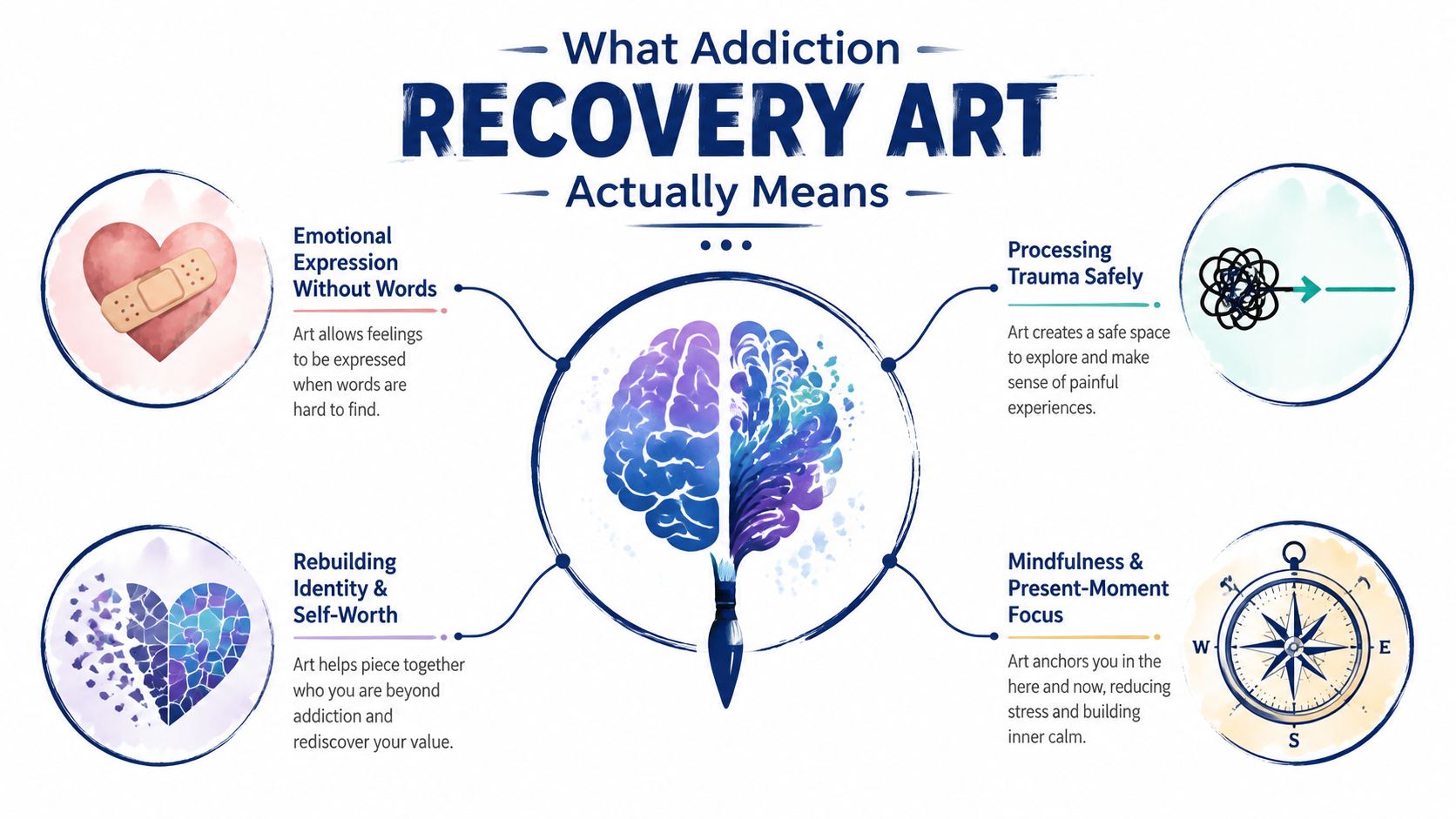
A resident may sit at a table with paper and colored pencils, unsure whether the activity belongs in serious addiction treatment. The answer depends on its purpose, facilitator, and place in the level-of-care plan. Addiction recovery art is an umbrella term. It can mean credentialed art therapy led by a master's-level clinician, or supportive creative activities such as guided drawing, music groups, journaling, movement, and crafts within a broader rehab schedule.
Clinical art therapy follows a defined process. A trained provider assesses needs, selects an intervention, offers a prompt, observes responses, and connects the creative process to treatment goals. The artwork is not graded, and a therapist does not treat a symbol as a diagnosis. Instead, an image, movement, sound, or written passage becomes material for reflection and therapeutic conversation.
Clinical work and supportive creativity
A recreational art period may offer residents a calming activity and a way to connect with peers. Mindfulness-based making may direct attention toward texture, color, breath, or repeated movement. These activities can support a treatment environment, but the label art therapy requires more than providing supplies or calling an activity therapeutic.
Facilitators may include registered or board-certified art therapists, recreation therapists, expressive arts facilitators, and peer specialists. Their training and responsibilities differ. Families can ask who leads the group, what support is available if distress arises, and whether participation is documented as part of treatment.
Why nonverbal work can help
Shame, trauma, anxiety, and early withdrawal can make direct conversation difficult. Someone may choose a color, shape, rhythm, or image before identifying the emotion underneath. The creative process works like an additional doorway into treatment. It may help the team notice patterns, practice coping, and invite communication without asking the person to explain everything immediately.
Creative work complements cognitive behavioral therapy, medication-assisted treatment, and group therapy. It does not replace medical monitoring, psychiatric care, relapse-prevention planning, or evidence-based counseling. Its value comes from fitting the person's needs and level of care, from detox through residential treatment, PHP, IOP, and sober living.
Practical rule: The activity matters less than the clinical frame around it. A simple drawing can become meaningful treatment when a qualified professional connects it to safety, goals, and follow-up.
The Evidence Behind Creative Approaches to Recovery
A person in early recovery may attend medical care, counseling, and peer support while also using creative work to manage distress. Research supports a careful conclusion: creative therapies can contribute to recovery, but findings are not equally strong across every modality or outcome. Their role is best understood as one part of a treatment continuum, not as a substitute for detox monitoring, medication, or counseling.
A 2025 review in the Journal of Substance Abuse Treatment reported that only about 16.5% of the U.S. population had presented for treatment for substance use disorders, while just 6% had received treatment. It also found that 38.6% of 307 addiction treatment programs offered art therapy. The PubMed Central review supports viewing art therapy as a recognized complementary service, although availability differs by program and it is not a standalone cure.
A foundational national survey found that 36.8% of U.S. treatment programs offered art therapy, compared with 14.7% offering music therapy and 11.7% offering both. Larger centers were more likely to provide these services, while centers receiving Medicaid revenue were less likely to offer art therapy. Programs requiring 12-step meetings had 2.12 times higher odds of offering it than programs without that requirement. The national treatment-program survey describes adoption patterns, not identical benefits for every participant.
What the strongest findings measure
A systematic review found the clearest quantitative findings in music therapy, including greater contemplation or readiness for change, improved motivation, and reduced cravings in randomized trials. Reported standardized effects included approximately 0.90 and 0.76 for contemplation or readiness, 0.54 for motivation, and -0.54 for cravings. The systematic review of creative arts therapies also emphasized that evidence for visual art therapy remains thinner.
A separate review found that group arts activities may support health and wellbeing pathways, while calling for larger samples, quantitative measures, and follow-up. The rapid review of group arts activities points toward structured, multi-session programming that can examine retention, completion, and engagement.
| Modality | Evidence strength | Key outcomes |
|---|---|---|
| Music therapy | More developed quantitative evidence | Readiness, motivation, craving, and distress-related outcomes |
| Visual art therapy | Preliminary and uneven | Expression, engagement, emotion regulation, and wellbeing |
| Movement and drama | Limited compared with music | Embodiment, role exploration, connection, and emotional processing |
| Expressive writing | Useful clinical application, outcome evidence varies | Narrative organization, reflection, and coping practice |
At home, a slow creative routine can offer grounding without becoming clinical treatment. how bonsai relieves stress gives a practical example of attentive care. It should not be confused with art therapy, which includes clinical goals, trained facilitation, and links to the person's level of care.
Common Art Therapy Modalities and What Sessions Look Like
A typical creative therapy session lasts 45 to 90 minutes, depending on the level of care, clinical goals, and participant stability. The room may contain tables, paper, paint, clay, instruments, or open floor space. Some sessions are individual, while others use a small group to build connection and practice communication.
Visual art therapy
A clinician might offer mask-making, body mapping, collage, or a directed painting prompt. A participant could create the outside and inside of a mask, then discuss the difference between the public identity and the private experience. Another person might map tension in the body with color and compare the image across treatment milestones.
The therapist focuses on process and meaning-making, not artistic quality. A useful prompt might be, “What part of recovery feels visible, and what part remains hidden?” The participant chooses how much to share.
Music therapy
Music sessions may begin with receptive listening, especially when someone needs help settling during detox or withdrawal management. A therapist might ask participants to notice changes in breathing, muscle tension, or craving intensity without demanding immediate discussion.
Other sessions use lyric analysis, rhythm, songwriting, or group music-making. A relapse-prevention exercise could involve writing a short song about an early warning sign and the action that follows it. Music therapy has stronger measurable findings than visual art therapy in the available review literature, but it still functions as an adjunct to standard treatment.
Movement-based work
Movement therapy may use gentle stretching, guided shaking, breathwork, or dance. The room needs enough space for participants to move without crowding, and the facilitator should offer seated alternatives. A prompt such as “Notice where the body says no, then find a smaller movement that feels safe” supports choice and bodily awareness.
Yoga-integrated movement can also provide a structured way to practice attention, though it shouldn't be forced during acute medical instability.
Drama and expressive writing
Drama therapy may use role work, psychodrama, or an empty-chair exercise adapted from gestalt approaches. Someone might rehearse saying no to a former using acquaintance while another participant plays the role of a supportive family member.
Expressive writing can be quieter. Timed journaling, unsent letters, gratitude inventories, and narrative prompts help organize experience without requiring polished prose. The facilitator watches for overwhelm and closes with grounding rather than ending immediately after intense material.
The finished product can be ordinary. The therapeutic work happens through choice, attention, reflection, and safe connection.
How Art Fits Into Detox, Residential, PHP, IOP, and Sober Living
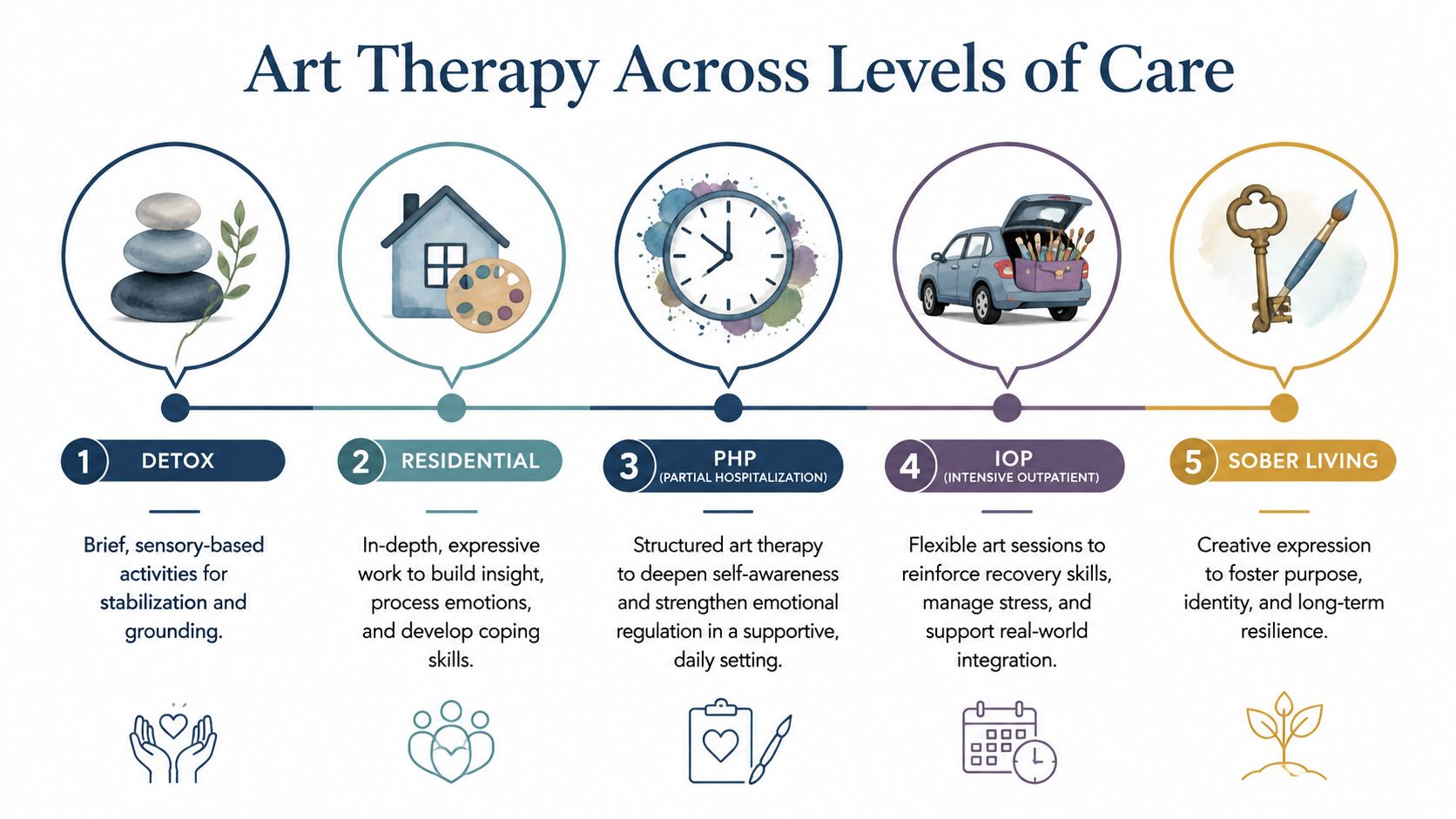
Creative interventions serve different purposes at different levels of care. A short sensory activity during detox shouldn't be treated as equivalent to trauma-focused art therapy in residential treatment, and a peer-led project in sober living isn't the same as billable clinical care.
Detox
During medical detox, the priority is stabilization. Creative activities should be brief, predictable, and sensory, such as coloring, textured materials, simple rhythm, or guided breathing paired with drawing. Staff may use them to support grounding and offer a healthy focus during distress, but medical monitoring and withdrawal treatment remain central.
Residential care
Residential programs can provide more structured work because clients have consistent access to staff and therapeutic services. A weekly art therapy group might address identity disruption, shame, trauma-related avoidance, or recognition of relapse patterns. Individual sessions can connect a creative task to a treatment-plan goal, such as identifying emotional triggers or practicing a coping response.
Families comparing programs should ask whether the art room is recreational, clinically facilitated, or both. This overview of inpatient rehab activities can help families understand how creative programming may sit alongside therapy, education, recreation, and daily structure.
PHP and IOP
PHP often uses creative work to prepare clients for greater independence. A group might create a visual coping menu for work stress, family conflict, or exposure to familiar neighborhoods. IOP can extend that practice into the community through journaling assignments, music-based reflection, or a short creative exercise completed between sessions.
The clinical question changes from “Can this person participate?” to “Can this person use the skill when stress appears outside treatment?”
Sober living
Sober living programs may use peer-led projects, shared music, photography, or community art to reinforce routine and belonging. These activities can support a sober identity, but they aren't automatically therapy. Clinical services require appropriate staffing, documentation, supervision, and connection to treatment goals, while recreational craft time is generally voluntary community programming.
Creative Practices You Can Try at Home
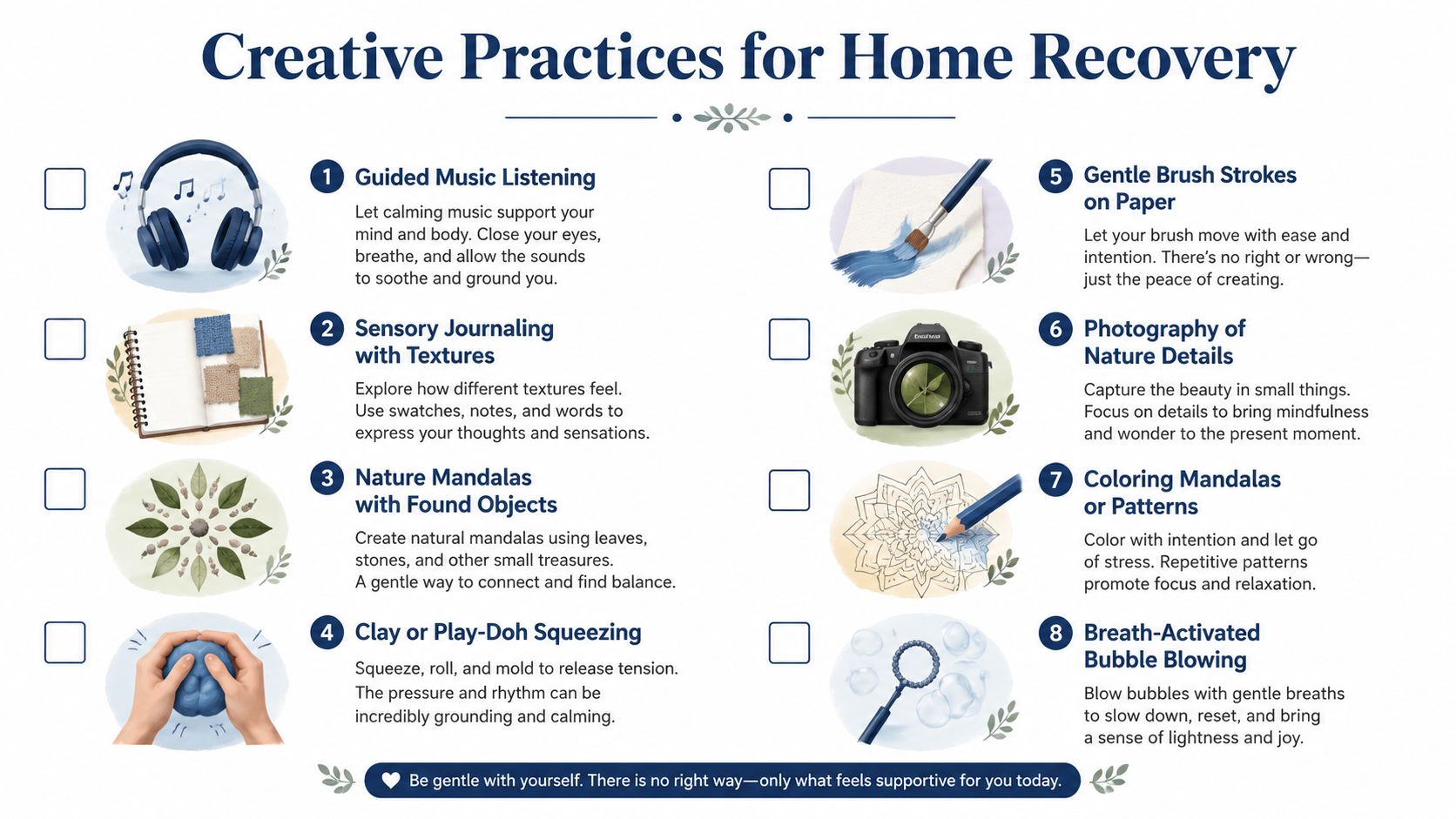
Home-based creative practice should be simple, bounded, and emotionally manageable. The purpose is to support grounding and routine, not to conduct trauma processing without clinical supervision.
Low-risk activities
- Morning sketch journal: Set aside 15 minutes with paper and a pencil. Draw lines, objects, or colors that match the morning's energy, then write one practical intention for the day.
- Mood playlist: Choose songs for calm, focus, or connection, and note the mood before and after listening. If a song brings up using memories or increases cravings, stop it and switch to a neutral track.
- Gratitude collage: Use old magazines, printed images, or handwritten words to assemble a page about people, places, routines, or values that support sobriety.
- Clay grounding: Squeeze and reshape modeling clay for a short period while noticing pressure, temperature, and texture. The practice should end before frustration or painful memories build.
- Nature mandala: Arrange leaves, stones, or other found objects, then return them to nature. The activity encourages attention without requiring symbolic interpretation.
- Gentle painting: Use repetitive brush strokes on paper with one or two colors. The focus is steady movement, not a finished image.
- Photography and observation: Photograph small details in nature, such as bark, light, or a leaf, and write one sentence describing what the camera helped the person notice.
- Breath-activated bubbles: Blow bubbles slowly and lengthen the exhale only as far as comfortable. Anyone who feels lightheaded should stop and breathe normally.
These exercises can complement meditation and other recovery skills. Meditation for addiction recovery offers related guidance for building present-moment attention.
Family participation
A family member can sit nearby, make their own collage, or ask whether company is welcome. They shouldn't interpret symbols, search for hidden meanings, or pressure a loved one to display private work. A respectful question is, “Would the person like to talk about it, or would they prefer to leave it private?”
Creative work should pause if it triggers intrusive memories, dissociation, escalating anxiety, or stronger cravings. Those reactions call for contact with a therapist, treatment team, crisis service, or emergency support when safety is at risk.
Qualifications and Safety Considerations
Not every creative activity is art therapy. A counselor may use a drawing prompt during a session, and a recreation therapist may lead a meaningful art group, but credentialed art therapy involves specialized education, supervised clinical training, assessment, and treatment planning.
In the United States, the Art Therapy Credentials Board recognizes designations including Registered Art Therapist, ATR, and Board Certified Art Therapist, ATR-BC. Art therapists typically complete master's-level education, while state licensure requirements vary. A program may also employ licensed clinicians with expressive-arts training who integrate creative methods without holding an art therapy credential.
Trauma-informed practice
Unstructured art-making can bring forward material that a person isn't ready to process. A trained clinician may use a phased approach, containment strategies, and titration, meaning the provider helps the client approach difficult material in manageable amounts while returning attention to safety and the present moment.
The therapist may begin with grounding, offer choices about materials, and establish a closing routine. The participant can decline a prompt or change the activity. These safeguards matter especially for people with trauma histories, dissociation, severe anxiety, or co-occurring psychiatric symptoms.
Safety check: Creative work should expand a person's coping options, not leave them alone with emotions that exceed their current support.
Questions for a treatment program
Families and prospective clients can ask:
- Who leads the group? Ask whether the facilitator is an art therapist, licensed clinician, recreation therapist, expressive-arts facilitator, or peer specialist.
- How is safety handled? Ask what happens if a participant dissociates, becomes highly distressed, or reports increased cravings.
- How does art connect to care? Ask whether goals and responses are documented in the treatment plan.
- What supervision is available? Clarify how creative sessions fit within the larger clinical team.
- Is participation voluntary? A safe program should explain choices, alternatives, and limits of participation.
Avoid providers who promise that art alone will resolve trauma, prevent relapse, or replace medical and psychiatric care. The strongest clinical position is more modest and more useful: creative work may support engagement, regulation, and reflection when it's appropriately structured.
How Still Water Wellness Group Integrates Art Into Recovery
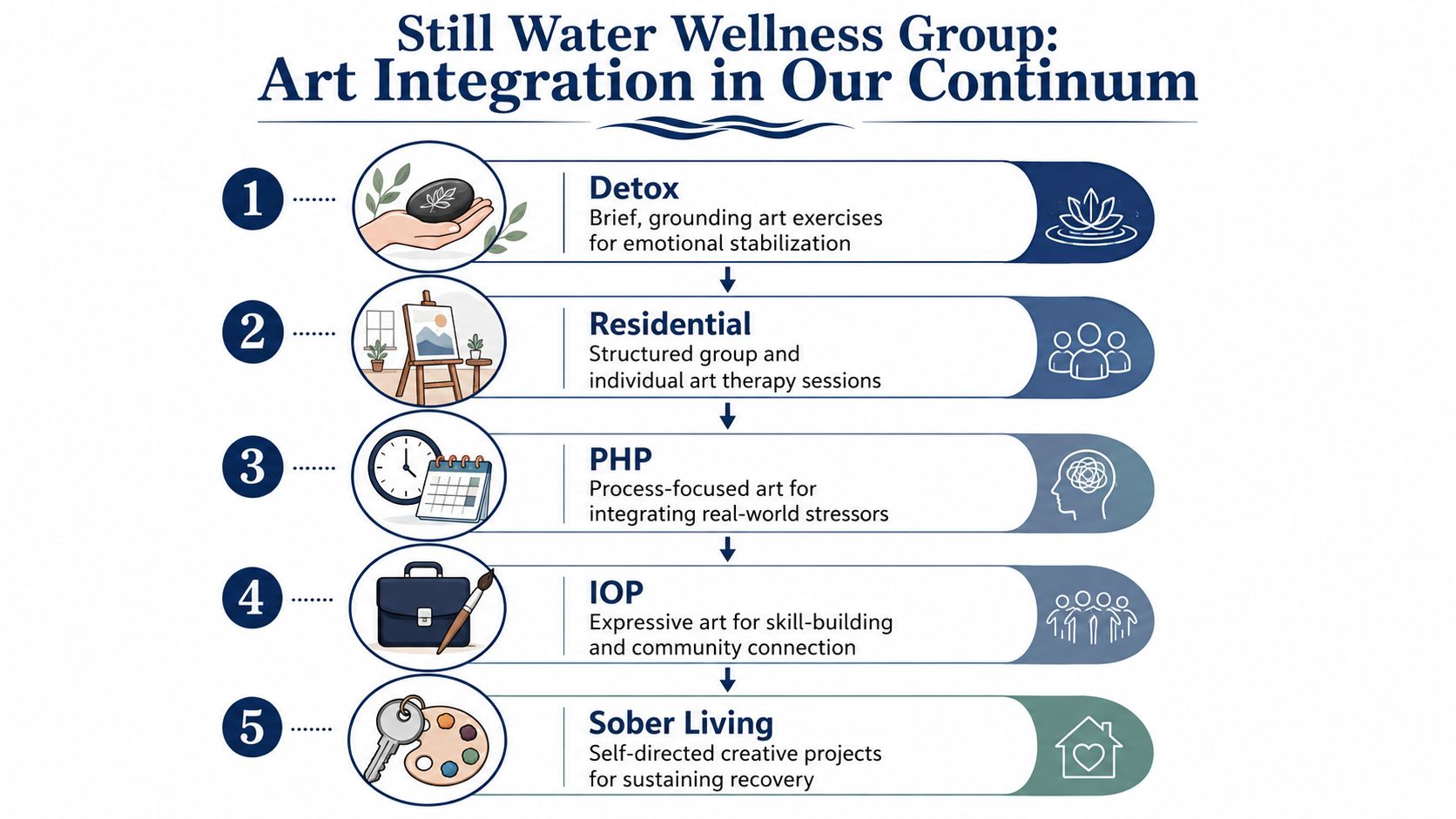
Still Water Wellness Group places art and experiential work within a continuum of care in Orange County. Creative activities serve different purposes as a client moves from medical stabilization toward independent recovery. The same painting prompt may support grounding during early care, then become a way to examine stress or practice coping later.
Matching creative work to clinical needs
During detox, brief grounding activities may help reduce arousal and withdrawal anxiety while medical staff address physical safety. Residential treatment allows more time for structured groups, individual art therapy linked to treatment-plan goals, and music and movement sessions.
Residential studio groups meet twice weekly. Individual art-therapy sessions connect creative work with identified clinical goals, while weekly music and movement groups offer additional ways to practice regulation, expression, and connection. Activities remain flexible because withdrawal status, trauma history, mood, and concentration can differ from client to client.
PHP and IOP combine process-oriented art groups, trauma-informed sculpting, and journaling with CBT and DBT curricula. Clients can examine current stressors, rehearse coping choices, and apply treatment skills in family, work, and community settings. Creative work supports the clinical plan; it does not replace it.
Supporting the transition beyond structured care
Sober-living transitions may include alumni studio nights and community mural projects. These activities can reinforce connection, routine, and a continuing sober identity. They remain separate from formal therapy unless a qualified clinician provides and documents the intervention as clinical care.
A registered art therapist or licensed clinician with relevant expressive-arts training leads or co-leads all art and experiential work. The clinical team supervises sessions, and relevant observations are documented in the master treatment plan. People comparing levels of support can also review inpatient drug rehab with a broad treatment model.
For adults and families in Orange County, admissions staff are available through a 24/7 line for confidential questions, same-day assessments, and insurance verification. A conversation can help clarify whether detox, residential treatment, PHP, IOP, sober living, or dual-diagnosis care fits the current situation.
Still Water Wellness Group offers care that can include medical detox, MAT, residential treatment, PHP, IOP, sober living, and supervised art and experiential therapies for substance use and co-occurring mental health needs. Visit Still Water Wellness Group or call (866) 450-0391 to request a confidential assessment, verify insurance, and discuss the next safe step toward treatment.