
The first week of recovery can feel awkward in a way that's hard to explain. A person may have the book open on the kitchen table, the meeting list on the phone, and a knot in the stomach that says this is too much, too fast, too exposed. For a lot of people, the question is not whether the Twelve Steps matter. It's whether there's a version that doesn't feel like a shove.
A gentle path through the Twelve Steps answers that question with patience, structure, and respect for where someone is today. Patrick Carnes frames the work as a process with exercises that fit into daily life, not a test of whether someone is spiritual enough, tough enough, or far enough along to belong (Patrick Carnes on A Gentle Path through the Twelve Steps). That matters in early recovery, because people rarely arrive calm and ready. They arrive scared, guarded, and unsure what kind of help will feel safe enough to keep using.
When the Twelve Steps Feel Too Big to Start
A man sits in the parking lot outside his first meeting and keeps the engine running. He has already decided to go in, then decided not to, then checked the time three times. What stops him isn't laziness. It's the fear that the room will ask for a confession he can't make, a surrender he doesn't understand, or a spiritual language that feels foreign.
That reaction is common. The original Twelve Steps were built as a full recovery sequence, but early recovery minds do better when the work is slowed down and translated into plain language. A gentle approach does exactly that. It treats the steps as a sequence of small, workable actions, not a moral exam. It also makes room for shame, trauma, and uncertainty, which is often where relapse risk lives.
Practical rule: if the steps feel impossible, the problem usually isn't the person's character. The problem is the pace.
That's why a softer framework can be clinically useful instead of “less serious.” People don't need to be forced into insight before they're ready. They need enough safety to stay present long enough to learn what the steps are asking for. For some, that starts with a meeting. For others, it starts with a page of notes, a phone call, or a quiet read through the material.
A useful place to start is understanding sponsorship as support, not pressure, especially when the idea of being “told what to do” already feels activating. A plain explanation of that role can help, and what a sponsor does is easier to absorb when it's not wrapped in jargon.
What the Twelve Steps Are and How a Gentle Path Differs
The Twelve Steps were first published in 1939 with the Alcoholics Anonymous basic text, and the sequence is still used widely in modern recovery care, including in treatment centers that continue to lean on 12-Step models (Twelve-step program history). The original framework is simple in one sense and demanding in another. It moves from admitting powerlessness, to seeking help, to inventory, amends, daily upkeep, and service.
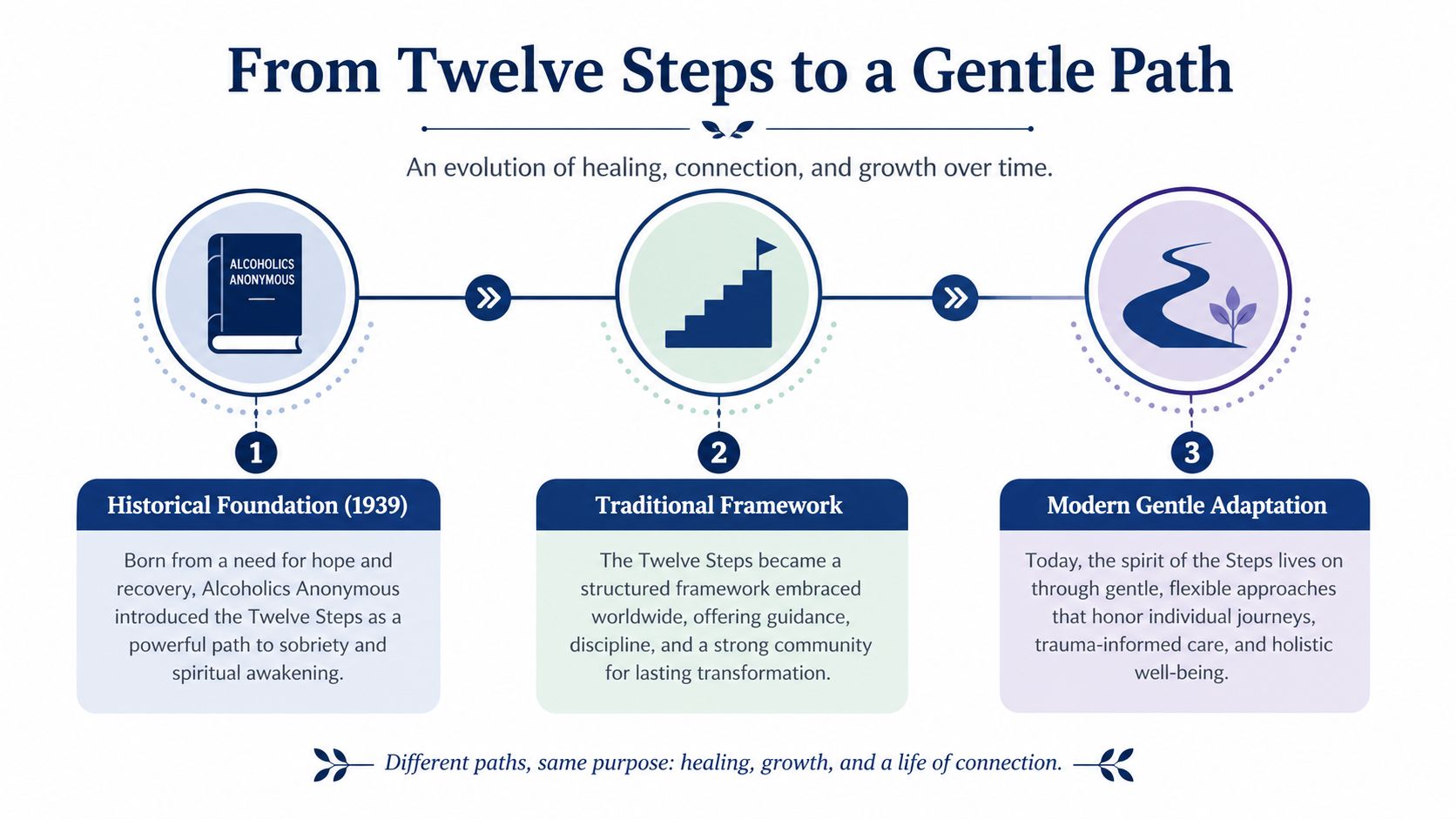
The original structure
The classic sequence stays recognizable because it works as a map. It asks a person to face reality, accept help, repair damage, and keep practicing recovery behaviors. That structure is why it still shows up in broad treatment systems today. Industry summaries citing SAMHSA reported that nearly 50% of U.S. treatment centers used 12-Step models in 2023 (Twelve-step program history).
What makes the gentle path different
Patrick Carnes's A Gentle Path through the Twelve Steps keeps the same step framework but changes the entry point. The work is paired with exercises, which turns reading into practice and makes room for emotional pacing (Patrick Carnes recovery guide). In plain terms, gentle means slower, more supported, and more trauma-aware. It does not mean watered down. It means the person can stay engaged without being pushed into overwhelm.
A gentle path keeps the spine of the Twelve Steps, then adds pacing, reflection, and language that can stay honest without making the room feel dangerous.
That difference matters in dual-diagnosis care and in treatment plans that include medication-assisted treatment. A person can work the steps while also treating depression, anxiety, trauma, or opioid use disorder, because the stepwork and the clinical care serve different jobs. Clinical care steadies the body and mind. Stepwork helps the person build honesty, connection, and a new way of living.
A simple way to read the difference
- Traditional framing: the person may be asked to move quickly into full group participation.
- Gentle framing: the person is allowed to begin with reading, writing, and one honest conversation.
- Traditional expectation: spiritual language may be taken at face value.
- Gentle adaptation: spiritual language can be held as values, meaning, or willingness.
- Traditional pace: stepwork can feel linear and public.
- Gentle pace: stepwork can be private first, then shared when trust is built.
That is why a trauma-informed version of the steps can sit beside clinical treatment instead of competing with it. A person who needs detox, MAT, PHP, IOP, or sober living does not have to choose between medical support and recovery work. The two can run in parallel, with the pace adjusted so the person can stay present long enough to learn.
For readers who want a direct comparison of formats and pacing, alternative 12-step approaches can help show where gentle work fits.
The Twelve Steps Grouped Into Four Recovery Phases
A person who opens all twelve steps at once can feel the same pressure they feel in early recovery, too much information, too fast. Grouping the steps into phases gives the mind something it can hold. It also fits the way recovery tends to happen in real life, with starts, pauses, backtracking, and returns instead of a clean straight line.
Surrender and honesty, Steps 1 to 3
The first phase asks a person to stop acting as if the problem can be managed alone. It begins with truth, not performance. Step 1 is about admitting the problem, Step 2 opens the door to hope, and Step 3 shifts the burden of control into something larger than sheer willpower.
A gentle version of this phase might sound like, “Today, alcohol or drugs are running my life more than I want them to.” That is enough to begin. The person does not have to sound dramatic or heroic to be honest.
Inventory and repair, Steps 4 to 7
This is the part that scares many people because it asks for self-examination. Step 4 includes a “searching and fearless moral inventory”, which in practice usually means written reflection on patterns, harms, fears, and defenses (Step wording excerpt). Step 5, Step 6, and Step 7 keep that work moving from paper to humility and change.
The gentle version does not ask someone to dig up everything at once. It asks for a few pages, a few patterns, a few honest sentences. That is enough to begin. A private reflection prompt for this phase might be, “What keeps showing up in relationships when stress gets high?”
Daily maintenance, Steps 8 to 10
These steps focus on behavior that needs repetition. Step 8 prepares a person to make amends, and Step 9 includes the important boundary that amends should not injure the other person or others (Step wording excerpt). Step 10 keeps the work going with ongoing self-checks.
The gentle version is steady, not dramatic. A person reviews what happened, notices where honesty slipped, and corrects course without turning one mistake into a crisis. A good question here is, “What do I need to clean up before it grows larger?”
Service and growth, Steps 11 and 12
Step 11 deepens reflection and Step 12 turns recovery outward through service and message carrying. The original text links Step 12 with a “spiritual awakening” and a commitment to help others (Step wording excerpt). In real life, that awakening often looks less like fireworks and more like calmer choices, better follow-through, and cleaner relationships.
A reflection prompt for this phase is simple, “What changes when recovery stops being private only and becomes useful to someone else?”
Why Stepwork Changes the Brain and the Behavior
A person in early recovery may know the rules of the program and still feel pulled by old reactions. That gap makes sense. Addiction affects reward, craving, and self-regulation, and recovery works by helping the brain build stronger pathways for control and emotional steadiness, as described in the Shortform summary. Stepwork matters because it is repeated practice, not just reading and agreeing with the ideas.
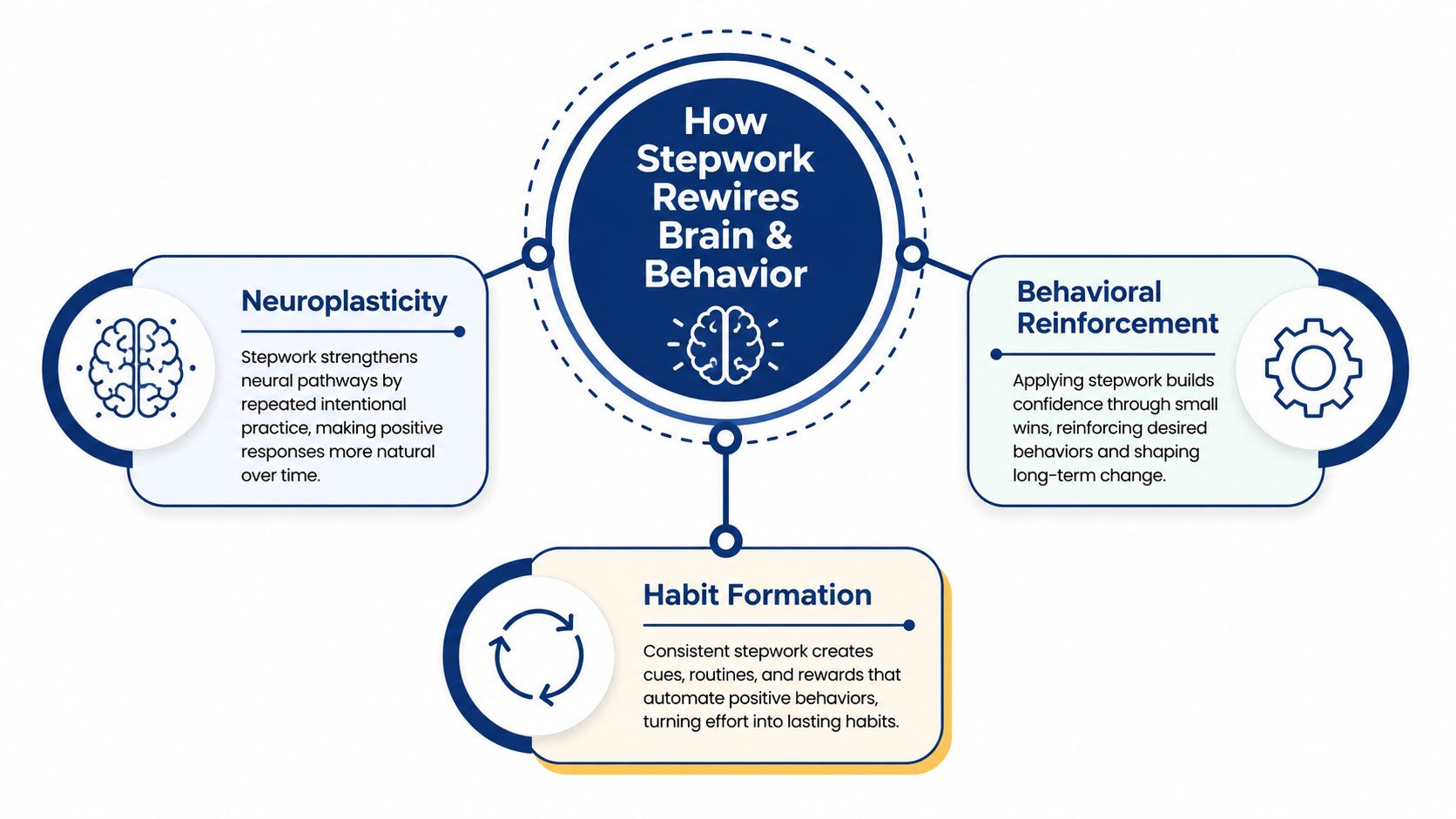
Inventory writing works because it slows the story down
A written inventory asks a person to sort facts from panic, pattern from shame, and trigger from excuse. That pause matters. It creates enough distance from the automatic reaction to let the person see what is happening, instead of only feeling swept up by it.
Inventory also brings hidden beliefs into view. A person may notice the same inner rule showing up again and again, the kind that keeps the cycle in place even when the person wants something different. That is why inventory work can feel intense even when it is paced carefully and handled with support.
Amends work repairs more than a relationship
Addiction often leaves broken trust in its wake, and that damage reaches both other people and the person doing the stepwork. Thoughtful amends can rebuild contact in a way that is honest and bounded. The goal is not to erase what happened. The goal is to stop acting as if repair is out of reach.
The limit built into Step 9 matters clinically. An amends that injures the other person, or puts someone else at risk, is not a healthy repair. That boundary keeps the process grounded in reality, which is part of what makes a PHP drug rehab setting so useful for people who need structure while they practice these skills.
Daily steps train the nervous system
Step 10, Step 11, and Step 12 rely on repetition. Repetition matters because the body learns through practice. When honesty, reflection, and connection happen again and again without catastrophe, the nervous system starts to treat them as safe enough to use.
That is one reason gentle stepwork can still feel hard. It asks the body to respond in a new way to old cues. Over time, that repeated experience can support habit formation, emotional regulation, and steadier choices, which is how stepwork changes behavior in a way that lasts.
Adapting a Gentle Path for Co-Occurring Mental Health Conditions
A person with addiction and trauma, depression, anxiety, or bipolar symptoms often needs more than encouragement. They need timing. In 2023, about 20.4 million U.S. adults had both a mental illness and a substance use disorder, which shows how common dual diagnosis really is. The problem is not just the overlap of conditions. It's that treatment often has to fit a nervous system that's already overloaded.
Match the step to the symptom load
If someone is actively flooded, Step 4 can become destabilizing instead of clarifying. A trauma-aware clinician may slow that work down until the person has more grounding skills. That isn't avoidance. It's sequencing. The same goes for group intensity. A room that feels safe to one person may feel exposing to another, especially when shame, hypervigilance, or mood swings are already high.
Translate spiritual language instead of forcing it
Not every reader connects with “Higher Power” language in the same way. A gentle path can use values, conscience, community, or willingness as the working frame while the person gets stable. That keeps the structure intact without making belief the barrier to participation.
Ask for signs of trauma-informed support
A trauma-informed sponsor or counselor listens for shutdown, not just resistance. They make room for pauses. They don't turn every hesitation into defiance. They help the person notice what's happening in the body and avoid treating pain as a character flaw.
A few practical questions matter more than polished explanations:
- Can this person slow the pace when a step starts to trigger shame or panic?
- Can the work stay coordinated with therapy or psychiatric care?
- Can the language be adapted without losing the recovery structure?
- Can the person leave group feeling regulated enough to come back?
A gentle path works best when it doesn't compete with clinical care. It should fit around treatment, not replace it.
Integrating the Gentle Path With Detox, MAT, PHP, IOP, and Sober Living
A gentle step approach makes the most sense when it sits inside a treatment continuum. Detox, medication support, therapy, and stepwork all do different jobs. When those jobs are sequenced well, the person isn't asked to do emotional work while the body is still in crisis.
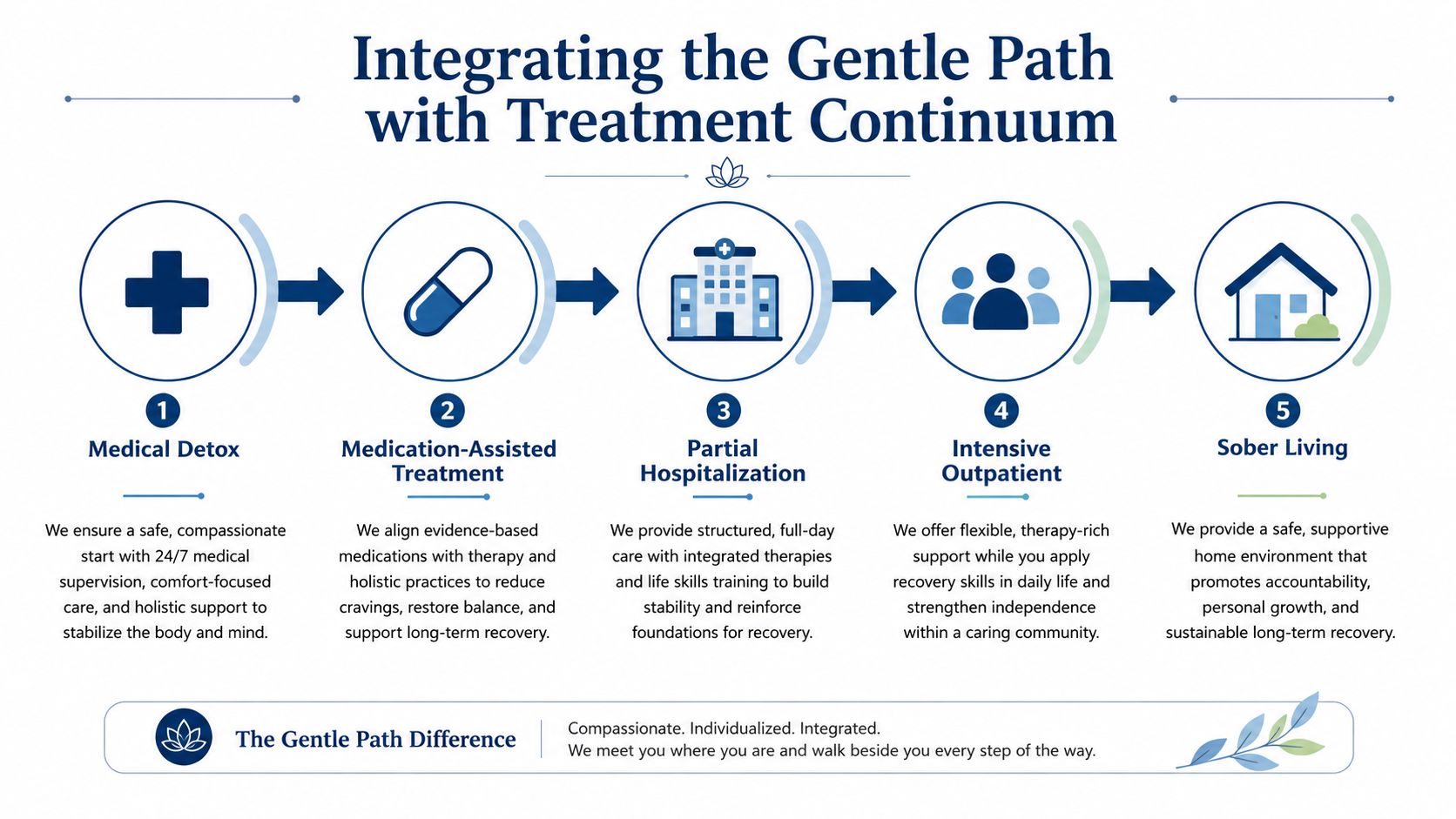
Detox and early stabilization
Medical detox gives the body a chance to settle. That matters because Step 1 can't land well if someone is still fighting withdrawal, dehydration, or severe sleep disruption. The first recovery conversation often needs to be simple, direct, and brief.
MAT and stepwork can fit together
Medication-assisted treatment can be clinically compatible with stepwork when the person, prescriber, and support network agree that medication is part of stability, not a moral failure. That alignment matters for people who need a less rigid path. It can also reduce the pressure to “prove” recovery by suffering unnecessarily.
PHP and IOP give recovery a rhythm
Partial hospitalization and intensive outpatient care provide structure, repetition, and supervision while life is still moving. That's where Steps 8 to 10 often fit well, because the person is practicing repair and accountability while still getting daily clinical support. A PHP-level structure can also help with pacing, since stepwork can be introduced alongside groups, individual therapy, and medication management. A clear description of PHP drug rehab helps readers see why this level can hold more than one recovery task at a time.
Sober living supports the maintenance phase
Sober living works well for the later steps because it gives the person space to practice habits, not just discuss them. That's where the daily rhythm of reflection, service, and follow-through becomes more visible. When the environment is stable, the steps stop feeling like a theory and start looking like a lifestyle.
Still Water Wellness Group offers a full continuum that includes detox, MAT, residential treatment, PHP, IOP, and sober living, along with dual-diagnosis support in Orange County. For readers trying to fit stepwork into clinical treatment rather than choosing one or the other, that kind of coordination can make the difference between starting and sticking.
How Families Can Support Step Work Without Taking Over
Family members usually want one thing, progress they can trust. The hard part is that urgency can sound like pressure, and pressure can make a person hide. Support works better when it protects autonomy. Recovery belongs to the person doing the work, even when the whole family is affected.
Use curiosity, not surveillance. “How is your step work going?” invites conversation. “Have you done your steps yet?” often invites defensiveness.
That small shift matters more than it first appears. It tells the person that the family is paying attention without becoming the manager of the process. It also leaves room for honest updates, including the difficult ones.
Family support meetings can help relatives stop overfunctioning and start setting cleaner limits around money, housing, and relapse. A meeting like that gives families a place to sort out their own fear, grief, and confusion so they do not carry all of it into every conversation at home. Love stays intact, but rescue steps back.
Some families also want practical reading they can return to between conversations. For that, browse their blog posts from Empire Medical Wellness can be a useful place to look for support topics without turning every discussion into a crisis meeting.
Warning signs still matter. If a loved one is becoming more isolated, symptoms are escalating, or substance use is returning, family patience alone may not be enough. That is the moment to support clinical reinforcement, not just wait longer.
Taking the Next Step in Orange County
A gentle path works because it respects what early recovery feels like: uncertain, emotional, and sometimes too loud for one more demand. The best version of the Twelve Steps does not rush people past fear. It gives them a structure they can carry while their body and mind get steadier. For Orange County families and patients, that means looking for care that can hold detox, MAT, therapy, and stepwork in one coordinated plan.
Still Water Wellness Group in Lake Forest offers that kind of setting near Saddleback Mountain and the Laguna Beach coast, with 24/7 admissions, insurance verification, and a continuum that can move from medical stabilization to sober living. A first conversation can be quiet, confidential, and focused on what level of care fits the moment. For someone who needs a softer, clinically grounded start, that kind of entry point matters.
Still Water Wellness Group helps people build recovery plans that can include detox, MAT, residential care, PHP, IOP, sober living, and dual-diagnosis support. If a gentle path through the Twelve Steps feels like the right fit, visit Still Water Wellness Group to start a confidential conversation and ask about admissions support today.