The house may look normal from the outside. Inside, one person is checking the time, listening for the garage door, scanning a face for signs of drinking, and wondering whether tonight will bring apologies, silence, anger, or another promise that won't last. That kind of vigilance wears people down. It creates exhaustion that outsiders rarely see.
Dealing with an alcoholic spouse can make a person question everything, including their judgment, loyalty, and limits. Many spouses spend years trying to keep the peace, protect children, manage work, and hold the relationship together. None of that means they caused the problem. It means they've been surviving inside it.
Your Guide to Navigating Life With an Alcoholic Spouse
Many spouses reach a point where love starts to feel tangled up with fear. They hide bottles before family visits. They replay conversations, wondering whether they were too harsh or too soft. They tell themselves that if they choose the right words, set the right mood, or absorb one more crisis, things might finally change.
That belief is understandable. It's also where many people get stuck.
Alcohol addiction changes how a household functions. Plans become unstable. Trust erodes. Children notice more than adults hope they do. The spouse who isn't drinking often becomes the manager, excuse-maker, peacekeeper, and emotional shock absorber all at once. Over time, that role can feel so familiar that it becomes hard to tell where support ends and self-erasure begins.
Love can support recovery. Love can't force recovery.
The seriousness of the situation deserves plain language. Research indicates that marriages end in divorce approximately 50% of the time when one spouse is a heavy drinker, a rate that nearly triples the standard divorce probability found in the general population where alcohol abuse is absent, according to research on alcohol and divorce. That doesn't mean every marriage is doomed. It does mean waiting passively usually carries a cost.
For some spouses, part of regaining clarity includes learning what separation could mean legally and practically. Anyone trying to understand the family law side of this can review how divorce factors affect rights in Florida to see how substance use can intersect with custody, support, and broader marital decisions.
What a spouse needs to hear early
- It's not their fault: A partner didn't create another adult's addiction by being too emotional, too demanding, or not supportive enough.
- They can still care a great deal: Compassion and boundaries can exist at the same time.
- They need a plan: Hope without action often turns into more delay, more chaos, and more grief.
Some marriages recover. Some don't. In both cases, the healthiest path starts when the spouse stops organizing life around the drinking and starts organizing it around truth, safety, and support.
Understanding Alcoholism as a Medical Disease
Alcohol use disorder isn't a character flaw. It's a medical disease that affects judgment, impulse control, motivation, and the ability to respond consistently to consequences. That doesn't erase responsibility. It does explain why promises alone rarely hold and why logic often fails in the middle of active drinking.

A spouse may think, “If they loved this family enough, they'd stop.” Addiction often doesn't work that way. The drinking starts to override good intentions, family roles, and self-protection. That's why many people see cycles of remorse, temporary change, and relapse.
Why recognition takes so long
Confusion is common, not a sign of weakness. Studies on spouses of alcoholics, particularly wives, show they take an average of 10 years to fully believe and acknowledge that their partner's behavior is a chronic, unmanageable problem rather than a temporary lapse, according to clinical research on spouses of alcoholics.
That finding matters because it explains a painful reality. Many spouses don't miss the signs because they're careless. They miss them because addiction often unfolds in denial, minimization, temporary improvement, and repeated rationalization.
A spouse can be intelligent, observant, and deeply caring, and still need years to name what's happening accurately.
High-functioning versus obvious alcoholism
Not every alcohol problem looks dramatic at first. Some spouses live with a partner who still works, pays bills, and appears socially polished. Others face visible impairment, job instability, blackouts, or frequent crises.
A practical comparison helps:
| Pattern | What it can look like at home |
|---|---|
| High-functioning presentation | Drinking is hidden, minimized, or framed as stress relief. The spouse notices irritability, emotional absence, secrecy, and broken promises before outsiders notice a problem. |
| Overt chronic drinking | Alcohol use disrupts routines more openly. There may be missed obligations, unsafe driving, money problems, conflict around children, or drinking early in the day. |
Both patterns can damage a marriage. The difference is often visibility, not seriousness.
What this means for the non-drinking spouse
When alcoholism is seen as a disease, the goal shifts. The spouse no longer wastes energy trying to win a debate about morality. Instead, attention moves to safer and more effective questions:
- What behavior is happening
- What impact is it having on the home
- What boundaries are needed now
- What level of professional help is appropriate
This perspective also helps reduce one of the most destructive habits in these relationships: personalizing every drinking episode as proof that the spouse wasn't loved enough, respected enough, or persuasive enough. Addiction is driving the behavior. That's why treatment, not pleading, has to become the center of the response.
How to Set Healthy Boundaries and Have the Talk
Once a spouse sees the problem clearly, the next challenge is talking about it without turning the conversation into another spiral. Timing matters. Tone matters. Boundaries matter even more.
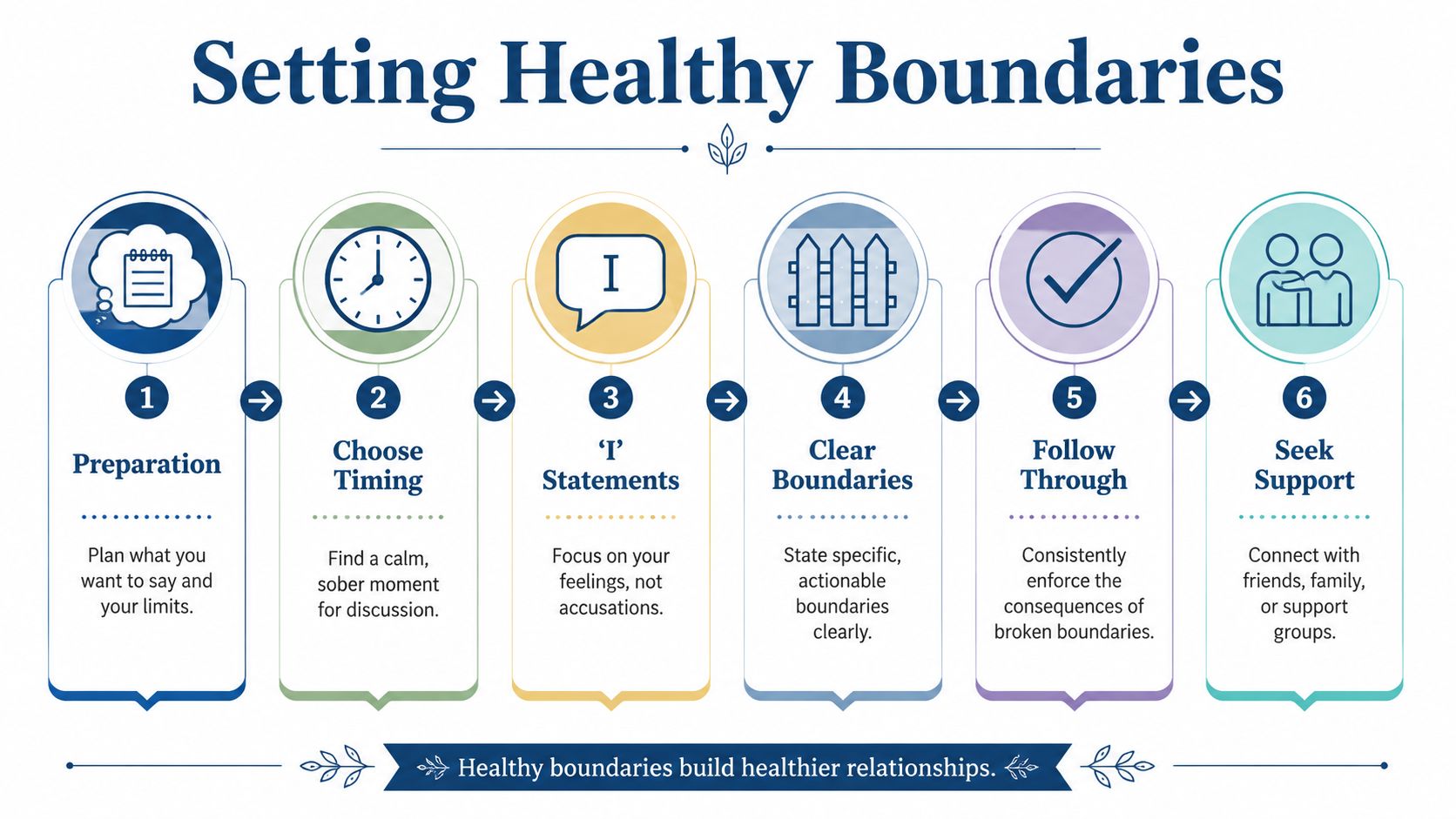
The most useful guidance is straightforward. Conversations should happen only when the spouse is sober, using nonjudgmental “I” statements such as “I'm scared when you come home drunk,” while clearly naming limits and avoiding arguments, according to guidance on dealing with an alcoholic spouse.
What works better than confrontation
A productive conversation doesn't sound like a courtroom argument. It sounds measured, specific, and grounded in reality.
Useful phrases include:
- “I'm scared when you drive after drinking.”
- “I won't cover for you with the kids when you're intoxicated.”
- “I'm willing to help you look at treatment options when you're ready.”
What usually backfires:
- “You always ruin everything.”
- “You care more about alcohol than your family.”
- “If you loved us, you'd stop.”
Those statements may feel true in the moment, but they usually trigger defensiveness, denial, or a counterattack. If emotional shutdown has become part of the relationship, some spouses find it helpful to understand the broader pattern of CheatScanX insights on emotional distance, especially when alcohol has intensified an already detached dynamic.
Boundaries that protect rather than punish
Boundaries aren't threats. They're statements about what the spouse will and won't participate in.
A healthy boundary is specific and enforceable:
- At home: No alcohol in shared spaces.
- At work: No calling an employer to explain missed shifts.
- With children: No unsupervised care while intoxicated.
- With money: No access to funds that are repeatedly used for drinking.
Practical rule: If a boundary depends on controlling the other person's behavior, it isn't a boundary yet. It's a wish.
Follow-through is the hard part
Many spouses set strong limits in a calm moment, then retreat when guilt, fear, or pressure hits. That's human. It's also why change stalls. If the spouse says, “If you come home intoxicated, you'll sleep separately tonight,” then that needs to happen.
Consistency teaches reality in a way arguments never do.
For anyone preparing for a treatment conversation, this guide on how to talk to a family member about rehab can help a spouse organize what to say before emotions take over. Preparation reduces rambling, mixed messages, and last-minute retreat.
A spouse doesn't need to be cold. They do need to be clear. The message is simple: there is care for the person, but there will no longer be cooperation with the addiction.
Guiding Them Toward Treatment Options in Orange County
Orange County families don't have to guess whether addiction is a local crisis. In Orange County alone, over 5,500 hospitalizations and 700 deaths related to substance abuse occur annually, highlighting the urgent local need for extensive addiction intervention, according to Orange County addiction statistics.
That local reality matters because many spouses wait too long, hoping the next argument, apology, or scare will be enough. Usually, it isn't. When alcohol use is disrupting safety, parenting, health, or daily functioning, professional treatment becomes the most effective next move.
Matching care to the level of need
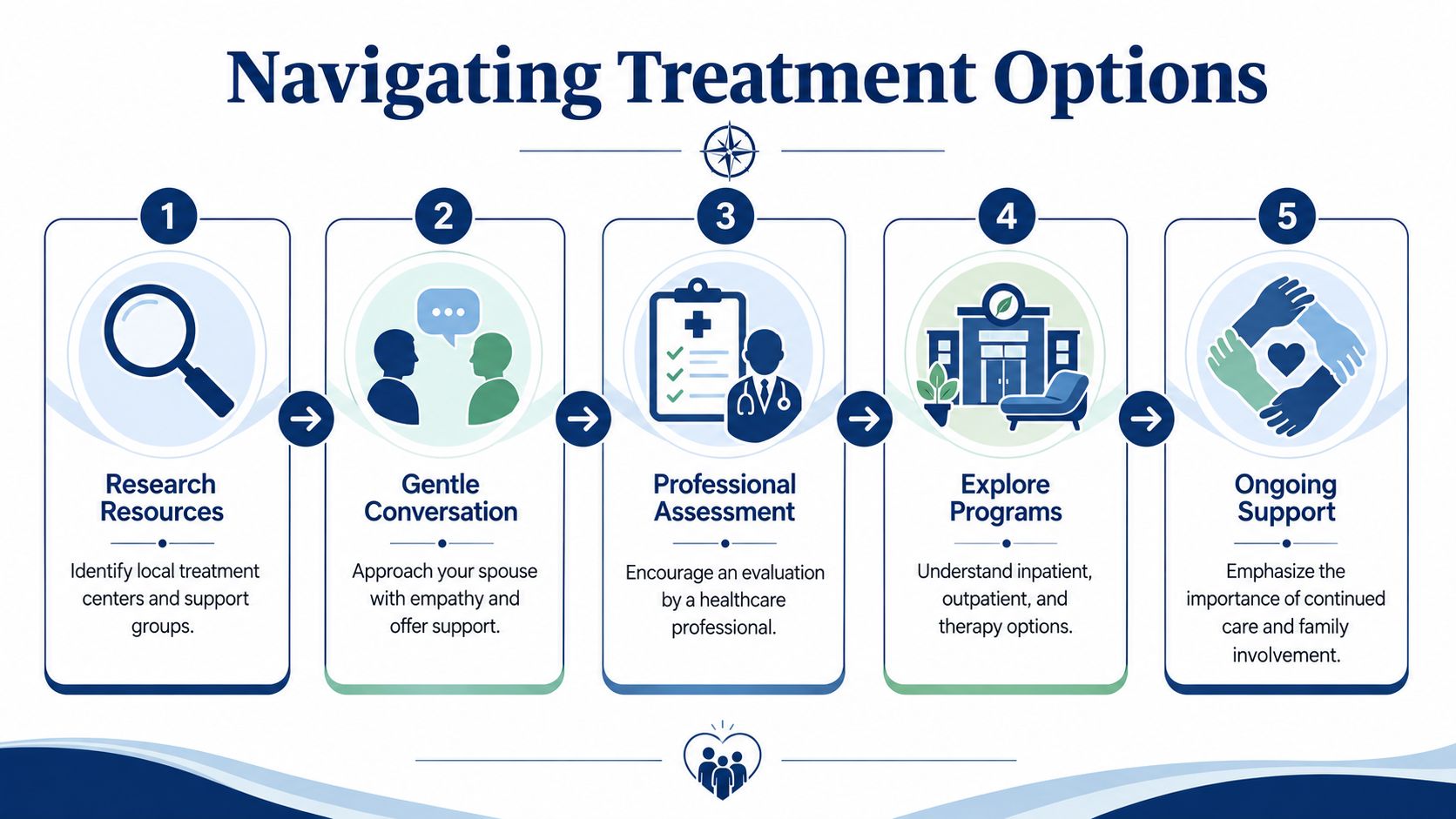
Treatment isn't one thing. It's a continuum, and the right starting point depends on how severe the drinking is, whether withdrawal is a concern, and whether mental health symptoms are part of the picture.
Here's how spouses in Orange County can think about the main options:
| Level of care | Best fit |
|---|---|
| Medical detox | For someone who may face unsafe withdrawal symptoms and needs medical monitoring while alcohol leaves the body. |
| Medication-assisted treatment | For someone who may benefit from medical support that helps reduce cravings or stabilize early recovery. |
| Residential treatment | For a spouse whose home environment is too unstable for early sobriety, or whose drinking is severe enough to require a structured setting. |
| Partial hospitalization program | For someone who needs intensive clinical care during the day but doesn't require the same level of overnight structure as residential treatment. |
| Intensive outpatient program | For someone who needs a strong treatment schedule while maintaining some work, family, or home responsibilities. |
| Sober living | For someone leaving a higher level of care who still needs accountability and a recovery-focused living environment. |
Don't ignore dual diagnosis needs
Some spouses focus only on the alcohol and miss the mental health side. Anxiety, depression, trauma, bipolar disorder, and other co-occurring conditions can keep relapse cycles going if they aren't treated alongside the drinking.
That's why dual diagnosis care matters. If the spouse drinks to blunt panic, numb trauma, or manage severe mood swings, treatment has to address both layers. Otherwise, the person may stop drinking briefly and still feel unbearable symptoms that push them back toward alcohol.
Treatment works best when it targets the drinking and the pain underneath it.
What admission usually looks like
For many families, the idea of “getting help” feels vague until someone explains the first few moves. In practice, the admissions path is often simple:
- A confidential call: A spouse or loved one describes what's happening, including drinking patterns, safety concerns, and whether the person may need detox.
- Insurance verification: Coverage is reviewed so the family understands available benefits before making decisions.
- Clinical screening: Staff determine which level of care fits the person's current condition.
- Scheduling: If the spouse agrees, admission can move quickly.
- Family guidance: Loved ones get practical direction on what to do next and what not to do while waiting.
Spouses who are also trying to protect the relationship while pursuing care may benefit from reading about why couples rehab in Orange County can help some partners heal together. It's not right for every situation, especially when safety is unstable, but it can be a useful option in the right clinical context.
For day-to-day limit setting during this stage, many families also benefit from this mental health guide on boundaries, especially when they need help separating support from rescue.
The clearest next step
When the spouse is open to help, delay creates risk. If there's uncertainty about detox, dual diagnosis care, residential treatment, PHP, or IOP in Orange County, the most practical move is to speak directly with an admissions team that can assess the situation in real time. Confidential guidance is available at (866) 450-0391.
Even if the drinking spouse is still ambivalent, the non-drinking spouse can call first. That conversation often gives the family enough structure to stop reacting and start moving.
Protecting Your Own Peace Through Self-Care and Support
When one person's drinking dominates the home, the other spouse often disappears into management mode. Meals become rushed. Sleep gets lighter. Friendships shrink. Medical appointments are postponed. Joy starts to feel irresponsible.
That pattern has to be interrupted. A spouse can't make steady decisions while running on fear, isolation, and exhaustion.

Self-care that actually helps
In this context, self-care isn't indulgence. It's stabilization. That means practical habits that reduce chaos and restore decision-making.
Helpful forms of support often include:
- Consistent therapy: A private place to process anger, grief, fear, and confusion without filtering.
- Protected routines: Regular sleep, meals, work structure, and movement that aren't dependent on the drinker's mood.
- Reconnection: Time with trusted people who talk about more than the addiction.
- Reduced monitoring: Less checking, searching, tracking, and trying to predict every drinking episode.
Support doesn't have to look old-fashioned
Traditional groups still help many people. Al-Anon and similar family recovery spaces can reduce shame, teach detachment, and help spouses stop centering every thought on the alcoholic partner.
At the same time, modern support options matter, especially for spouses whose partners deny there's a problem. A 2024 study published in PubMed found that spouses of alcoholics are an “underserved population,” with nearly 100 women benefiting significantly from an online support program that included narrated instruction and animated coping tools, specifically targeting those whose partners denied addiction, according to reporting on the online support study.
That matters because denial can freeze a household. The drinker refuses help. The spouse feels trapped. Digital support gives the non-drinking partner immediate tools without waiting for the alcoholic to cooperate.
Support for the spouse should begin before the drinker agrees to treatment, not after.
What peace can look like in real life
Peace doesn't always mean the marriage is fixed. Sometimes it means the spouse has stopped arguing at midnight. Sometimes it means separate finances, quieter mornings, stronger limits with children, and one honest friend who knows the full story.
Sometimes it means admitting that love has turned into survival.
For readers who feel guilty about shifting attention back to themselves, this reflection on loving an addict without losing yourself can help reframe care, grief, and self-protection more clearly. A spouse is allowed to heal even while the other person remains unstable.
The goal isn't to become emotionally numb. It's to become less emotionally hostage to someone else's drinking.
Common Questions About Living With an Alcoholic Spouse
Some questions come up again and again because spouses are trying to make decisions in the middle of uncertainty. The answers need to be direct.
What if the spouse refuses treatment
A spouse can invite treatment, research programs, and state consequences. They can't force willingness. If the person keeps refusing help, the focus has to return to safety, children, finances, and emotional health.
What helps most is reducing debate and increasing reality. That may mean no longer hiding the problem, no longer rescuing, and no longer shielding the drinker from consequences. If the refusal comes with aggression or intimidation, the spouse should treat that as a safety issue, not just a relationship problem.
Is there any treatment approach with strong evidence behind it
Yes. Evidence-based data indicates that Alcoholics Anonymous is the most effective intervention for achieving sustained alcohol abstinence, outperforming other treatments and no intervention in multiple studies, according to Stanford Medicine reporting on AA outcomes.
That doesn't mean every person will embrace it immediately. It does mean spouses should take aftercare seriously. If the drinker enters treatment, continuing support matters. Recovery usually needs structure beyond the first admission.
What should the spouse protect first
In most households, the priority order is straightforward:
- Physical safety: No waiting for “proof” if behavior is becoming volatile.
- Children's stability: Keep routines as predictable and calm as possible.
- Money: Separate access where needed. Don't co-sign, cover debts tied to drinking, or absorb financial fallout in silence.
- Mental health: Get personal support early instead of waiting for a crisis.
How should relapse be understood
Relapse is common in alcohol recovery, especially early on. Research indicates that approximately 65% to 70% of individuals who attempt to quit drinking alcohol relapse within the first year, with the majority of relapses happening within the first 3 months of sobriety, according to reporting on alcohol relapse patterns.
That statistic should create realism, not hopelessness. Early recovery often needs close support, strong structure, and quick re-engagement when warning signs appear.
There's also reason for hope. According to the National Institute on Alcohol Abuse and Alcoholism, up to 60% of individuals who complete treatment remain abstinent for at least one year, particularly when they continue participation in support groups like Alcoholics Anonymous or structured outpatient aftercare, according to reporting on treatment abstinence outcomes.
When is it time to stop waiting
It's time when the spouse keeps moving the line to avoid conflict. It's time when children are adapting to chaos. It's time when finances are at risk. It's time when the home no longer feels emotionally or physically safe.
Waiting feels easier in the short term. Action is what changes the trajectory.
Still Water Wellness Group offers compassionate, confidential addiction treatment for individuals and families in Orange County who need a real plan. From detox and dual diagnosis care to residential treatment, PHP, IOP, and sober living, the team helps families move from crisis toward stability with personalized support. To explore treatment options, verify insurance, or speak with admissions at any hour, contact Still Water Wellness Group or call (866) 450-0391.