The search often starts the same way. Someone took LSD, expected the trip to end, and then noticed that something still feels off the next day. Thoughts may feel scattered. Sleep may be poor. A normal room can feel strange, or anxiety can seem much bigger than it should.
That experience can be unsettling, especially when the phrase LSD withdrawal symptoms shows up in search results and makes the situation sound more dangerous or mysterious than it is. Many people aren't dealing with a classic medical detox crisis. They're dealing with psychological aftereffects that feel real, uncomfortable, and confusing.
A calm explanation helps. So does knowing when simple support is enough and when a deeper mental health evaluation makes sense.
Feeling Off After LSD? You're Not Alone
A common situation looks like this. A person uses LSD on a weekend, expects to feel normal by the next morning, and instead wakes up uneasy. The visuals are gone, but there's still a sense of mental overstimulation. Small worries feel large. Sleep is uneven. A conversation that would usually feel easy now feels hard to follow.
For some people, that unsettled feeling passes quickly. For others, the problem isn't dramatic but it lingers long enough to become scary. They may wonder whether they're “withdrawing,” losing control, or developing a permanent mental health problem.
That confusion makes sense. The word withdrawal usually brings to mind intense physical symptoms and medical danger. LSD doesn't fit neatly into that picture, which is why online information often feels contradictory. One source says there's no withdrawal. Another describes anxiety, depression, confusion, and flashbacks after use. Both ideas can be true when the difference between physical withdrawal and psychological aftereffects is understood.
What matters most is this. Feeling shaken after LSD doesn't mean the person is weak, broken, or beyond help. It means the brain and nervous system may need time, stability, and sometimes professional support to settle.
Important reminder: Distress after LSD should be taken seriously, even when it doesn't match the kind of withdrawal people associate with alcohol or opioids.
That distinction can lower panic. It can also make the next step clearer for people in Southern California who are trying to decide whether rest, outpatient support, or a higher level of care makes the most sense.
Deconstructing LSD Withdrawal The Mind and Body After Use
Many readers search for LSD withdrawal symptoms because they feel bad after stopping use and need a name for what's happening. The term is understandable, but clinically it can be misleading.
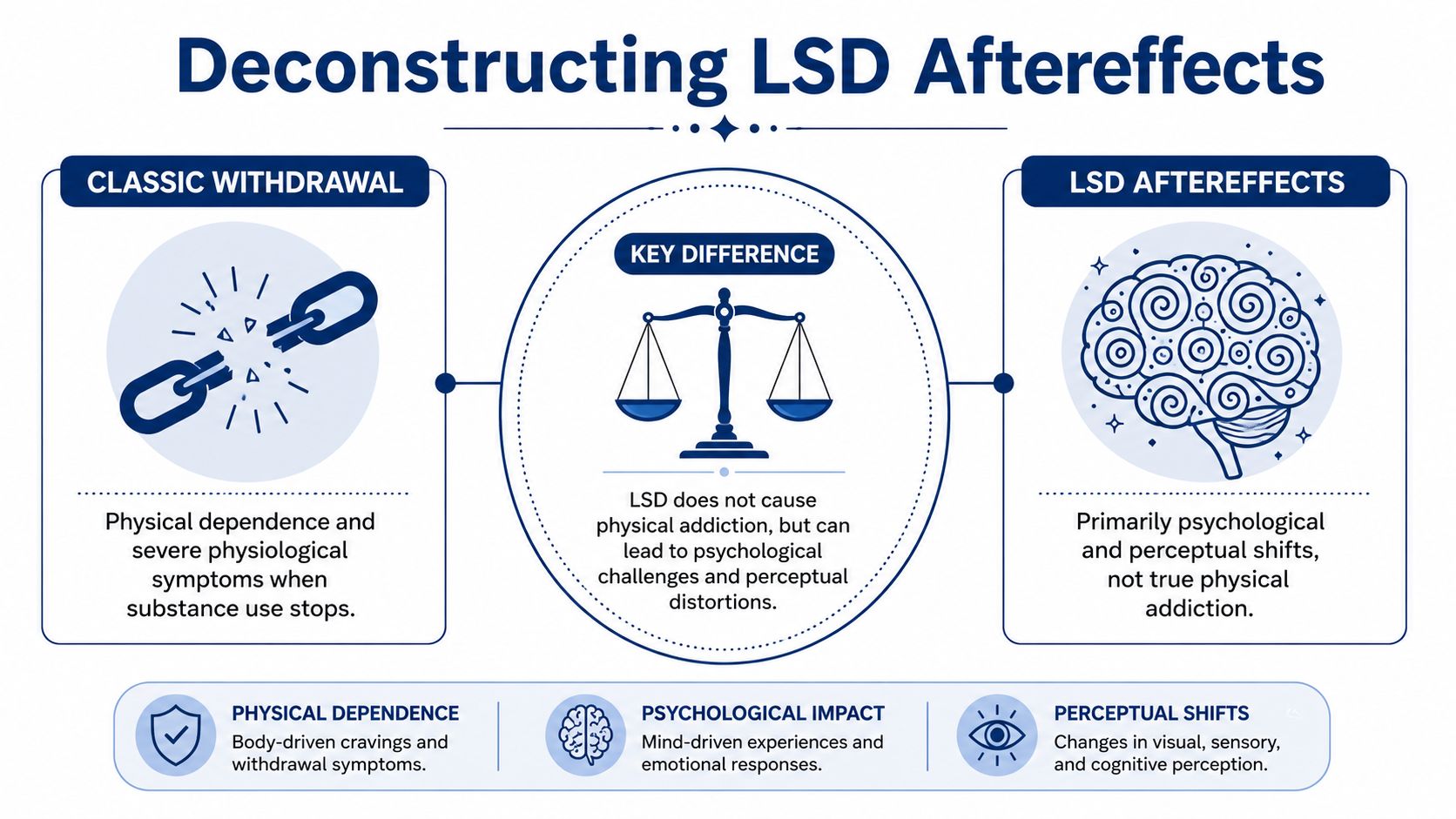
According to the DSM-based federal reference compiled by NCBI, LSD is not considered to produce a clinically recognized physical withdrawal syndrome, and the listed withdrawal symptoms are “Unknown.” That same reference notes that aftereffects are mainly psychological, including anxiety, depression, and confusion, especially after repeated use, and that there are no FDA-approved medications for addiction to LSD or other hallucinogens (NCBI reference on hallucinogen withdrawal findings).
Why people call it withdrawal anyway
The easiest way to understand it is to compare two very different problems.
One problem is like a broken bone. The body has a clear physical injury pattern, and clinicians know what signs to expect. That's closer to classic withdrawal from substances that cause physical dependence.
The other problem is more like recovering after a mentally and emotionally overwhelming event. The person may feel exhausted, raw, overstimulated, or disoriented, even though there isn't a classic physical withdrawal syndrome taking place. That's closer to what happens after LSD for some people.
What this means in practical terms
A person may still feel:
- Anxious or keyed up after the drug's main effects have ended
- Low, irritable, or emotionally flat
- Confused or mentally foggy
- Troubled by sleep disruption
- Shaken by flashbacks or unusual perceptual experiences
Those symptoms are real. They deserve attention. They just usually aren't part of a medically dangerous physical detox pattern.
A useful comparison can help. Readers who've seen how severe physical withdrawal can look in other substances may notice the difference by reviewing opioid withdrawal symptoms and what classic detox can involve. LSD aftereffects can be very distressing, but the clinical picture is different.
The absence of a classic physical withdrawal syndrome doesn't mean the person is fine. It means the main concern is psychological stability, not a standard detox emergency.
That distinction matters because it changes what good care looks like. The focus is usually on supportive monitoring, a calm environment, and screening for panic, depression, psychosis-like symptoms, or other mental health concerns.
Common and Atypical Symptoms of LSD Aftereffects
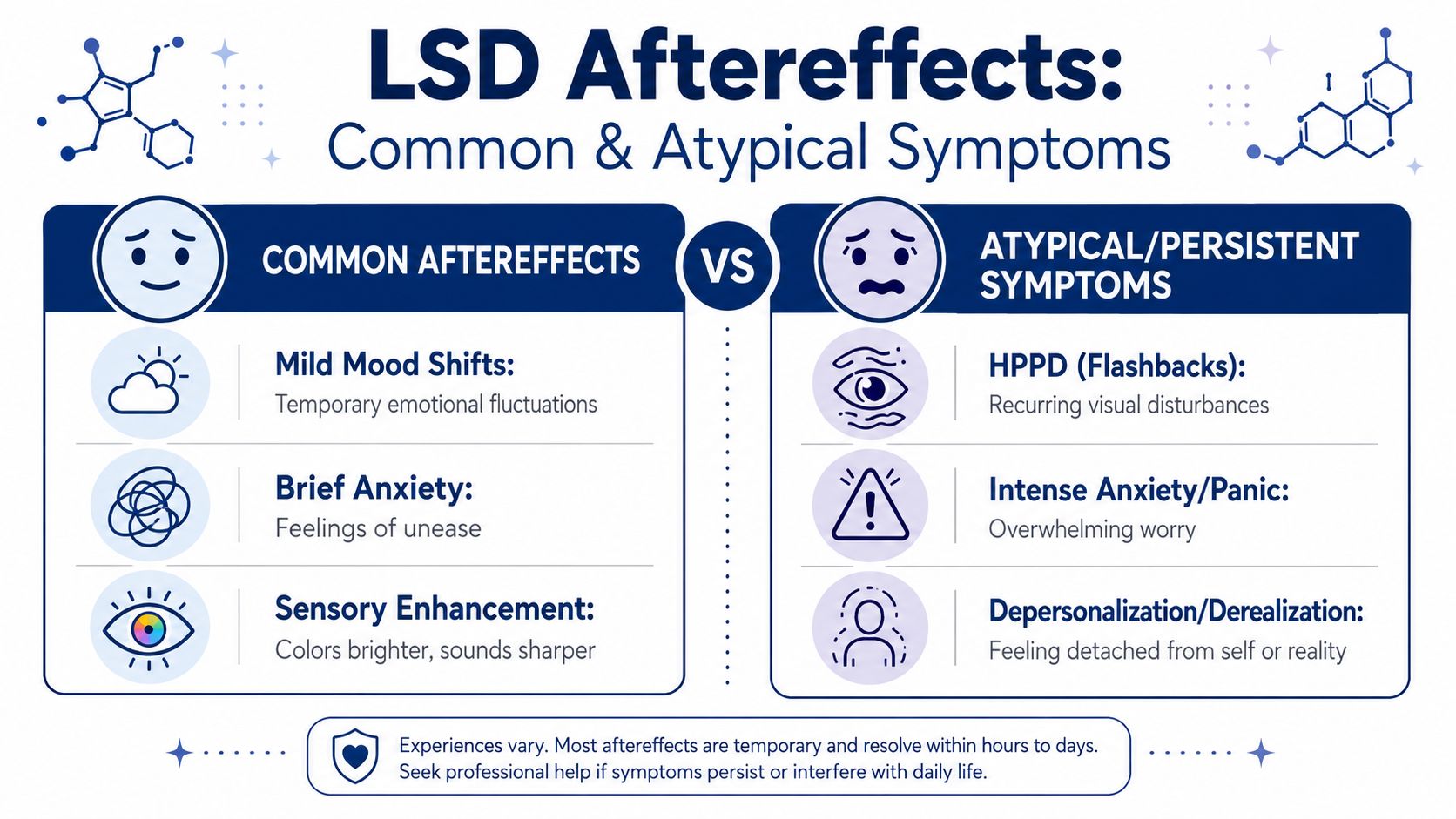
When people talk about LSD withdrawal symptoms, they're usually describing a cluster of psychological and perceptual aftereffects. Treatment literature repeatedly describes anxiety, depressed mood, irritability, insomnia, and impaired concentration as the most clinically relevant post-use problems.
These symptoms can emerge within hours to days after last use and may last several days to weeks, according to a treatment overview on LSD withdrawal symptoms and timeline.
Common aftereffects
These are the symptoms many people mean when they say they feel “off” after LSD:
- Anxiety: The person may feel restless, tense, overly alert, or unusually sensitive to stress.
- Depressed mood: A flat or sad emotional state can show up after use, especially when the experience was overwhelming.
- Irritability: Small frustrations may feel much harder to tolerate.
- Insomnia: Falling asleep may be difficult, or sleep may feel light and broken.
- Impaired concentration: Reading, working, or following a conversation can feel harder than usual.
- Confusion: Thoughts may feel jumbled, slowed down, or hard to organize.
These symptoms can be mild and short-lived. They can also be strong enough to interfere with work, parenting, school, or relationships for a period of time.
Less common but more concerning signs
Some experiences call for more attention because they may reflect a more significant mental health issue:
- Persistent visual disturbances or flashbacks: Visual changes that continue after the main drug effects have ended can be frightening.
- Depersonalization or derealization: The person may feel detached from self, surroundings, or reality. For readers trying to stop derealisation, grounding-focused education can be a useful starting point alongside professional evaluation.
- Panic-like reactions: Fear can rise quickly and feel physically overwhelming.
- Paranoia: Ordinary situations may feel threatening or loaded with hidden meaning.
- Deepening depression: Low mood that becomes heavier instead of improving deserves prompt attention.
A simple way to think about severity
| Symptom pattern | What it often feels like | What it may suggest |
|---|---|---|
| Mild and improving | Uneasy, tired, emotionally sensitive | Short-term aftereffects |
| Lingering and disruptive | Ongoing sleep, mood, or focus problems | Need for closer assessment |
| Intense or reality-altering | Severe paranoia, major perceptual distortion, suicidality | Urgent professional evaluation |
When symptoms start to affect safety, reality testing, or the ability to function, it's no longer helpful to argue about labels. The person needs care.
The Timeline How Long Do LSD Aftereffects Last
The typical question after a difficult experience is simple. How long is this going to last?
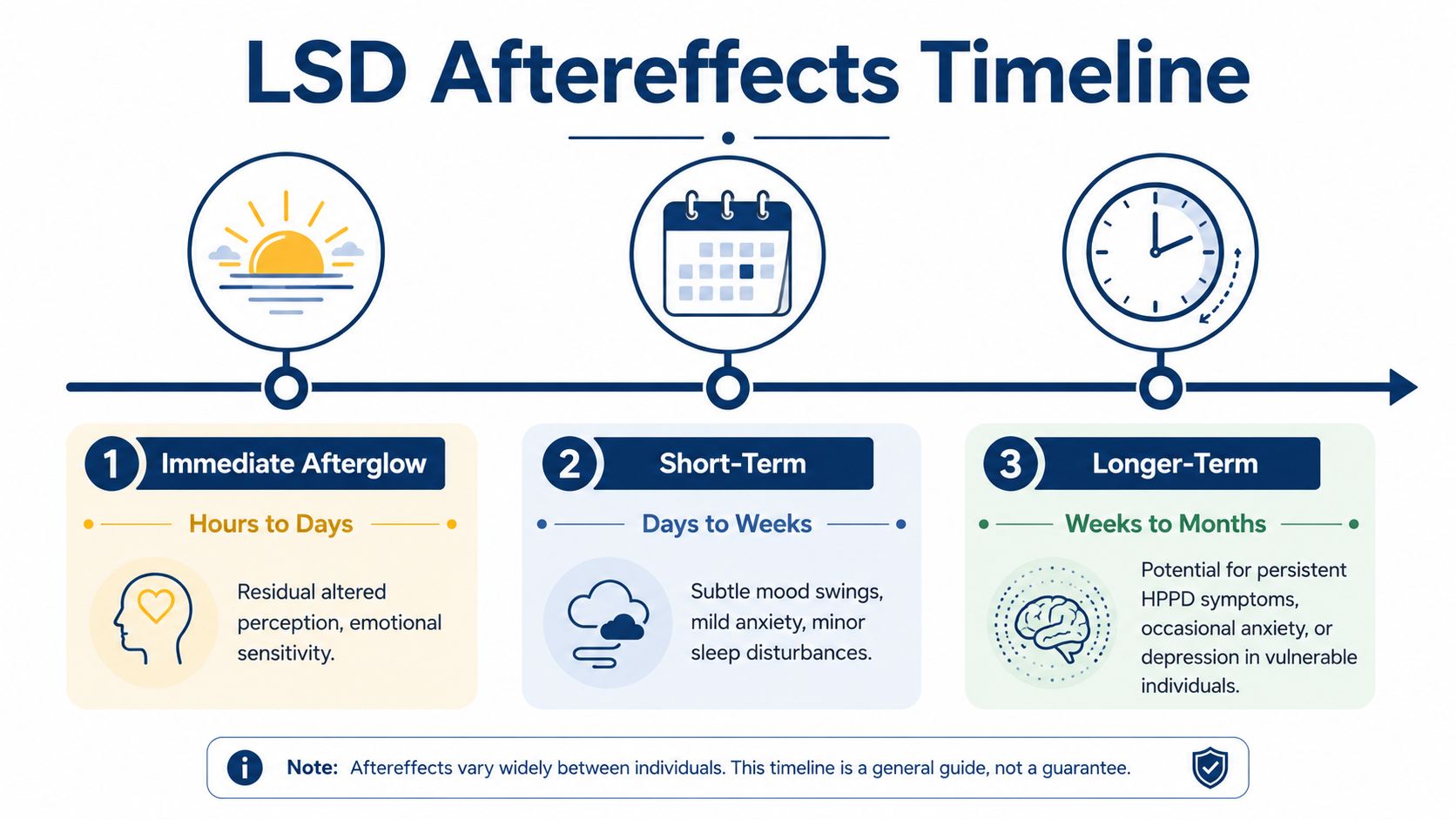
The best available timeline data suggests that many people have no withdrawal symptoms at all, and for those who do experience post-LSD problems, the pattern is usually short and variable rather than medically dangerous. One treatment source describes symptoms starting on day 1, worsening on day 2, peaking on day 3, starting to ease on day 4, with broader recovery often underway by week 2.
A rough recovery pattern
Some readers find it helpful to think in stages rather than exact deadlines.
Day 1
The person may notice anxiety, emotional sensitivity, poor sleep, or a sense of mental “static.”
Day 2 to Day 3
This is often the hardest stretch in the pattern described above. Mood swings, confusion, and distress can feel more obvious.
Day 4 and after
For many people who have symptoms, the intensity starts to ease.
By week 2
A broader return toward baseline is often underway, even if concentration or mood still isn't perfect.
Why the timeline varies
Two people can have very different recoveries after what looks like a similar experience. The difference may come from:
- How often LSD was used
- How much was taken
- Whether the person already struggles with anxiety or depression
- How stable the sleep, stress, and home environment are afterward
Some people need only reassurance and a quiet reset. Others keep feeling foggy, tense, or emotionally off for longer than expected.
Practical rule: If symptoms are gradually improving, that's reassuring. If they're staying intense, getting stranger, or lasting beyond the expected early window, a clinical assessment makes sense.
A timeline can offer hope, but it shouldn't be used to dismiss someone who still feels unwell. Lingering symptoms can mean more than “withdrawal.” They can point toward a co-occurring mental health condition or a post-use perceptual problem that needs proper evaluation.
Risk Factors When to Be Concerned About LSD Use
Not everyone faces the same level of risk after stopping LSD. The people most likely to have prolonged or severe symptoms are those with repeated or high-dose use and those with co-occurring mental illness. When concentration problems or depression last for weeks, treatment sources note that a deeper assessment may be needed rather than passively waiting for the problem to pass, and that residential or dual-diagnosis care can be critical in those cases.

Who may need a closer look
A more careful evaluation is wise when any of the following are true:
- Repeated use: The person has used LSD often enough that recovery no longer feels straightforward.
- High-dose use: The experience was unusually intense and the aftermath feels hard to shake.
- Existing anxiety or depression: LSD may worsen symptoms that were already present.
- History of severe mental health symptoms: Panic, paranoia, or psychosis-like experiences deserve caution.
- Symptoms that last for weeks: Lingering concentration problems, depression, or unusual perception changes need more than reassurance.
When concern should become action
Many people get stuck here because they're waiting for certainty. They tell themselves it's probably just stress, poor sleep, or a bad weekend. Sometimes that's true. Sometimes the bigger issue is that LSD use has uncovered a mental health problem that was already developing beneath the surface.
A few signs make waiting less appropriate:
| Concern | Why it matters |
|---|---|
| Suicidal thinking | Safety becomes the first priority |
| Severe paranoia | The person may not be interpreting reality clearly |
| Marked perceptual distortion | Persistent visual or sensory disturbance needs assessment |
| Depression that deepens | Mood symptoms may not resolve on their own |
| Ongoing inability to function | Work, school, or family life may be breaking down |
Dual-diagnosis care becomes especially important in such cases. If a person is dealing with substance use and anxiety, depression, trauma, or another mental health condition at the same time, treating only one piece rarely solves the whole problem.
Finding Relief Evidence-Based Care for Lasting Recovery
When LSD aftereffects don't resolve quickly, support works best when it addresses both substance use and mental health. That's why treatment often focuses less on a “detox cure” and more on stabilization, therapy, and a careful look at what the drug use may have uncovered or intensified.
The most useful question isn't “How can this be forced out of the body faster?” It's “What will help the mind settle, sleep return, and fear become manageable again?”

What effective care usually includes
A strong treatment plan often combines several elements:
- Psychiatric assessment: This helps determine whether the person is experiencing temporary aftereffects, a panic pattern, depression, a psychosis-like episode, or persistent perceptual symptoms.
- Individual therapy: Structured counseling can reduce fear, organize thinking, and help the person process what happened.
- Cognitive and behavioral strategies: These can help with catastrophic thoughts, avoidance, sleep disruption, and panic sensitivity.
- Dual-diagnosis treatment: If LSD use overlaps with anxiety, trauma, depression, or bipolar symptoms, both problems need attention.
- A calm, structured setting: Some people improve faster when they're removed from triggers, chaos, and isolation.
For readers comparing support options in different regions, resources such as Penticton counselling can also illustrate what therapy-centered mental health care looks like when emotional instability is the main concern.
Why supportive monitoring matters
LSD doesn't have a standard medication-based detox pathway like some other substances. That means treatment teams often focus on observation, safety, emotional regulation, and level-of-care decisions. A person with mild symptoms may do well in outpatient care. A person with suicidality, severe paranoia, or major functional decline may need residential or psychiatric support.
Readers exploring higher-acuity addiction services can review how medical detox fits into a broader treatment continuum, even though LSD itself usually doesn't produce the same physical detox pattern seen in alcohol or opioids.
A person doesn't need to “prove” classic withdrawal to deserve treatment. Ongoing fear, depression, insomnia, confusion, and perceptual changes are enough reason to seek help.
The role of whole-person care
Therapy often works better when it's paired with habits and practices that help the nervous system settle. A consistent sleep routine, reduced stimulation, gentle movement, mindfulness, and supportive daily structure can make a meaningful difference while deeper issues are being addressed.
In Orange County, many people also benefit from being treated in a quieter setting away from social pressure, overstimulation, and easy access to substances. That environment can support recovery from both the aftereffects of LSD use and the anxiety or depression that may be fueling ongoing distress.
Your Next Step to Feeling Better in Orange County
The most helpful takeaway is simple. LSD withdrawal symptoms usually don't mean a classic physical detox emergency. But the aftereffects can still be painful, disruptive, and serious enough to need professional care.
That matters for two reasons. First, it can reduce unnecessary panic. Second, it can help families and individuals focus on the right problem. If someone is dealing with anxiety, depression, insomnia, confusion, derealization, flashbacks, or fear that isn't lifting, the actual need may be psychiatric support and dual-diagnosis treatment rather than just “waiting it out.”
A practical next step
If the person is safe and symptoms are mild, it may help to reduce stimulation, prioritize sleep, stay around trusted people, and monitor whether things are clearly improving.
If symptoms are intense, prolonged, or affecting safety, the next step should be more direct:
- Get evaluated quickly if there's suicidality, severe paranoia, or marked perceptual disturbance.
- Look for dual-diagnosis support when mood or anxiety symptoms were present before LSD use or seem worse after it.
- Choose a setting that matches severity, whether that's outpatient, PHP, residential, or another structured level of care.
Some readers also look for ways to support sleep and physical calm while they seek help. General wellness education, such as this overview of the benefits of magnesium glycinate taurate, may be of interest, but supplements aren't a substitute for evaluation when symptoms are severe or persistent.
Orange County residents who are weighing treatment options can also explore drug rehab centers in Orange County to understand what levels of support are available locally.
A person in Irvine may need the same thing as someone in Huntington Beach, Costa Mesa, Mission Viejo, or Lake Forest. A calm assessment. A confidential conversation. A plan that fits the actual symptoms instead of a label that doesn't quite fit.
If help is needed now, confidential admissions support is available at (866) 450-0391.
Still Water Wellness Group offers compassionate, confidential addiction and dual-diagnosis treatment in Lake Forest for adults and families across Orange County. From detox and residential care to PHP, IOP, and aftercare planning, the team helps people stabilize, understand what's driving their symptoms, and build a path toward lasting recovery. To learn more or speak with admissions any time, visit Still Water Wellness Group.