A family often reaches this decision after months, sometimes years, of fear, bargaining, and false starts. One night the phone rings, someone is intoxicated again, or withdrawal is getting worse, or depression has become impossible to ignore. The search begins with one urgent question: should treatment start with inpatient care or outpatient care?
That question matters, but it's not the whole decision.
The better question is this: what level of care gives this person the safest start and the strongest path forward? In most serious cases, the right answer isn't choosing one model forever. It's choosing the right starting point, then moving through the right continuum of care.
Making the First Most Important Decision in Recovery
A spouse may be looking at someone who swears they can stop on their own. A parent may be searching from a parking lot after another frightening call. An adult struggling with addiction may be trying to hold onto work, family, and dignity while life keeps narrowing. In that moment, “inpatient vs outpatient rehab” feels like a test with only one correct answer.
It isn't.

What families usually need first isn't jargon. They need clarity. They need to know whether the person they love can safely stay at home, whether detox is necessary, whether anxiety or depression is driving the substance use, and whether “flexibility” is just another way to stay close to triggers.
The first treatment decision should protect life, stabilize the crisis, and create enough structure for real change to begin.
That's why this choice has to be grounded in reality, not wishful thinking. If someone is dealing with severe alcohol or drug use, repeated relapse, unstable mental health, or a home environment full of conflict or access to substances, outpatient care may sound easier but can fail quickly. If symptoms are milder, home support is strong, and the person can consistently follow through, outpatient may be appropriate.
What families are really deciding
This isn't just about where someone sleeps. It's about four practical questions:
- Safety: Is medical supervision needed for withdrawal, cravings, or psychiatric instability?
- Structure: Can this person recover while living in the same environment where the problem keeps happening?
- Support: Is there healthy accountability at home, or constant pressure and chaos?
- Stamina: Does this person need a full reset first, then a step-down plan afterward?
Families don't need a perfect answer on day one. They need the next right level of care. That's the decision that opens the door to recovery.
Defining the Two Main Paths to Healing
The cleanest way to understand inpatient vs outpatient rehab is to stop thinking in labels and start thinking in lived experience.
What inpatient rehab actually means
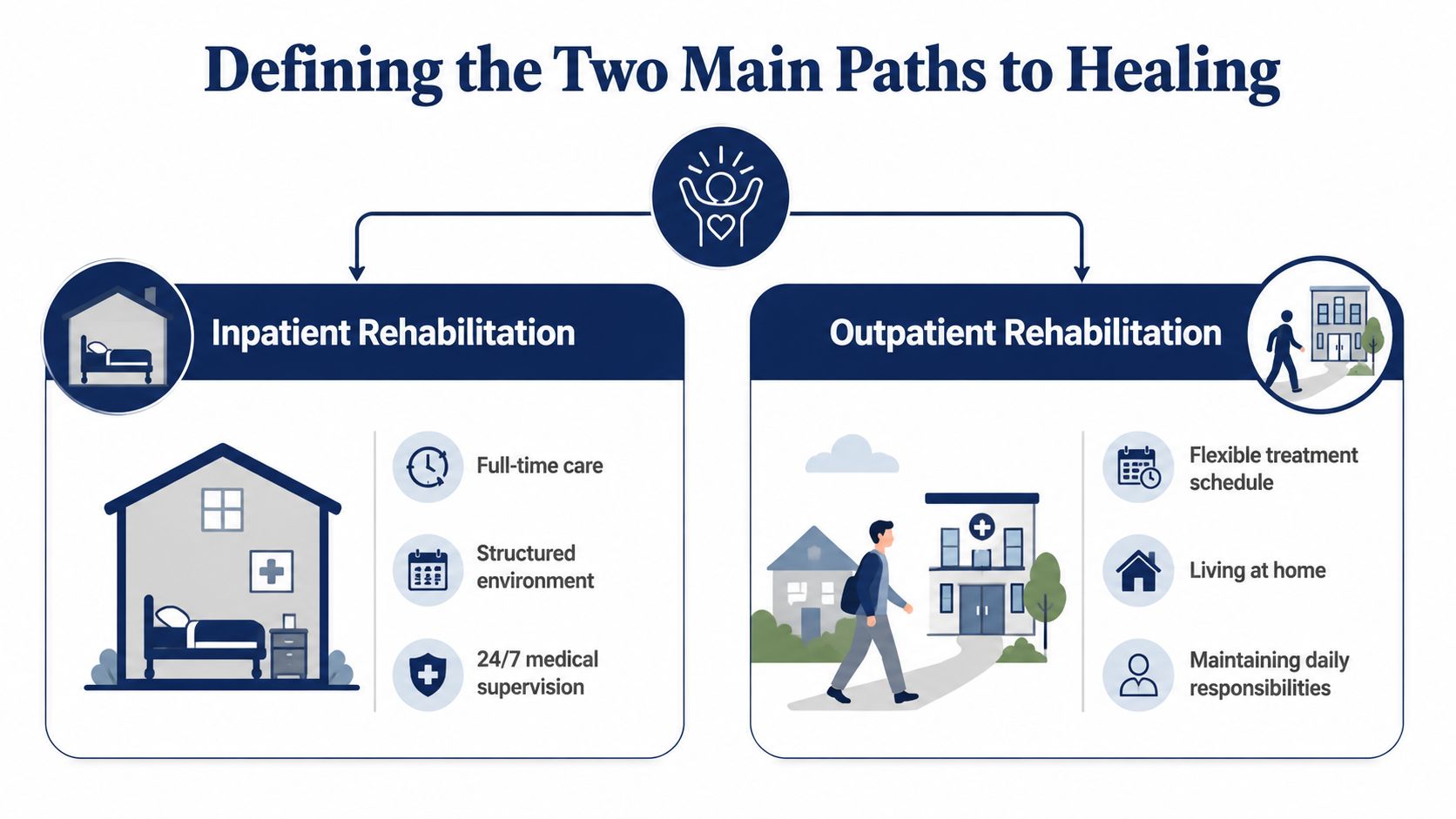
Inpatient rehab, also called residential treatment, means the person lives on site and receives full-time support in a structured setting. That structure matters. According to an NCBI overview of treatment settings and outcomes, inpatient rehabilitation programs demonstrate significantly higher treatment completion rates than outpatient programs, with one evidence-based study finding that inpatients are three times more likely to complete treatment.
That doesn't happen by accident. Inpatient care removes access to the daily triggers, routines, and relationships that often keep addiction going. It places recovery at the center of the day. The person isn't trying to get sober between work stress, relationship conflict, and easy access to alcohol or drugs.
A typical inpatient setting also makes room for deeper clinical work. If depression, trauma, anxiety, or emotional dysregulation are feeding the substance use, healing has to go beyond detox and abstinence. Families looking at broader mental health care may also benefit from reading about addressing root causes of depression naturally because co-occurring symptoms rarely improve through willpower alone.
What outpatient rehab actually means
Outpatient rehab means the person lives at home and attends treatment on a scheduled basis. That can include PHP and IOP, which offer more support than standard weekly counseling. Outpatient care can work well when the person is medically stable, motivated, and living in an environment that supports recovery instead of sabotaging it.
It also allows daily responsibilities to continue. That's the main appeal. But it's also the main challenge. Recovery skills must be practiced in the same environment where the substance use developed.
Why the continuum matters more than the label
The strongest treatment planning doesn't treat inpatient and outpatient as rivals. It treats them as stages.
A modern recovery path often looks like this:
- Detox when withdrawal or medical stabilization is needed
- Residential treatment for immersive support
- PHP for high structure during re-entry
- IOP for continued therapy and accountability
- Sober living or aftercare for longer-term stability
Practical rule: The right question isn't “inpatient or outpatient?” It's “what level of care is appropriate now, and what should come next?”
For readers who want a clearer picture of what residential care includes, this overview of inpatient treatment options can help put the level of support into practical terms.
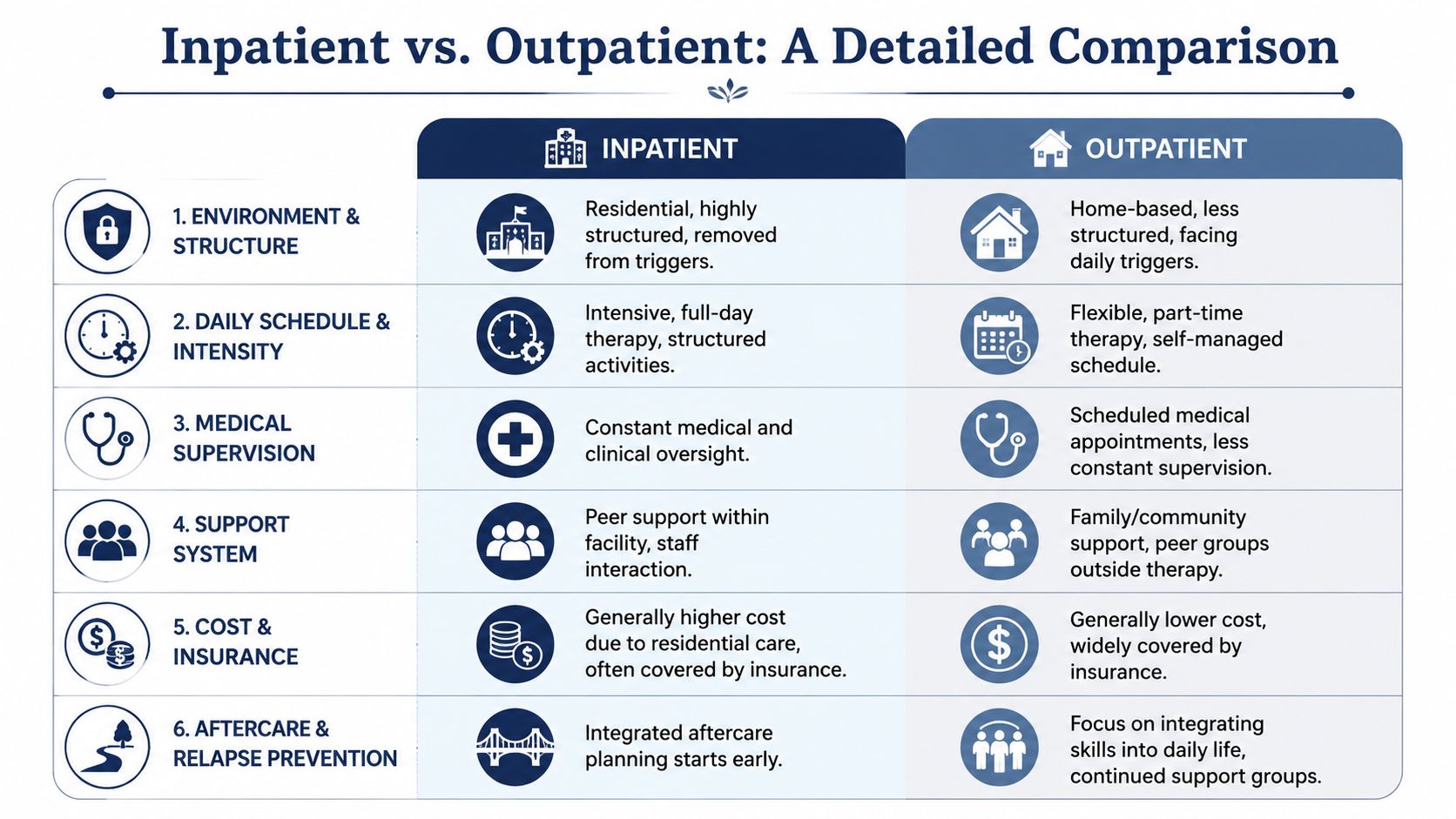
Inpatient vs Outpatient A Detailed Comparison
Families often need a direct side-by-side view before they can make a decision under pressure. The differences become clearer when they're tied to real life, not marketing language.
| Feature | Inpatient Rehab (Residential) | Outpatient Rehab (PHP/IOP) |
|---|---|---|
| Living arrangement | Lives on site in a structured treatment setting | Lives at home and attends scheduled treatment |
| Environment | Removed from daily triggers and access to substances | Remains in regular home, work, and social environment |
| Daily rhythm | Recovery-focused routine throughout the day | Treatment is part of the week, not the whole day |
| Clinical support | Continuous oversight and immediate staff response | Scheduled sessions and check-ins |
| Best fit | Higher-acuity cases, unstable symptoms, unsafe home settings | Stable cases with reliable support and follow-through |
| Major strength | Immersion and protection during early recovery | Flexibility and real-world integration |
| Main risk | Higher disruption to work and daily logistics | Greater exposure to triggers and inconsistency |
Environment and structure
Inpatient care creates a contained environment. Meals, groups, therapy, rest, peer interaction, and recovery work happen inside one coordinated setting. That matters for people whose home life is chaotic, whose social circle still uses substances, or whose cravings become overwhelming when left alone.
Outpatient care asks the person to leave treatment and return to ordinary life each day. That can be useful when the home is stable and accountability is strong. It can also become a loophole when the environment is full of pressure, secrecy, and easy relapse.
A flexible schedule helps only when the person is stable enough to use that freedom well.
Daily schedule and intensity
Inpatient treatment typically fills the day with therapeutic structure. There is less idle time, fewer opportunities to disappear, and more chances for staff to notice when someone is struggling before a lapse turns into a full relapse.
Outpatient programs vary. PHP is more intensive than IOP, and both can be valuable. Still, the person must manage transportation, sleep, family conflict, work stress, and exposure to old patterns while trying to build new ones.
Medical and clinical support
Many families underestimate risk. If a person is withdrawing, unstable, suicidal, severely depressed, or cycling through intense cravings, more support is not a luxury. It's basic safety.
Inpatient care offers immediate access to a treatment team throughout the day. Outpatient care can absolutely provide strong therapy, but it does not give the same around-the-clock containment.
Peer community and accountability
Residential treatment surrounds people with peers who are also doing the work. That daily proximity can reduce isolation and shame fast. Someone who has spent years hiding addiction may finally talk openly once the secrecy breaks.
Outpatient support is real, but less immersive. The person gets treatment contact, then returns to whatever waits at home.
The practical bottom line
- Choose inpatient first when substance use is severe, relapse keeps happening, withdrawal may be risky, or mental health symptoms are complicating everything.
- Choose outpatient first when the person is stable, the home is supportive, and treatment can be followed consistently without constant supervision.
- Use both when possible because the strongest recovery plans often begin with more structure and gradually step down.
Matching Your Needs to the Right Program
The wrong level of care wastes precious time. The right level creates traction quickly.

A useful way to decide is to stop asking what sounds easiest and ask what the situation requires. That's especially important because benchmark data summarized by The Plymouth House on inpatient versus outpatient effectiveness reports inpatient completion ratios of 64.5% to 85%, versus 35% to 55% for outpatient programs, and notes that residential treatment clients are more than three times as likely to complete treatment.
Signs that inpatient is the better starting point
Some indicators should push the decision firmly toward residential care:
- Withdrawal risk is present: If stopping alcohol, opioids, or other substances may trigger dangerous symptoms, starting at home is risky.
- Relapse has become a pattern: A person who keeps returning to use after promises, brief abstinence, or prior treatment usually needs more containment.
- Mental health symptoms are active: Depression, anxiety, trauma, bipolar symptoms, or other co-occurring conditions can destabilize recovery fast.
- Home isn't safe for healing: If the household includes substance use, conflict, enabling, or constant stress, outpatient may place recovery in the same conditions that helped break it.
When outpatient may be appropriate
Outpatient care can be a strong fit when the person is medically stable, willing to participate, and supported by a home environment that reinforces treatment. It also works well as a next phase after residential care, when the person is ready to practice recovery skills in daily life without losing clinical support.
That distinction matters. “Can live at home” is not the same as “should live at home.”
Clinical reality: Convenience should never outrank safety, psychiatric stability, or relapse history.
A simple self-check for families
If several of these are true, a higher level of care usually makes more sense:
- Substance use has escalated in frequency or consequences.
- Prior attempts to quit haven't held.
- The person lies, isolates, or disappears during use.
- Mood symptoms worsen when substances are reduced.
- The home environment includes easy access to drugs or alcohol.
Families trying to understand how different programs fit together can review the full levels of care in addiction treatment. That often makes the decision feel less like a leap and more like a sequence.
Understanding the Costs and Navigating Insurance
Cost stops many families before treatment even starts. That's understandable. It also leads people to choose the cheaper option before asking whether it's the right clinical option.
Why inpatient costs more
Residential treatment costs more because it includes more. Housing, meals, around-the-clock staffing, intensive therapy, medical oversight, and a fully structured environment all raise the price. A summary from The Recovery Village on inpatient and outpatient rehab costs and structure reports that inpatient programs can range from $2,000 to $40,000 per month, while outpatient costs are often under $1,000 total.
That price gap is real. So is the difference in what each setting is built to handle.
Why sticker price can mislead families
A lower upfront cost can still become the more expensive choice if the level of care is too low, the person drops out, or the cycle of relapse continues. The cheapest program isn't the best value if it doesn't stabilize the problem.
In California, insurance has become a bigger part of the conversation. According to Rehab Select's discussion of parity and coverage trends, California's MHPAEA enhancements mandate equal coverage for substance use disorder residential care versus outpatient care, and 78% of major plans now verify 30 to 90 day inpatient stays for Orange County residents, up from 52% in 2023. The same source notes that outpatient saves 40% to 60% upfront, but inpatient can prevent major long-term relapse-related costs.
What families should do before ruling treatment out
A better process looks like this:
- Verify benefits first: Many families assume rehab is unaffordable before checking actual coverage.
- Ask about the full continuum: Insurance may cover multiple stages, not just one.
- Focus on medical necessity: The clinical picture often determines what level of care is authorized.
- Plan beyond admission: Treatment works better when detox, residential, outpatient, and aftercare are viewed together.
For readers trying to understand coverage details, this guide on whether insurance can cover rehab is a useful starting point.
Measuring Success Beyond Treatment Completion
Finishing a program matters. Staying sober and stable after discharge matters more.
That's where many families misunderstand inpatient vs outpatient rehab. They compare settings as if recovery ends at discharge. It doesn't. Early treatment is only the first phase. The primary objective is sustained recovery through a sequence of care that adjusts as the person gets stronger.
What long-term success actually looks like
Long-term outcomes improve when treatment intensity matches severity, then steps down instead of ending abruptly. A 2023 SAMHSA outcome summary discussed here reports that inpatient or residential treatment yields 40% to 60% abstinence rates at 1-year follow-up for severe disorders, compared with 20% to 35% for standard outpatient alone. The same summary reports that combining IOP or PHP after inpatient boosts outcomes to 55% to 70%.
That is the clearest argument for the continuum of care. Residential treatment can stabilize the person. Step-down treatment helps protect the gains.
Why discharge day is a vulnerable moment
A person can leave treatment feeling motivated and still be unprepared for ordinary stress. Work pressure, family arguments, loneliness, boredom, grief, and old contacts don't wait. They return immediately.
That's why strong programs build a bridge instead of a cliff. Someone may move from residential treatment into PHP, then IOP, then sober living or ongoing therapy. The structure gradually loosens while accountability remains.
Recovery is strongest when support decreases in stages, not all at once.
Small practices that support the bigger plan
Clinical care should stay central, but practical recovery tools matter too. Some people benefit from structured reflection after discharge. For families or clients who want a simple, faith-oriented writing practice alongside formal treatment, this Bible-based recovery journaling guide can be a useful supplemental resource.
Long-term recovery usually depends on a combination of things done consistently:
- Continued treatment attendance: Momentum fades fast without follow-through.
- A changed environment: Returning to the exact same routines often recreates the same outcomes.
- Ongoing mental health care: Co-occurring symptoms don't disappear just because detox is over.
- Daily recovery habits: Sleep, structure, meetings, reflection, and boundaries all matter.
Success shouldn't be judged by whether a person completed a set number of days. It should be judged by whether treatment created a realistic path to staying well.
How We Guide You on Your Path to Recovery
Families in Orange County often need more than a recommendation. They need a place that can handle the whole journey without forcing a loved one to start over each time the level of care changes.

Still Water Wellness Group is built around that continuum. Care can begin with medical detox and stabilization, move into residential treatment, then continue through PHP, IOP, and sober living support in one connected treatment philosophy. That matters because transitions are where many people fall through the cracks.
What that approach means in practice
Treatment isn't limited to stopping substance use. The clinical team also addresses co-occurring mental health conditions, including PTSD, depression, anxiety, bipolar disorder, and eating disorders. Recovery plans are developed for the person's actual presentation, not forced into a generic template.
The setting supports that work. Lake Forest offers a quieter environment for healing, with access to the calm natural backdrop of Southern California near Saddleback Mountain and Laguna Beach.
What families can expect
Clients receive a blend of evidence-based and holistic support, including:
- Core therapy: Individual counseling, group therapy, addiction education, and relapse-prevention planning
- Dual-diagnosis care: Integrated support for mental health and substance use at the same time
- Whole-person treatment: Yoga, meditation, art therapy, breathwork, sound baths, massage, experiential therapy, and nature-based activities
- Aftercare planning: A real next-step plan instead of a vague discharge packet
A treatment program should do more than get someone sober for a short stretch. It should prepare them to live differently once structure starts to ease.
Admissions are available around the clock, and insurance verification is confidential. For a family trying to decide between inpatient and outpatient care, that immediate guidance can make the difference between another delay and a real start.
Frequently Asked Questions About Rehab
Some questions come up in nearly every admissions conversation. Clear answers help families move from panic to action.
| Question | Answer |
|---|---|
| Can someone keep working while in rehab? | Often yes in outpatient care, because treatment is scheduled around daily life. Inpatient treatment usually requires stepping away from work for a period so recovery can become the full focus. |
| Does needing inpatient rehab mean the addiction is severe? | Not always, but inpatient is usually the better choice when there's withdrawal risk, repeated relapse, unstable mental health, or an unsafe home environment. |
| Is detox the same as rehab? | No. Detox addresses immediate physical stabilization. Rehab addresses the behavioral, emotional, and psychological work needed to support recovery afterward. |
| Can family be involved in treatment? | Yes. Family involvement is often a major part of recovery because addiction affects the whole household. Healthy participation can improve accountability, boundaries, and communication. |
| What if outpatient treatment isn't enough? | The level of care can be increased. A person who keeps struggling in outpatient may need residential treatment first, then a later return to outpatient as a step-down phase. |
| How long should treatment last? | The right length depends on severity, mental health, relapse history, and stability at home. The strongest plans aren't built around the shortest stay. They're built around what gives recovery a real chance. |
| What if the person refuses help? | Families should still speak with admissions or clinical professionals. Even when a loved one isn't ready, the family can learn how to respond, set boundaries, and prepare for intervention options. |
| Is outpatient rehab “less serious” treatment? | No. Good outpatient care is still real treatment. It's simply a different level of support, best suited to people who are stable enough to recover while living at home. |
A few final concerns deserve plain answers.
What families often get wrong
The biggest mistake is treating treatment like a one-time event. A person doesn't usually go from crisis to stable recovery in a single leap. Most need a sequence of support, with intensity highest at the beginning and lower over time.
Another mistake is overvaluing privacy or convenience. People sometimes resist inpatient because it interrupts life. Addiction is already interrupting life. Residential treatment interrupts the addiction first.
What to do next if the choice still feels unclear
A family doesn't need to diagnose everything alone. The next step is a professional assessment that looks at substance use history, medical risk, mental health symptoms, relapse patterns, and home stability.
When those pieces are evaluated objectively, the right starting point usually becomes obvious.
Still Water Wellness Group provides detox, residential treatment, PHP, IOP, sober living support, dual-diagnosis care, and personalized aftercare in Lake Forest, serving Orange County and Southern California. Families who need immediate guidance on inpatient vs outpatient rehab can speak confidentially with the admissions team, verify insurance, and get help identifying the safest next step. To start that conversation, contact Still Water Wellness Group at (866) 450-0391.