
A family often reaches this point after a hard phone call. Insurance has lapsed. A policy doesn’t cover the level of care a loved one needs. Someone has already tried to stop drinking or using at home, and it didn’t hold. The next question is immediate and painfully practical. How can treatment be paid for now?
That question matters, but it isn’t the only one that matters. The other question is what it costs to wait.
People searching for how to pay for rehab without insurance usually assume the cheapest option is automatically the safest option. In real life, that isn’t always true. A delayed admission can mean another binge, another psychiatric crisis, another job problem, another night when the family doesn’t sleep. The right financial decision is usually the one that protects access to care at the right time, with the right level of support.
Your Guide to Getting Treatment When Insurance Isn't an Option
The first thing families need to hear is simple. Lack of insurance doesn't mean lack of options. It means the path may take more calls, more paperwork, and more creativity.

For many people in Orange County and Southern California, the biggest mistake isn’t asking for help. It’s assuming they must solve the whole financial problem before treatment can begin. That mindset keeps people stuck. In many cases, admissions teams can help identify partial solutions, staged payment arrangements, or lower-cost levels of care that still move treatment forward.
A second problem is waiting too long for a “free” opening without weighing the consequences. Research shows that every week of delay in addiction treatment increases relapse risk and compounds co-occurring mental health conditions. For individuals in Orange County with diagnoses like PTSD and depression, this delay can lead to the need for more intensive and costlier care later on, highlighting the clinical and financial ROI of securing immediate treatment according to this discussion of treatment delays and rehab payment planning.
Practical rule: If the no-cost option requires a long wait, the real price may be paid in worsening symptoms, family instability, and higher treatment needs later.
That doesn’t mean every family should rush into the first private program available. It does mean the decision should be based on total impact, not just sticker price. A family comparing options should look at medical risk, mental health symptoms, home stability, and whether the person is likely to follow through if treatment is postponed.
Some readers may still have partial benefits or coverage questions even if they believe insurance isn’t workable. A quick review of whether insurance can cover rehab can help rule that in or out before other funding paths are built.
The better question to ask
Instead of asking, “Can treatment be free?” a more useful question is, “What is the fastest realistic path into safe care?”
That question opens more doors:
- Public funding paths for people with limited resources.
- Facility-based payment options that reduce upfront barriers.
- Personal financing strategies that make immediate admission possible.
- Application tactics that help families move faster and negotiate clearly.
Recovery often starts when the family stops waiting for a perfect answer and starts building a workable one.
Exploring Government Grants and Non-Profit Aid
Public funding is often the starting point for people who need rehab and don’t have insurance. These options matter because they can make treatment available when private payment isn’t realistic. They also come with rules, paperwork, and timing issues that families should understand before relying on them.
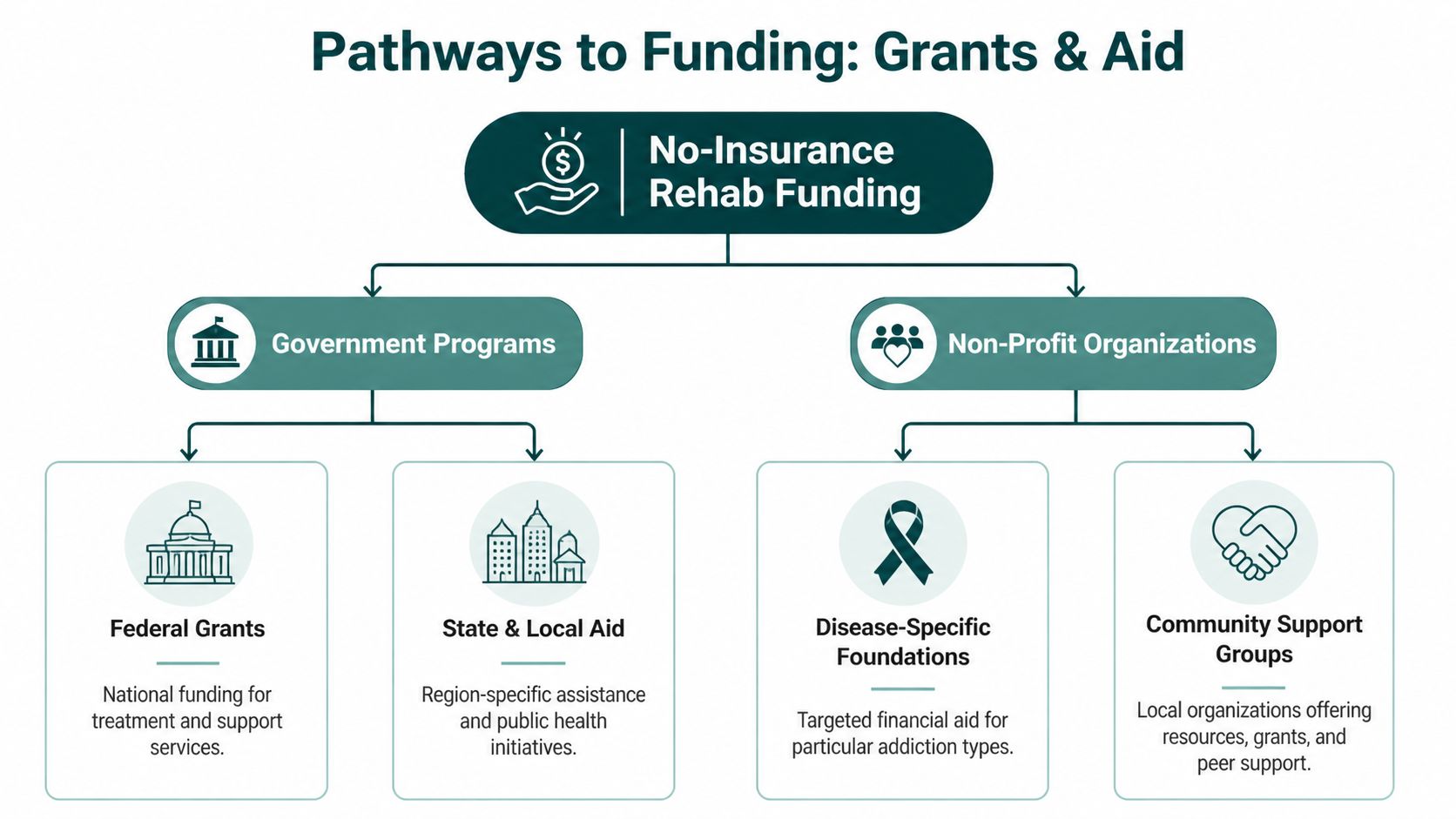
Federal and state funding pathways
The strongest public funding foundation is the federal grant system administered through SAMHSA. The Substance Abuse and Mental Health Services Administration offers grants through its block grant program, a foundational funding mechanism for uninsured individuals. Many state-funded rehab programs also exist, though they often have specific eligibility criteria like proof of residency and income, and they may have waitlists due to high demand, as described in this overview of rehab options without insurance.
That distinction is important. Families often hear “grant funding” and assume they can fill out one application and get immediate approval. In practice, federal funds are typically distributed through state systems and public treatment networks. The person seeking treatment usually accesses that support through a state, county, or contracted provider rather than receiving a check directly.
What applicants usually need
Most state-funded programs ask for documentation that shows both eligibility and need. Missing paperwork often slows the process more than anything else.
Common requests include:
- Proof of residency such as a lease, utility bill, or other address documentation.
- Income verification such as pay stubs, benefit letters, or tax paperwork.
- Addiction history including prior treatment episodes, recent substance use, or screening information.
- Identity documents that help the agency confirm the application matches the person seeking services.
Some programs also want contact information for referral sources, emergency contacts, or mental health providers when a co-occurring condition is involved.
Families move faster when they gather documents before making calls. The application process feels less overwhelming once the paperwork is in one folder.
County and local behavioral health support
For California residents, county behavioral health systems can be especially important. In Orange County, local public systems may help with screening, referrals, and placement into available substance use and mental health services. These pathways can be valuable for uninsured adults, especially when mental health symptoms are part of the picture.
County systems aren’t always simple to manage. Phone trees can be long. Intake criteria can be narrow. Placement may depend on bed availability rather than ideal timing. Still, they are worth pursuing because they can open doors to detox, outpatient support, residential treatment, and follow-up care that would otherwise be out of reach.
Readers looking for ongoing help after admission or support while waiting can also review resources for people in recovery, especially when the family needs multiple layers of support instead of a single referral.
Non-profit and community-based help
Non-profit aid can fill gaps that public systems can’t cover quickly. These organizations may offer treatment access, support services, transportation help, peer support, or referral guidance. Some are faith-based. Others are community-led or issue-specific.
A realistic way to use non-profit support is to treat it as one part of a broader funding strategy:
- Ask whether they provide direct financial help or only referrals.
- Clarify whether services include treatment or just support meetings.
- Find out how quickly they can act, especially if detox or residential care may be needed.
- Keep expectations practical, because community aid can be meaningful without covering the full cost of care.
Public and charitable options can absolutely help. The problem is timing. When the person is medically unstable, actively using, or dealing with depression, trauma symptoms, or severe anxiety, waitlists may create risks that the family can’t afford to ignore.
How to Work With a Rehab Facility on Payment
A treatment center shouldn’t be treated like a cashier’s window. The best admissions conversations sound more like problem-solving. Families who call with honesty, paperwork, and clear questions usually uncover more options than they expected.
Private and nonprofit facilities may have flexibility that isn’t visible on a website. Some use sliding-scale fees. Others offer installment arrangements, short-term holds while financing is finalized, or internal scholarship review. Not every center can do every one of those things, but many can do more than callers assume.
Ask better questions early
The first financial conversation should be direct. Families don’t need polished language. They need accurate answers.
A useful call often includes questions like these:
- What is the full expected cost for the recommended level of care?
- What is included in that amount, and what would be billed separately?
- Is there a sliding-scale option based on income or hardship?
- Can payment be broken into stages rather than paid all at once?
- Are there scholarship funds or hardship reviews available right now?
- If residential care isn’t possible immediately, is there a lower level of care that can start sooner and safely?
These questions achieve two goals. They clarify the actual financial picture and signal to the admissions team that the family is serious about finding a workable path.
A facility can’t usually solve a financial problem it doesn’t understand. The more clearly a family explains the situation, the easier it is to identify practical options.
What works and what usually doesn't
Some approaches consistently help. Others usually waste time.
What tends to work:
- Calling instead of relying on web forms. Real-time discussion often reveals payment pathways that don’t show up online.
- Sharing documents promptly. Income proof, household obligations, and treatment history help financial staff assess options.
- Being open about urgency. If the person may leave, use again, or decompensate, timing matters in placement decisions.
- Staying flexible on level of care. A medically appropriate step-down option may create an earlier start.
What usually doesn’t work:
- Waiting for a perfect all-inclusive solution. Most families build treatment funding from several sources.
- Assuming the first quote is the only quote. Programs may have different terms depending on timing and clinical need.
- Focusing only on the upfront bill. Families should also ask how aftercare will be managed.
For households already juggling overdue balances, it can help to use outside budgeting ideas before or during treatment planning. A practical example is Superior Credit Repair's debt negotiation strategies, which can help families think through creditor conversations while prioritizing essential healthcare decisions.
One call can change the path
Still Water Wellness Group is one treatment option in Orange County that offers confidential admissions support and helps clients explore funding paths when insurance isn’t available or isn’t enough. That kind of admissions conversation matters because the family often needs both a clinical recommendation and a financial plan at the same time.
The hardest part is usually making the first call. Once that happens, the situation often becomes more manageable. A family may learn that a lower upfront amount is possible, that a different level of care makes sense, or that a short-term financing bridge can prevent a dangerous delay.
For immediate guidance, families can call (866) 450-0391 and talk through options confidentially. That call doesn’t commit anyone to treatment. It gives the family real information, which is often what lowers panic enough to take the next step.
Creative Financing Strategies for Private Treatment
When public aid is too slow and private payment feels impossible, the answer is often to combine personal funding tools instead of relying on one source. Often, many employed adults and families overlook options that are already available to them.
The most underused strategy is often tax-advantaged healthcare money. Many people don't realize that Health Savings Accounts can be used to pay for rehab costs, including lodging, meals, and even transportation. For employed individuals, even those with high-deductible plans, this can be a tax-advantaged way to cover out-of-pocket treatment expenses, according to this explanation of paying for rehab without insurance.
Start with money that may already be available
An HSA or FSA can change the conversation quickly. Families sometimes think of those accounts as tools for routine medical expenses and forget they may also help with addiction treatment costs. For someone who is employed, underinsured, or facing a large out-of-pocket obligation, using pre-tax healthcare funds may be cleaner than reaching for high-interest debt first.
Retirement-based hardship access may also be worth reviewing with a tax professional or plan administrator when treatment is medically necessary. The key is to verify the rules before acting, document the medical purpose, and understand how the withdrawal affects long-term savings.
Comparing Personal Financing Options
| Funding Method | Best For… | Key Consideration |
|---|---|---|
| HSA or FSA funds | Employed adults who already have healthcare accounts | Confirm which treatment expenses are eligible and how reimbursement works |
| Retirement hardship access | People with limited liquid cash but available retirement funds | Review plan rules carefully and understand long-term financial trade-offs |
| Personal loan or healthcare financing | Families needing immediate admission and structured repayment | Focus on monthly affordability, not just approval speed |
| Crowdfunding | People with a supportive network willing to help quickly | A clear, honest story usually matters more than polished wording |
| Family loan | Relatives who want to help but need boundaries | Put repayment expectations in writing to reduce conflict later |
How to judge each option
A good financing choice does more than secure admission. It protects the household after discharge.
Families should weigh:
- Speed of access so treatment can begin when the person is willing to go.
- Repayment pressure because a plan that creates extreme stress later can undermine recovery.
- Effect on aftercare budgeting since counseling, sober living, medication, and transportation may still be needed.
- Relationship cost when money comes from family or friends.
A family loan, for example, can be helpful when expectations are clear. Trouble usually starts when one person thinks it’s a gift and the other expects repayment on a strict timeline. A short written agreement can preserve trust.
For households trying to see the bigger financial picture after treatment begins, this ultimate guide for debt freedom can help organize repayment thinking without losing sight of healthcare priorities.
The hidden value of immediacy
Private financing makes the most sense when delay creates obvious risk. That may include unsafe withdrawal, repeated relapse, severe depression, unstable housing, or a home environment that keeps pulling the person back into use. In those situations, the goal isn’t to find the cheapest theoretical option. It’s to fund the safest available next step.
For people evaluating local pathways, affordable rehab centers in Southern California can be a useful starting point when comparing levels of care and practical payment approaches.
Your Application and Negotiation Toolkit
Panic makes paperwork harder. A simple checklist reduces mistakes, speeds up screening, and helps families speak with confidence when money is tight.

Application checklist
Before applying for grants, scholarships, sliding-scale review, or state-funded placement, gather:
- Photo identification to verify the applicant’s identity.
- Proof of residency if the program requires local or state eligibility.
- Income documents such as recent pay records, benefit letters, or tax documents.
- Basic household expense list including rent, utilities, transportation, and dependent care.
- Treatment history with prior detox, rehab, outpatient care, or psychiatric admissions.
- Medication list if the person is taking psychiatric or medical prescriptions.
- Emergency contacts and safe contact numbers for follow-up calls.
- A short written summary of why treatment is needed now.
That last item matters more than many families realize. A concise explanation of current substance use, mental health symptoms, safety concerns, and recent consequences helps admissions and finance staff understand urgency.
Questions that protect families from surprises
Before signing anything, ask for clarity in plain language.
Important questions include:
- What exactly is being charged?
- What services are included in the quoted amount?
- Are medications, psychiatric visits, labs, or discharge planning billed separately?
- What happens if the recommended length of stay changes?
- What is the refund or early-discharge policy?
- Who should be contacted if payment trouble comes up during treatment?
Get the financial explanation in writing when possible. Verbal reassurance is helpful, but written terms prevent confusion later.
How to negotiate without making the conversation adversarial
Negotiation works best when it is calm and specific. Families don’t need to argue. They need to present facts.
A useful approach sounds like this:
- State the constraint clearly. Explain what can be paid now and what cannot.
- Show willingness to move quickly. Facilities are more likely to work with families who are prepared to act.
- Ask for options, not favors. That keeps the conversation practical.
- Bring documentation. Financial staff can do more with proof than with estimates.
- Stay focused on placement. The goal is admission into appropriate care, not winning a bargaining contest.
If one option falls through, that doesn’t mean treatment is impossible. It usually means the funding stack needs to change. A grant application, family contribution, reduced upfront payment, and lower initial level of care can sometimes work together even when none of them would solve the problem alone.
The Most Important Step You Can Take Today
People don’t need one perfect answer to how to pay for rehab without insurance. They need a path that is real, available, and fast enough to matter. For some, that path starts with public funding and county support. For others, it’s a payment plan, an HSA, help from family, or a short-term financing bridge that gets treatment started now.
The most important takeaway is this. Waiting has a cost too. Families usually feel that cost before they can name it. It shows up in worsening mental health, broken routines, missed work, legal stress, family conflict, and the growing fear that the next crisis could be much worse.
There is no universal “right” funding method. There is only the method that gets the person into appropriate care without losing critical time. A safe outpatient start may be enough in one case. In another, residential treatment may be the only realistic option because home is unstable, symptoms are severe, or relapse risk is too high.
The right financial plan is the one that helps treatment begin before motivation disappears or the situation gets more dangerous.
Families in Orange County and Southern California often spend days trying to solve this alone. That usually adds confusion, not clarity. A confidential admissions call can sort through level of care, timing, likely paperwork, and realistic payment paths much faster than online research alone.
If a loved one is struggling right now, the next step is simple. Call (866) 450-0391. Ask direct questions. Explain the financial situation clearly. Find out what can be done today, not someday. That one conversation can turn fear into a plan.
Still Water Wellness Group provides drug and alcohol treatment in Orange County with confidential admissions support, and families can start by calling (866) 450-0391 or visiting Still Water Wellness Group to discuss treatment options and practical next steps.