Searching for addiction treatment centers southern california usually starts in a bad moment. A family is up late, tabs are open, every program sounds the same, and nobody knows which call is the right one. The urgency is real, but panic leads families to ask the wrong questions first.
A better approach is to slow the process down just enough to make a clean decision. California has a huge treatment network, but size alone doesn't make the choice easier. About 8% of California residents, more than 3 million people, live with a substance use disorder, yet only 10% receive professional treatment. The state also has nearly 1,800 facilities serving almost 97,000 clients on any given day according to California substance use treatment data from SAMHSA. That means help exists, but the right fit matters.
Families also need support for the stress of this process itself. Alongside clinical care, practical resources on sleep, anxiety, and regulation can help loved ones stay steady during the search, including this guide to natural supplements for stress relief.
Starting Your Search for Healing in Southern California
Southern California gives families options. That's a strength, but it also creates noise. Some centers are highly structured, ethical, and clinically sound. Others are heavy on marketing and light on substance.
The smartest move is to stop searching for the "perfect rehab" and start screening for the right level of care, the right clinical depth, and the right admissions process. Those three factors tell a family far more than polished photos or vague promises.
The first decision isn't where. It's what level of care is needed
A person who can't get through withdrawal safely doesn't need an outpatient brochure. That person needs detox. Someone who has already stabilized but keeps relapsing in the same home environment may need residential treatment. A person with work and family responsibilities might need PHP or IOP if the clinical team believes it's appropriate.
Practical rule: The best program is the one that matches current medical risk, psychiatric needs, and relapse history. Not the one with the nicest website.
A clear search framework helps families act faster
Before calling any center, it helps to write down four basics:
- Primary substance use: Alcohol, opioids, stimulants, benzodiazepines, or polysubstance use.
- Immediate safety concerns: Recent overdose, suicidal thinking, severe withdrawal history, or unstable mental health symptoms.
- Current living situation: Supportive home, unstable housing, or a home environment tied to active use.
- Payment path: Insurance, private pay, or a mix of both.
Those notes cut through confusion. They also help an admissions team determine whether a center is appropriate from the first conversation.
Orange County and the wider Southern California region remain a major hub for treatment because families can often find detox, residential care, outpatient services, and recovery housing within the same region. That matters. Recovery usually goes better when the next step is already built into the plan.
Navigating the Continuum of Care in Southern California
Many families think rehab is one thing. It isn't. Effective treatment works as a continuum of care, which means the person moves through different levels of structure as stability improves. That model protects early recovery and reduces the chaos of trying to rebuild too quickly.
For a closer look at how these stages fit together, families can review levels of care for addiction treatment.
What each level actually means
Medical detox is the front end for people who need monitoring during withdrawal. This is often the right starting point for alcohol, opioids, benzodiazepines, or heavy daily substance use. Detox is about safety and stabilization. It is not the full treatment plan.
Residential or inpatient treatment gives the person a live-in setting with daily therapy, structure, accountability, and separation from triggers. This is the right fit when the home environment is unsafe, relapse risk is high, or mental health symptoms are interfering with basic functioning.
Partial Hospitalization Program or PHP offers a high level of clinical support without overnight residence in the treatment setting itself. It works well for people who are medically stable but still need a full treatment day and close oversight.
Intensive Outpatient Program or IOP is a step down in intensity. It allows people to practice recovery skills in real life while still attending structured therapy several days per week.
Sober living and aftercare create the bridge from treatment into normal life. Here, many people either protect their progress or lose it. A stable living environment, relapse prevention planning, and ongoing clinical support matter here.
Levels of Addiction Treatment at a Glance
| Level of Care | Intensity & Environment | Typical Duration | Best Suited For |
|---|---|---|---|
| Medical Detox | Highest medical oversight, supervised withdrawal setting | Varies by substance and medical need | People at risk for unsafe withdrawal or acute instability |
| Residential Treatment | Live-in, highly structured therapeutic environment | Varies by clinical need | People needing separation from triggers and round-the-clock support |
| PHP | Full treatment days, strong clinical structure, no overnight hospital-style care | Varies by progress | People stepping down from residential or needing intensive daytime care |
| IOP | Several therapy sessions each week with more independence | Varies by progress | People stable enough to live at home or in supportive housing |
| Sober Living and Aftercare | Recovery-focused housing and continuing support | Ongoing | People building consistency, accountability, and long-term relapse prevention |
The mistake families make most often
They choose based on convenience instead of acuity.
If someone needs detox and gets placed into a lower level of care, the treatment plan starts off misaligned. If someone needs a protected residential setting and gets sent home too soon, cravings, conflict, and access to substances can undo the early gains fast.
A solid Southern California program should be able to say where the person starts, what comes next, and what support follows after discharge.
That answer should be plain, specific, and easy to follow. If a center can't explain the progression clearly, that is a problem.
Core Components of High-Quality Addiction Treatment
The level of care tells a family where treatment happens. The next question is what happens there. At this stage, quality starts to separate itself from marketing.
A strong program combines evidence-based treatment with whole-person support. It doesn't force families to choose between clinical care and humane care. Good treatment does both.

The clinical foundation should be obvious
Families should expect to hear about therapies such as CBT, DBT, relapse prevention, individual therapy, group therapy, and family work. Those aren't buzzwords. They are part of the daily work of helping a person change patterns, regulate emotions, challenge destructive thinking, and respond differently to stress.
For opioid addiction, Medication-Assisted Treatment, or MAT, is not optional quality care. MAT using medications like buprenorphine has been shown to reduce illicit opioid use by 50% to 70% in the first six months according to Blue Shield of California's substance use treatment guidance. A center that treats opioid use disorder should be able to explain how MAT fits into detox, residential care, and outpatient treatment.
Holistic care should support the clinical work, not replace it
Integrative services can help people stay engaged, settle the nervous system, and reconnect with their body. That matters in early recovery, especially for people who feel numb, restless, ashamed, or emotionally flooded.
Useful examples include:
- Yoga and breathwork: These can help clients slow down and tolerate discomfort without reaching for a substance.
- Art therapy and experiential work: These often help when a person can't easily put emotions into words.
- Meditation and sound-based practices: These can support focus and stress regulation.
- Nature-based activity: In areas near Saddleback Mountain and Laguna Beach, outdoor movement can become part of building a healthier daily rhythm.
The key question is simple. Do these services deepen the treatment plan, or are they being used to distract from weak clinical programming?
What a family should listen for on the phone
A capable admissions or clinical team should be able to explain the treatment model in plain English:
- How therapy is delivered: Individual, group, family, psychiatric, and relapse prevention work.
- How medications are handled: Especially for withdrawal management, cravings, and psychiatric support.
- How progress is measured: Not with vague inspiration, but with regular clinical review and step-down planning.
- How treatment is personalized: Based on substance use history, mental health, trauma, physical health, and relapse pattern.
Still Water Wellness Group in Lake Forest is one example of a Southern California center offering detox, residential, PHP, IOP, sober living, MAT, and dual-diagnosis services in one continuum. That's the kind of practical model families should look for when they want fewer handoff problems between stages of care.
Why Integrated Dual-Diagnosis Treatment Is Non-Negotiable
A large share of people entering addiction treatment aren't dealing with substance use alone. Depression, anxiety, trauma, bipolar symptoms, panic, disordered eating, and chronic emotional dysregulation often sit underneath the addiction or intensify it. Treating only the substance use problem leaves the underlying drivers untouched.
That is why integrated dual-diagnosis treatment matters. Not a referral to mental health later. Not a separate therapist somewhere else. Integrated care from day one.

Siloed treatment keeps people stuck
When a program says it treats addiction but only lightly screens for mental health issues, families should pay attention. A person might stop using briefly, but if untreated trauma, depression, or anxiety keeps firing in the background, relapse risk stays high.
Top-ranked treatment centers show that integrated dual-diagnosis programs achieve 12-month abstinence rates of 55% to 65%, compared with 30% to 40% in siloed care, and co-occurring mental health conditions are present in over 60% of people with substance use disorders according to Statista and Newsweek addiction treatment center ranking data.
Families looking into this issue in more depth can also review dual diagnosis treatment centers in California.
What integrated care looks like in practice
Real dual-diagnosis treatment includes more than a checkbox on an intake form. It usually involves:
- Psychiatric evaluation early in treatment: Not weeks later, and not only if the client asks.
- Medication management when clinically appropriate: For mood, anxiety, trauma symptoms, or other psychiatric conditions.
- Therapy that addresses both conditions together: Addiction patterns and mental health symptoms need to be discussed in the same treatment plan.
- Staff who understand trauma and emotional regulation: Clients shouldn't be punished for symptoms that need treatment.
Non-negotiable question: Ask whether mental health care is integrated into the addiction treatment plan or handled as a separate issue. The wrong answer is vague.
Families often benefit from learning more about emotional regulation and trauma outside of formal treatment too. For loved ones trying to understand how beliefs, anxiety, and emotional healing connect, Episode 130 on emotional wellness offers useful context.
Why this matters so much in Southern California
Many people searching addiction treatment centers southern california are looking for privacy, a calmer environment, and a fresh start. Those things help, but a beautiful setting doesn't treat PTSD. A quiet room doesn't stabilize bipolar symptoms. Good intentions don't resolve panic, grief, or long-standing depression.
Integrated dual-diagnosis care does. Families should insist on it.
How to Vet Addiction Treatment Centers and Avoid Red Flags
Southern California has many treatment options, especially in Orange County. That makes vetting essential. Families shouldn't assume that a polished admissions call means a center is ethical, licensed appropriately, or clinically equipped for complex cases.
That caution is justified. The high density of treatment centers in some Southern California areas has been linked to risks like patient brokering, and studies cited in a Southern California rehab guide found significantly higher overdose odds for visitors to certain treatment hubs. That is why choosing accredited, ethical centers with proven clinical structure matters, as outlined in this Southern California rehab guide.
The short list of what to verify first
Before discussing amenities, ask about the basics.
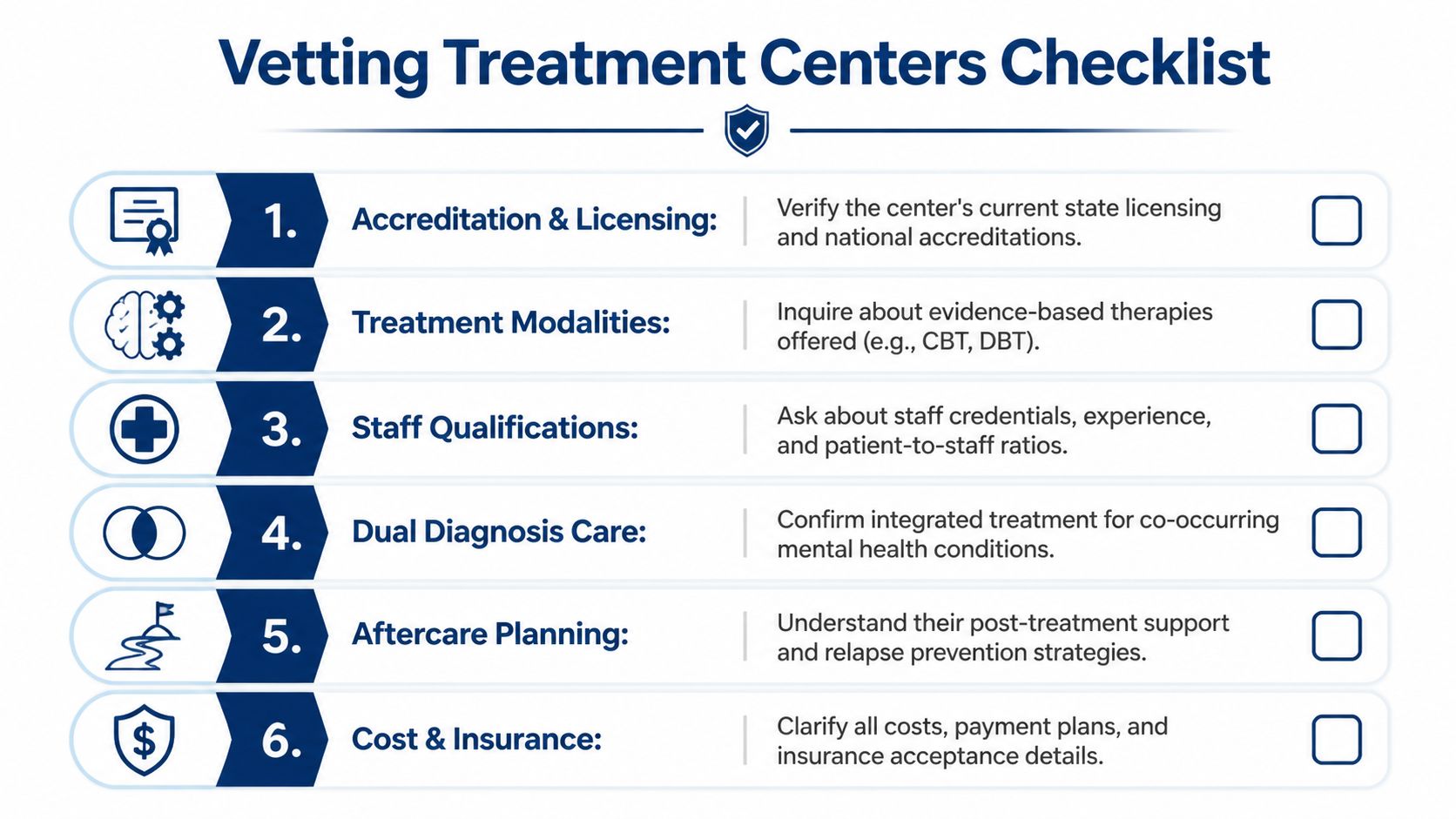
- Licensing and accreditation: Confirm current state licensing and ask whether the center holds recognized accreditation.
- Medical capability: Ask who manages detox, medications, and psychiatric needs.
- Clinical staffing: Ask what kinds of licensed professionals are involved in treatment.
- Dual-diagnosis integration: Get a direct answer, not a vague promise.
- Aftercare planning: Ask what happens after residential, PHP, or IOP ends.
- Financial clarity: Ask for a plain explanation of what insurance may cover and what out-of-pocket costs may remain.
Questions families should ask on every call
Some calls reveal a lot in the first few minutes. Others only become clear when the family asks direct questions.
Questions about safety and legitimacy
- Who evaluates whether detox is medically necessary?
- Who prescribes and manages medications?
- What happens if psychiatric symptoms worsen during treatment?
- Is family contact part of the process, when appropriate?
A serious center answers these without hesitation.
Questions about treatment quality
- Which evidence-based therapies are used regularly?
- How is relapse prevention taught and practiced?
- How are treatment plans adjusted if a client isn't progressing?
- What level of care comes after discharge from the current program?
If the answer keeps drifting back to scenery, comfort, or generic inspiration, that's a warning sign.
A treatment center should be able to explain its care model in plain language. Families should never have to decode jargon to find out whether treatment is actually comprehensive.
Red flags that should end the conversation
These don't need overthinking.
- Pressure to admit immediately without enough screening: Fast placement isn't the same as appropriate placement.
- Unclear cost answers: If billing questions get slippery, expect problems later.
- No direct explanation of dual-diagnosis care: That often means mental health treatment is thin.
- Promises that sound absolute: Recovery is individualized. Ethical programs don't make guarantees.
- Overfocus on location perks: Treatment should lead the conversation, not lifestyle.
How to handle insurance and cost without getting overwhelmed
This part stops many families, but it shouldn't.
Start by asking the center to verify benefits and explain the result in plain terms. Families should ask:
- Is the plan in network, out of network, or case by case?
- What services are being checked for coverage? Detox, residential, PHP, IOP, medications, psychiatry, and aftercare support all matter.
- What costs may still be the family's responsibility?
- Is there a payment plan if insurance doesn't cover the full stay?
Don't accept vague reassurance. Ask for a breakdown.
For families searching in Lake Forest, Irvine, Laguna Hills, Mission Viejo, or elsewhere in Orange County, the strongest addiction treatment centers southern california are usually the ones that combine clinical transparency with financial transparency. Both matter equally when a family is trying to make a safe decision quickly.
Making the Call to Admissions
It is 9:30 p.m. Someone in the family finally says, "Call now before they change their mind."
That moment feels heavy because the call can either calm the situation down or make it harder. The right admissions team brings order fast. They ask focused questions, explain what happens next in plain language, and help your family make a safe decision without confusion.
The call has one job. Figure out the right starting point, confirm whether the program fits the person's needs, and explain the path to admission and payment clearly enough that your family can act.
What usually happens on the first call
Expect a structured conversation, not a sales pitch. The admissions coordinator should ask about current substance use, last use, withdrawal risk, mental health symptoms, medications, past treatment, medical concerns, insurance, and any immediate safety issue at home.
That screening matters because level of care should be chosen based on risk, not preference. If someone needs detox, the team should say that directly. If residential is too much or too little support, they should explain why.
Families who want a preview of the process can review common admissions questions and answers.
What to have ready before calling
A little preparation saves time and usually leads to a better recommendation.
- Insurance card details: Member ID, plan name, subscriber name, and date of birth.
- Substance use information: What the person is using, how often, how much, and when they last used.
- Mental health and medical history: Diagnoses, medications, recent hospitalizations, suicide risk, seizures, or other urgent concerns.
- Current logistics: Where the person is now, whether they are willing to come in, and who can help with transportation.
If the person is intoxicated, in withdrawal, talking about self-harm, or medically unstable, say that first. Do not wait for the coordinator to get there.
What to ask during the call
Use the call to get answers on treatment and cost at the same time. That is how families avoid wasted time and last-minute surprises.
Ask these questions plainly:
- What level of care do you recommend, and why?
- How do you handle mental health treatment if depression, anxiety, trauma, or bipolar symptoms are part of the picture?
- What will insurance likely cover, and what could we still owe?
- What happens in the first 24 hours after arrival?
- What paperwork, medications, and identification should we bring?
- If this is not the right fit, where should we go instead?
A strong admissions coordinator answers those questions directly. They do not dodge the money conversation. They do not rush past psychiatric needs. They do not pressure your family to commit before explaining the clinical reason for the recommendation.
What a strong admissions team sounds like
You should leave the call with a clear next step. Maybe that means same-day detox. Maybe it means scheduling an assessment for PHP or IOP. Maybe it means the center is not appropriate and your family needs a different setting.
Good admissions teams make that clear. They explain benefits verification, expected out-of-pocket cost, intake timing, arrival instructions, and who to call if the situation changes overnight.
The best calls lower panic because they replace guesswork with a plan.
Frequently Asked Questions About Starting Recovery
Families usually reach this point with a few practical fears still hanging around. Those questions matter because they often determine whether someone gets help now or puts it off again.
How does someone know which level of care is right?
The answer should come from a proper clinical screening, not guesswork. Withdrawal risk, medical history, mental health symptoms, relapse pattern, and home environment all shape that decision. If the person is medically or psychiatrically unstable, a higher level of care is usually the safer starting point.
What if insurance doesn't cover the full cost?
That doesn't automatically end the process. Families should ask for a benefit verification, a plain explanation of any uncovered portion, and available payment options. The key is clarity. A center should explain costs before admission, not after.
What should someone pack for residential treatment?
Most programs will provide a packing list, but the basics are usually straightforward. Comfortable clothing, toiletries approved by the center, identification, insurance information, and any prescribed medications in their original containers are common starting points. Leave valuables, unnecessary electronics, and anything prohibited by the center at home.
Can a person go straight into outpatient care instead of detox or residential?
Sometimes, yes. Often, no. If the person has significant withdrawal risk, repeated relapse, an unstable home environment, or serious mental health symptoms, outpatient treatment may be too light. The right answer depends on safety and clinical need, not preference alone.
How can family members support a loved one without making things worse?
Support works best when it is calm, firm, and consistent. Families should avoid arguing with someone who is intoxicated, avoid rescuing the person from every consequence, and avoid making promises they can't keep. It helps to focus on clear next steps, maintain boundaries, and participate in family programming if the treatment center offers it.
What if the loved one says they don't need help?
That happens all the time. Families don't need to wait for a perfect moment or a dramatic breakdown. They can still call, describe what is happening, and ask what options exist. An admissions team can often help the family prepare for the next conversation in a more productive way.
Is dual-diagnosis treatment necessary if the person has never had a formal mental health diagnosis?
Possibly. Many people enter treatment without ever being properly assessed for depression, trauma, anxiety, or other conditions. The absence of a diagnosis doesn't mean the absence of a mental health issue. It often means nobody has evaluated it carefully yet.
What if the person is afraid of being away from home or work?
That fear is common. It should be acknowledged, but it shouldn't run the decision. Addiction already takes people away from work, family, health, and peace of mind. Treatment is the interruption that gives those things a chance to come back.
How fast can admission happen?
It depends on the person's needs, medical safety, insurance verification, and bed availability. The most important point is this. Families don't need to have everything figured out before making contact. The call itself is often what turns confusion into a plan.
What should a family do right now?
Gather the basics, stop bouncing between random websites, and make one informed call. If the situation feels urgent, treat it like it is urgent. Delay rarely improves addiction.
Still Water Wellness Group offers confidential admissions support, insurance verification, and a full continuum of care in Lake Forest for adults seeking drug and alcohol treatment in Southern California. Families who need a clear next step can learn more at Still Water Wellness Group or call (866) 450-0391 to speak with an admissions coordinator.