A person often lands on this topic in a rough moment. The hands are shaky. Sleep didn’t happen. The stomach feels off. Anxiety is climbing, and the search bar fills with one urgent question: is there any alcohol withdrawal over the counter medicine that can make this stop safely?
That question makes sense. When withdrawal starts, individuals are not looking for a complicated explanation. They want relief, privacy, and something they can get today.
The hard truth is that over-the-counter options have a very narrow role. Some products may ease mild discomfort, such as headache, nausea, dehydration, or vitamin depletion. None of them treat the underlying withdrawal process that can become dangerous fast. For some people, a home attempt stays uncomfortable. For others, it turns into confusion, hallucinations, or a seizure.
This guide treats the search for alcohol withdrawal over the counter medicine as a safety decision, not a shopping list. The goal is simple. Help Orange County readers tell the difference between symptoms that may be supportive-care only and symptoms that mean it’s time to get medical detox involved right away.
The Search for an At-Home Alcohol Withdrawal Remedy
Early withdrawal rarely announces itself clearly. It often starts with symptoms people try to explain away.
A person may wake up and think it’s just a bad hangover. Then the shaking feels different. The heart seems too fast. Small noises are irritating. Nausea comes in waves. Sweating starts even in a cool room. At that point, many people look for a pharmacy solution because it feels more manageable than admitting alcohol withdrawal may be happening.
That instinct is understandable. OTC medicine feels accessible and familiar.
Why this search happens
People searching for alcohol withdrawal over the counter medicine want one of three things:
- Fast relief: They want the nausea, headache, tremor, or panic to settle down.
- Privacy: They don’t want family, work, or neighbors to know what’s happening.
- Control: They hope a few common products will let them handle this without formal treatment.
Those goals are human. They’re also where risk begins.
Practical rule: If someone is searching for a product but also feeling shaky, confused, increasingly panicked, or unable to keep fluids down, the real need isn’t just symptom relief. It’s a medical safety check.
The real problem with a DIY approach
Over-the-counter products can sometimes help the edges of withdrawal. They can’t control the core process inside the brain and nervous system. That’s why a person may feel temporarily better after taking something for nausea or pain, yet still be moving toward severe withdrawal.
This is the key distinction. A hangover usually improves with time, hydration, and rest. Withdrawal can escalate.
That’s why the right question isn’t “What can be bought at the store?” It’s “How risky is this withdrawal likely to become?” Once that question gets answered accurately, the next step becomes much clearer.
Understanding Alcohol Withdrawal Syndrome
Alcohol withdrawal syndrome happens because the brain adapts to alcohol over time. When alcohol is suddenly removed, the nervous system can swing into an overactive state.
A simple way to picture it is a seesaw. Alcohol keeps one calming side pressed down. The brain responds by pushing the stimulating side up to compensate. When alcohol disappears, the calming force drops away and the stimulating side can spring up too far. That overcorrection drives the shakiness, sweating, anxiety, insomnia, nausea, agitation, and in some cases hallucinations or seizures.
Why symptoms can escalate
The important point is that withdrawal isn’t just discomfort. It’s a brain and body stress response.
The brain changes involved in withdrawal are tied to the balance between calming and excitatory signaling. OTC products don’t correct that imbalance. They may help one symptom at a time, but they don’t stop the process itself.
That’s one reason clinicians have treated alcohol withdrawal as a medical issue for a long time. In 1992, approximately 13.8 million Americans, or 7.4% of the U.S. adult population, met the criteria for alcohol abuse or dependence, and by 2000, 226,000 patients were discharged from hospitals with diagnoses of alcohol withdrawal, according to the American Academy of Family Physicians review.
A general timeline people should recognize
Withdrawal often follows a pattern, though each person’s course differs.
| Time after last drink | What may start happening |
|---|---|
| 6 to 12 hours | Shaking, anxiety, headache, nausea, sweating, trouble sleeping |
| 24 to 48 hours | Symptoms may intensify. Tremors can worsen. Risk becomes more concerning. |
| Beyond that | Some people move into severe symptoms such as hallucinations, major confusion, or seizures |
A person who wants a more detailed symptom overview can review alcohol detox symptoms to compare what they’re experiencing with common withdrawal patterns.
Withdrawal is not the same as a hangover
A hangover usually tracks with dehydration, poor sleep, and alcohol’s aftereffects. Withdrawal points to dependence and nervous system rebound.
That distinction matters because the treatment logic changes. A hangover calls for rest and hydration. Withdrawal may call for medical monitoring, prescription medication, and urgent escalation if the pattern turns severe.
The most dangerous part of alcohol withdrawal is that it can look manageable before it stops being manageable.
Managing Mild Withdrawal Symptoms with OTC Aids
At this stage, the right question is not, “What can I buy over the counter to get through this?” The safer question is, “Do my symptoms still fit the narrow window where comfort care is reasonable, or am I crossing into territory that needs medical detox?”
That distinction matters. Over-the-counter aids can reduce discomfort in a limited set of mild symptoms. They do not treat the withdrawal process itself, and they do not protect a person from seizures, hallucinations, or sudden deterioration.
What “mild” actually means
In practice, mild withdrawal means symptoms are uncomfortable but still limited. A person may have shakiness, sweating, nausea, poor sleep, headache, or anxiety, while remaining oriented, able to drink fluids, and free of alarming changes in perception or behavior.
The line can shift fast. I tell families to use home care only as a risk check, never as proof that the situation is safe. Anyone trying to judge whether staying home is even reasonable should review detoxing from alcohol at home symptoms as a warning framework, not as a do-it-yourself plan.
Symptom-by-symptom OTC support
Headache and body aches
A non-prescription pain reliever may help with mild headache or muscle aches. Relief has limits. Easing pain does nothing to calm the overactive nervous system that drives alcohol withdrawal.
Choice matters here. People with heavy alcohol use may also have dehydration, stomach irritation, or liver stress, so self-medicating is not as simple as grabbing the first bottle in the cabinet.
Nausea and stomach upset
For mild nausea, some people tolerate ginger, bland food, or small sips of water or electrolyte solution better than a full meal. An over-the-counter stomach remedy may also reduce discomfort.
The practical test is straightforward. If vomiting continues, fluids will not stay down, or weakness is getting worse, home care is no longer doing enough.
Dehydration and electrolyte loss
Sweating, poor intake, and vomiting can drain fluid quickly. Oral rehydration solutions are usually a better choice than sugary drinks or large amounts of plain water alone.
Take small sips every few minutes. If the person cannot keep up with fluids, appears increasingly weak, or seems less alert, the safer move is medical evaluation.
Sleep trouble
Sleep is often one of the first things people want to fix. I understand that instinct. Still, sedating over-the-counter sleep aids can cloud the picture and make it harder to tell whether someone is resting, becoming confused, or slipping into a more dangerous withdrawal state.
A quiet room, low stimulation, and supervision are often safer than adding a sleep product without guidance.
Vitamin support
Vitamin replacement deserves special attention, especially thiamine, also known as vitamin B1. People who drink heavily are often nutritionally depleted, and thiamine support may help reduce the risk of serious alcohol-related brain injury.
It is still only one piece of the picture. If someone has poor nutrition, repeated vomiting, weight loss, or mental fogginess, those are reasons to involve a clinician, not reasons to rely on vitamins alone.
People who already know their liver tests have been affected by alcohol may also want to understand strategies to lower GGT levels, but that longer-term liver discussion should never distract from the immediate safety question during withdrawal.
What OTC care can and cannot do
| OTC support may help with | OTC support cannot do |
|---|---|
| Mild headache or body aches | Prevent seizures |
| Mild nausea | Stop hallucinations or delirium |
| Fluid and electrolyte replacement | Stabilize severe autonomic symptoms |
| Basic vitamin support | Replace monitoring and prescription detox care |
| Short-term comfort | Make a risky withdrawal safe at home |
This is the trade-off Orange County residents need to see clearly. OTC products may improve comfort during a mild early withdrawal. They are not a treatment plan. They are a checkpoint. If symptoms are intensifying, changing quickly, or becoming hard to interpret, it is time to call for professional help.
The Hidden Dangers of Self-Managing Withdrawal
The biggest danger with self-managing alcohol withdrawal isn’t only that OTC products are limited. It’s that they can create a false sense of safety.
A person takes something for nausea, drinks water, lies down, and believes the worst has passed. Meanwhile, withdrawal is still building under the surface. By the time the situation looks unmistakably serious, the person may already be in crisis.
OTC products can complicate the picture
Different products carry different concerns.
- Pain relievers: Some people use them casually even when there may already be alcohol-related liver stress, stomach irritation, or dehydration.
- Sleep aids: Sedating antihistamines can blur the line between normal fatigue and dangerous confusion.
- Stacking remedies: Combining several OTC products without guidance can make it harder to tell what symptom belongs to withdrawal and what side effect belongs to the medication.
That matters because alcohol withdrawal is a moving target. A person needs a clear view of worsening symptoms, not a foggier one.
“Feeling a bit better” can be misleading
Symptom relief isn’t the same as stabilization. Nausea can improve while the heart rate remains high. A headache can ease while tremors worsen. Someone may finally doze off, but wake up more agitated.
Relief of one symptom should never be mistaken for proof that withdrawal is under control.
Another issue is timing. Withdrawal doesn’t always peak immediately. That delay tricks people into thinking they’ve successfully managed it on their own.
Liver concerns add another layer
Many people searching for alcohol withdrawal over the counter medicine are also worried about alcohol’s effect on the liver. That concern is valid, but liver support content shouldn’t be confused with acute withdrawal treatment. General wellness guidance, including strategies to lower GGT levels, may help someone think about longer-term liver health. It won’t address an active withdrawal emergency.
A person can have both problems at once. The urgent one still comes first.
Red Flags When You Must Seek Immediate Medical Help
When alcohol withdrawal crosses into severe territory, guessing is dangerous. The goal at that point isn’t comfort. It’s immediate medical intervention.
Emergency signs that should not be watched at home
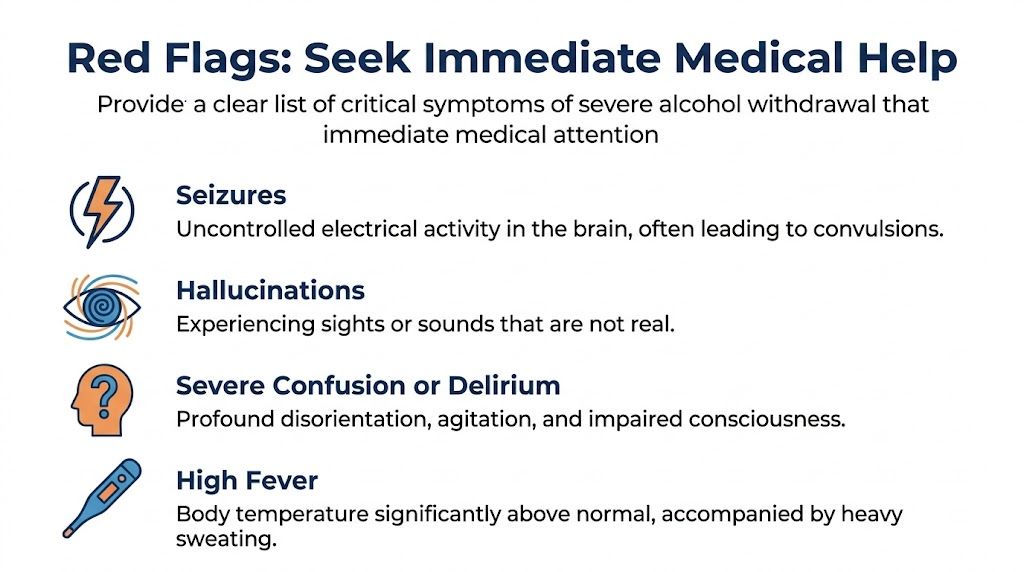
Seek emergency care right away if any of these appear:
- Seizures: Any convulsion, loss of consciousness, or sudden collapse is an emergency.
- Hallucinations: Seeing, hearing, or feeling things that aren’t there signals dangerous withdrawal.
- Severe confusion or delirium: Not knowing where one is, becoming extremely agitated, or acting wildly out of character requires urgent care.
- High fever with heavy sweating: This can accompany severe withdrawal and rapid deterioration.
- A racing heart or major physical distress: If the body seems to be spiraling, don’t wait for it to settle on its own.
The line between urgent and emergency
Some families waste precious time trying to decide where to go. If there’s any uncertainty about the level of care, this explanation of the distinction between urgent care and an emergency room can help clarify why severe withdrawal symptoms belong in emergency-level care.
In general, alcohol withdrawal red flags are not an urgent care problem. They’re an ER problem.
A simple decision framework
Use this practical split:
| Situation | Safer response |
|---|---|
| Mild nausea, headache, mild shakiness, able to drink fluids, fully oriented | Contact a medical professional for guidance and monitor closely |
| Symptoms are getting stronger, not weaker | Escalate to medical detox evaluation quickly |
| Hallucinations, seizure, severe confusion, high fever, extreme agitation | Call 911 or go to the ER immediately |
If a loved one says, “Something feels really wrong,” and they’re withdrawing from alcohol, take that seriously even before the clearest red flags appear.
Don’t wait for every symptom on the list
People often delay because they want certainty. They look for one more sign, one more hour, one more chance to avoid calling.
That hesitation can be dangerous. Severe withdrawal doesn’t need permission to become life-threatening. If a person is deteriorating, confused, hallucinating, convulsing, or becoming impossible to safely supervise, home care has ended.
Medical Detox The Gold Standard for Safe Withdrawal
At this point, the question is no longer which over the counter product might take the edge off. The primary question is whether home care is still a safe option.
For anyone with a meaningful risk of alcohol withdrawal complications, medical detox is the safest setting because it treats withdrawal as an active medical condition that can change quickly over hours, not days. That distinction matters. A person can look stable in the morning and become confused, agitated, or medically unsafe later the same day.
Why prescription treatment works differently
OTC aids may help with comfort in very limited cases. They do not treat the underlying nervous system instability that drives dangerous alcohol withdrawal.
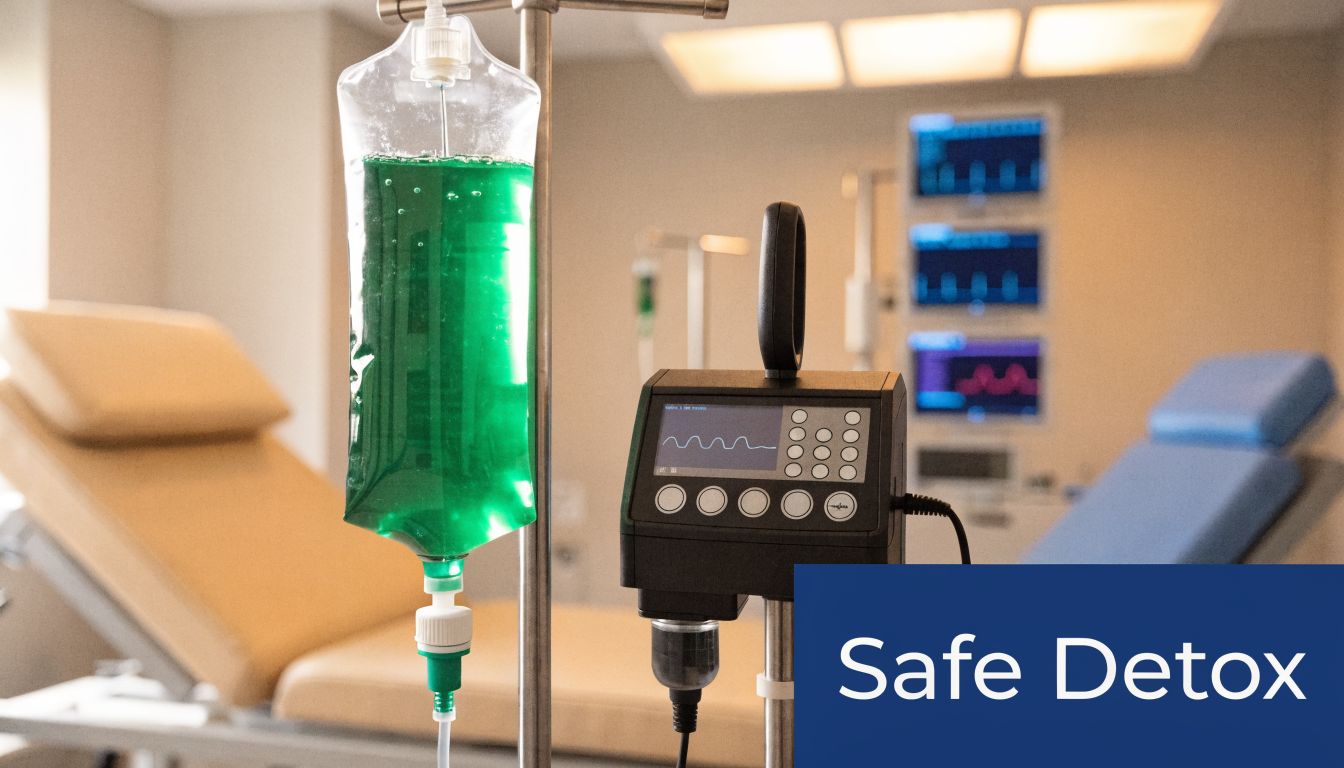
Medical detox can. In supervised care, clinicians assess severity, track changes in real time, and use prescription medication when indicated to reduce the risk of escalation. Benzodiazepines remain first-line treatment for many patients in alcohol withdrawal, based on established clinical guidance. The larger clinical problem is not a lack of treatment tools. It is that many people who need treatment never receive it.
That is one reason I encourage families to use the "OTC for withdrawal" search as a decision point, not a treatment plan. If symptoms are more than minor and short-lived, the safer move is an evaluation for medical detox in Orange County.
What medical detox actually provides
Detox is active treatment, not passive observation.
Ongoing assessment
Teams monitor vital signs, orientation, fluid status, sleep, tremor, anxiety level, and overall progression. If symptoms intensify, the care plan changes quickly.
Medications with a clear purpose
Prescription treatment can reduce agitation, lower seizure risk, and help stabilize the withdrawal process. That is very different from taking an OTC product that may mask discomfort while the medical risk continues to build.
Hydration and nutritional support
Many patients arrive dehydrated, undernourished, sleep deprived, and physically depleted. Treatment often includes fluids, symptom relief, and vitamins such as thiamine when clinically appropriate, because alcohol withdrawal is rarely just one problem.
A safer setting if the picture changes
This is one of the biggest trade-offs. At home, worsening symptoms can outpace the ability of family members to respond. In detox, staff can escalate care immediately if a patient becomes unstable.
The value of detox is not comfort alone. It is the ability to recognize early deterioration and intervene before a crisis develops.
Detox is the first step, not the whole treatment plan
Stopping alcohol safely is the beginning of care. It is not the full solution.
After withdrawal is controlled, many patients benefit from ongoing treatment that may include medications such as naltrexone or acamprosate, therapy, relapse-prevention planning, and dual-diagnosis support when anxiety, depression, trauma, or other mental health conditions are also present. Those options work best after a proper medical evaluation, not as a self-directed response to active withdrawal at home.
For Orange County residents, that is the clearest limit of self-care. OTC products may have a narrow role in easing mild symptoms for a small group of people, but they cannot replace medical supervision when withdrawal risk is real. Medical detox remains the gold standard because it protects the patient during the most medically unpredictable phase and gives them a stable start on recovery.
Your Path to Recovery in Orange County Starts Here
For people in Orange County, safety matters as much as willingness. Many are ready to stop drinking before they’re ready to face the medical risk alone. That’s exactly why a full continuum of care matters.
A strong treatment path starts with getting through withdrawal safely, then continues into the level of support that fits the person’s life, history, and mental health needs.

What a complete care path should include
A quality program in Southern California should offer more than detox alone.
- Medical detox: For stabilization during the acute withdrawal phase.
- Residential treatment: For people who need immersive support away from daily triggers.
- Partial hospitalization and intensive outpatient care: For step-down structure with more flexibility.
- Dual-diagnosis support: For people dealing with alcohol use alongside anxiety, depression, trauma, bipolar disorder, or eating disorders.
- Aftercare planning: Because discharge without a plan leaves people exposed during a vulnerable period.
A local option matters too. Care close to home can make family involvement, insurance coordination, and transitions into outpatient support much smoother.
Why environment and treatment style matter
People healing from alcohol dependence don’t just need symptom control. They need a setting where the nervous system can settle, trust can rebuild, and treatment doesn’t feel mechanical.
That’s why the environment matters. A calm Orange County setting, privacy, and a treatment team that can address both addiction and mental health often make the difference between a short interruption and a real turning point.
A well-rounded program should blend evidence-based treatment with supportive practices that help people regulate stress and reconnect with daily function. That may include individual therapy, group work, relapse-prevention planning, and selected wellness services that complement clinical care rather than replace it.
The next step should be simple
The hardest part for many families is the first call. They worry about cost, judgment, logistics, and whether the problem is “serious enough.”
If someone is searching for alcohol withdrawal over the counter medicine, the problem is already serious enough to justify a confidential conversation. A professional admissions team can help sort out whether emergency care, detox, residential treatment, or outpatient support makes sense.
Orange County residents who want to understand options for supervised withdrawal can review this overview of medical detox in Orange County, CA and use it as a starting point for action.
The safest recovery plan is the one that begins before withdrawal turns into a crisis.
Many people also assume treatment will be impossible to afford. In reality, insurance verification can often be handled quickly, and most major plans may be accepted depending on the program and level of care. That practical step removes a major barrier.
Reaching out early doesn’t commit anyone to a specific outcome. It gives them better information, better safety, and a clearer path than trying to self-manage a potentially dangerous withdrawal with pharmacy products alone.
Still Water Wellness Group offers confidential, compassionate support for people in Orange County who need help with alcohol detox, residential treatment, PHP, IOP, dual-diagnosis care, and long-term recovery planning. The team provides personalized treatment in a serene Lake Forest setting and can help verify insurance quickly. To speak with a 24/7 admissions specialist, call (866) 450-0391 or visit Still Water Wellness Group.