
Some nights follow the same script. The key turns in the lock. A spouse listens for the sound of footsteps, the smell of alcohol, the tone of the first sentence. The body tightens before the mind can catch up. Dinner shifts, the children go quiet, and the evening becomes an exercise in prediction, prevention, and damage control.
That is what living with alcoholic husband often feels like. It isn't only about drinking. It's about volatility, broken trust, financial stress, fear, shame, and the exhausting job of trying to keep a household functional while someone else's alcohol use keeps knocking it off balance.
A spouse in this position doesn't need vague encouragement. A spouse needs a practical framework. Safety comes first. Boundaries come next. Personal mental health can't stay at the bottom of the list. If children are in the home, their protection has to be active, not assumed. Treatment matters, but no partner should be asked to wait for treatment before protecting themselves.
Assessing Your Immediate Safety and Creating a Plan
Fear can become so normal in an alcohol-affected home that it starts to feel invisible. A spouse may tell herself that things are "not that bad" because there hasn't been a recent physical incident, even while living with threats, intimidation, reckless driving, smashed objects, missing money, or nights spent staying awake to monitor the mood in the house.
That minimization is common. It's also dangerous.
The connection between alcohol and partner violence is not abstract. WHO data notes that 55% of U.S. partner assaults occur after the perpetrator has been drinking, and heavier alcohol use raises the risk and severity of violence, as summarized in this review on the effects of living with an alcoholic spouse.
What to assess tonight
A useful safety check looks at behavior, not promises. A spouse should ask:
- Has he threatened, shoved, blocked a doorway, grabbed a phone, or destroyed property? Property damage often comes before direct assault.
- Does he drive intoxicated with the spouse or children in the car? That is an immediate safety issue.
- Are there weapons in the home? If yes, safety planning needs to become more urgent.
- Does his drinking change fast? Blackouts, rage, paranoid accusations, and sudden mood shifts raise risk.
- Has money gone missing or been used unpredictably? Financial chaos can trap a spouse in danger.
- Do the children change their behavior when he drinks? Kids often register danger before adults admit it.
Practical rule: If a spouse feels the need to monitor tone, hide keys, avoid certain rooms, or keep the children quiet to prevent an outburst, the home is already unsafe enough to justify a formal safety plan.
Build a real exit plan
A safety plan isn't a declaration of divorce. It's a lifeline. It gives a spouse options when alcohol makes the home unpredictable.
A simple plan should include:
Documents in one place
Keep identification, birth certificates, insurance cards, bank information, medication lists, custody paperwork, and school records together. Store copies outside the home if possible.Emergency cash and access
Set aside money if possible. Keep a spare credit card, transit card, or ride-share access available. Even a small amount can buy time and transportation.A packed bag
Include medications, chargers, keys, clothing, toiletries, children's essentials, and comfort items for kids.A coded message
Choose a text phrase with a trusted friend or family member that means "call me now" or "send help."Safe destinations
Identify at least two places to go, even if one is only for a few hours.Phone readiness
Keep the phone charged. Know where it is at all times. If a spouse thinks it may be taken, a backup phone can matter.
Know the escalation signs
Many spouses wait for certainty. Certainty usually comes too late. It is safer to act at the stage of escalation.
Warning signs include:
- Rapid intoxication
- Pacing, clenched jaw, glaring, or cornering behavior
- Accusations, especially about cheating, money, or disrespect
- Refusal to let a spouse leave the room or house
- Taking car keys, phone, purse, or wallet
- Threats of self-harm or harm toward others
- Waking children, dragging them into the conflict, or demanding they "take sides"
When these signs appear, the safest move is usually not debate. It is distance.
Leave the room early. Leave the house if needed. Safety planning works best before the crisis peaks.
When to call for outside help
A spouse should call emergency services if there is violence, credible threat, stalking, weapon access, intoxicated driving with children, or any situation where leaving safely isn't possible alone. Calling for help is not overreacting. It is using the right tool for the level of risk.
For spouses who need legal context, especially around family safety during unstable conditions, this article on domestic violence awareness explains why planning early matters when routines break down and danger rises.
For families trying to understand what supportive action can look like without covering up the addiction, this guide on helping a family member with addiction can help a spouse sort out support from self-sacrifice.
Ending the Cycle with Communication and Boundaries
Most spouses don't start by setting boundaries. They start by trying to keep the peace.
A husband misses work after drinking. His wife calls in sick for him. He promises it won't happen again. A week later, he drinks before a family event. She tells the children he has a headache. Then he spends too much money, gets defensive, and starts a fight. She stays up late explaining, pleading, warning, and bargaining. By morning, nothing has changed except her exhaustion.
That pattern feels like action. It isn't effective action.

Research on spouses of people with alcohol problems describes three coping styles: engaged, tolerant, and withdrawal. 93.4% of wives in the reviewed study used engaged coping by directly discussing the drinking, while 65% of spouses in tolerant patterns developed psychiatric disorders. The underlying study discussion appears in this review of coping behaviors among wives of alcohol-dependent husbands.
What works and what backfires
A boundary is a decision about what the spouse will do. An ultimatum tries to control what he will do.
A few examples make the difference clearer.
| Situation | Enabling response | Escalating response | Boundary response |
|---|---|---|---|
| He asks for money after drinking | Giving cash to avoid a fight | "You're ruining this family" | "I won't give money when you've been drinking" |
| He wants to discuss the relationship while intoxicated | Staying up for a circular argument | Threatening separation mid-fight | "I won't have this conversation tonight" |
| He misses a responsibility | Covering for him | Lecturing for an hour | "I won't lie for you" |
| He drives after drinking | Hoping he'll be careful | Fighting in the driveway | "The children and spouse won't get in the car with you" |
The boundary response is usually the least dramatic. That's part of why it works better. It removes the spouse from the role of manager, detective, and emotional shock absorber.
Scripts a spouse can actually use
A spouse doesn't need perfect wording. She needs repeatable wording.
If he's intoxicated
"This isn't a conversation for tonight. The spouse will talk tomorrow when you're sober."If he asks for cover
"The spouse won't call your boss or make excuses."If money is disappearing
"The spouse is separating household funds and paying bills directly."If he becomes verbally aggressive
"The spouse is leaving the room now. The conversation can continue when it's calm."If he pressures the spouse to stay and argue
"The spouse isn't discussing this while being yelled at."
These statements are short because long explanations often become openings for argument.
Boundaries usually sound boring. That's a strength, not a weakness.
The daily trade-off most spouses face
When a spouse stops enabling, the home may feel worse before it feels better. He may accuse her of being cold, disloyal, dramatic, or selfish. That doesn't mean the boundary is wrong. It often means the old system is no longer working for him.
Useful boundaries usually include practical changes:
Money boundaries
Separate accounts, direct bill payment, changed passwords, and clear records.Sleep boundaries
Separate sleeping arrangements if intoxication makes the bedroom unsafe or impossible.Parenting boundaries
No solo childcare while intoxicated. No pickups, no school transport, no discipline conversations after drinking.Conversation boundaries
Serious topics only when sober, calm, and time-limited.
A spouse who needs help finding language can use guides on how to set healthy boundaries as a starting point, then tailor the wording to the actual problem at home.
For spouses specifically dealing with this relationship dynamic, this article on how to help an alcoholic spouse offers practical next steps without slipping into rescue mode.
Prioritizing Your Own Mental Health and Well-Being
Spouses in alcohol-affected homes often treat their own suffering as secondary. They watch his intake, his mood, his job status, his health, his promises, his relapses. Meanwhile, their own sleep erodes, appetite changes, concentration drops, and anxiety starts driving the day.
That isn't selflessness. It's a setup for collapse.
The mental health strain on partners is severe. Nearly one in five U.S. adults, about 19%, has an anxiety disorder, and spouses living with an alcoholic partner face much higher distress. They are up to three times more likely to develop alcohol misuse themselves and have higher rates of depression. Those findings are summarized in the earlier-cited source on the effects of living with an alcoholic spouse.
Why self-care is not optional
A spouse living with chronic unpredictability often starts functioning like an emergency responder. She scans for risk, adjusts everyone else's schedule, smooths over consequences, and tells herself she'll rest later. But the nervous system doesn't stay on high alert without a cost. It shows up as panic, irritability, numbness, stomach problems, headaches, hopelessness, and emotional detachment.
Calling that "stress" can understate the seriousness. In many homes, it is prolonged trauma exposure.
A spouse doesn't have to wait until she feels broken to get support. The strongest move is earlier support, not later rescue.
What support actually helps
Support needs to be concrete. Generic advice to "take care of yourself" often lands flat because the spouse has no time, privacy, or emotional bandwidth. Better options are specific and scheduled.
Peer support
Al-Anon or similar family support groups can reduce isolation. The value is often simple. Other people understand the bizarre mix of love, anger, guilt, and fatigue without needing a long explanation.Individual therapy
Therapy gives the spouse a private place to sort fear from responsibility, grief from guilt, and boundaries from punishment.Medical care
If sleep, anxiety, depression, or substance use are escalating, a primary care or mental health evaluation matters.Protected routines
Sleep hygiene, regular meals, movement, time outside, and contact with stable people are not luxuries. They are stabilizers.
A spouse doesn't need permission to get well while her husband is still sick.
The identity problem nobody talks about enough
Long-term caregiving around addiction can shrink a person's identity. She becomes the one who monitors, hides, explains, and adapts. Hobbies disappear. Friendships fade. Personal plans get postponed until "things calm down," which may never happen on their own.
One of the most important parts of recovery for a spouse is rebuilding a self that is not organized around his drinking. That may include returning to work goals, reconnecting with siblings, joining a support group, restarting exercise, taking a class, or even having one evening each week that is not spent managing fallout.
There is another layer many spouses aren't warned about. Even after sobriety begins, resentment and isolation can surface. The husband may become absorbed in meetings, sponsorship, treatment tasks, or rebuilding his own life. The spouse may feel abandoned in a new way. Those feelings don't mean she is unsupportive. They mean her recovery also needs attention.
Signs a spouse needs more support now
A spouse should seek more help if any of these are happening:
- Using alcohol or medication to cope more often
- Feeling numb most of the time
- Panic, dread, or insomnia are becoming routine
- Friends or family are no longer being told the truth
- The spouse feels responsible for preventing every crisis
- Thoughts of self-harm, hopelessness, or total shutdown appear
That is not weakness. That is overload.
Navigating Addiction Treatment Options in Orange County
When a husband says he is finally ready for help, many spouses feel relief followed by confusion. They know treatment exists, but they don't know what the terms mean, what level of care fits, or what happens if he says yes today and changes his mind tomorrow.
Treatment gets easier to understand when it is viewed as a continuum of care. People don't all need the same level. Some need medical support at the start. Some need a live-in setting. Others need structured therapy while living at home. The right placement depends on safety, severity, mental health, motivation, relapse history, and home stability.
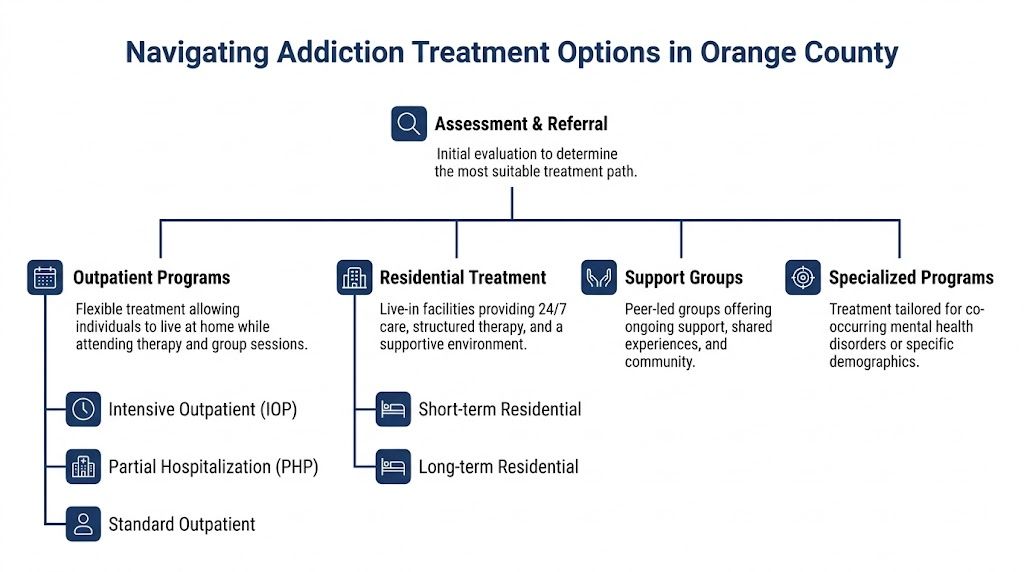
A structured blend of peer support and professional treatment can help families break codependency patterns. One cited framework reports benchmark success rates of 50% to 70% improvement in anxiety and depression for spouses when peer support is integrated with therapy, and it points to escalation into outpatient structures such as PHP and IOP when more support is needed, as described in this article on dealing with an alcoholic spouse.
What each level of care actually means
Some spouses hear "rehab" and imagine only one model. In reality, there are several.
| Level of Care | Primary Goal | Typical Duration | Best For |
|---|---|---|---|
| Medical detox | Stabilize withdrawal and monitor physical risk | Short-term | A husband who may have unsafe withdrawal symptoms or heavy daily alcohol use |
| Residential treatment | Remove the person from the drinking environment and provide round-the-clock structure | Short-term or longer-term, depending on need | A husband whose home setting, relapse pattern, or mental health makes outpatient care too thin |
| Partial hospitalization program (PHP) | Deliver high-structure treatment during the day without overnight stay | Varies by clinical need | A husband who needs intensive therapy but has safe housing |
| Intensive outpatient program (IOP) | Provide several therapy sessions each week while the person lives at home | Varies by progress and relapse risk | A husband stepping down from higher care or needing flexible structure |
| Standard outpatient | Maintain recovery work and monitor relapse risk | Ongoing or time-limited | A husband with more stability and lower immediate risk |
| Support groups | Build accountability and peer connection | Ongoing | Anyone needing sober community and reinforcement |
Decision points that matter
A spouse often asks, "How do we know what he needs?" The most useful questions are practical.
Withdrawal risk
If he shakes, sweats, becomes very anxious without alcohol, or has a history suggesting significant dependence, medical evaluation is important before trying to stop on his own. Withdrawal can be dangerous.
Home stability
If the home is full of conflict, access to alcohol, or active enabling, outpatient treatment may not be enough at the start. A more structured environment can interrupt the cycle.
Mental health
Many men with alcohol problems also deal with depression, anxiety, trauma, or other psychiatric symptoms. If those are present, dual-diagnosis care matters because treating only the drinking often leaves the driver of the drinking untouched.
Readiness and follow-through
Some husbands agree to treatment in the middle of a crisis and withdraw that agreement once the pressure drops. That is why speed matters. When readiness appears, families should move quickly to assessment and placement.
Questions to ask any program
A spouse doesn't need to become an addiction expert overnight. A short list of questions can filter out confusion:
- Does the program assess for co-occurring mental health conditions?
- Is there medical support for withdrawal if needed?
- What is the plan after the first phase of treatment?
- How is family involved, if appropriate and safe?
- What happens if he relapses during or after treatment?
- Is there help verifying insurance and coordinating admission?
A spouse who is looking specifically for structured local care can review Orange County outpatient alcohol rehab options to understand how outpatient treatment fits into a larger recovery path.
What treatment can and cannot do
Treatment can interrupt alcohol use, build coping skills, address trauma or depression, and create a recovery plan. It cannot manufacture motivation that disappears the moment discomfort appears. It also cannot repair the marriage on its own.
That is why spouses need parallel support. His treatment is not her treatment. If he enters detox, residential care, PHP, or IOP, the spouse still needs boundaries, therapy, support groups, and decisions about safety at home.
Treatment is a doorway, not a guarantee. Families do better when they treat it as the start of a process, not the end of the problem.
When Children Are Involved Protecting Their Future
Children don't need a full explanation of alcohol use disorder to be harmed by it. They only need to live near unpredictability. They notice the slurred speech, the broken promises, the strange bedtime, the fighting behind closed doors, the canceled plans, the fear in the other parent's face.
Adults often believe they are hiding it. Children usually know more than the adults think.
The scale of this issue is large. In the United States, 12.1% of children in two-parent households live with a parent who has an alcohol use disorder, and children in single-parent homes are 47.6% more likely to live with an alcoholic father, according to the same previously cited source on the effects of living with an alcoholic spouse.
What children need to hear
Children need truth in language they can hold.
For younger children:
- Keep it simple
"Dad has a problem with alcohol. It is not your fault." - Name the safety rule
"If Dad acts scary or confused, come to the other parent right away." - Repeat predictability
"The adults are working on keeping you safe."
For older children and teens:
- Be honest without oversharing
"His drinking affects the family, and the child is not responsible for fixing it." - Invite questions
Teens often already know more than adults realize. - Make a plan together
Who do they call, where do they go, what do they do if a conflict starts?
The key is not to recruit the child as a helper, messenger, monitor, or confidant. That role damages them.
Signs a child is carrying too much
A child may not say, "I'm traumatized." The signs usually show up in behavior.
- Anxiety
Trouble sleeping, clinginess, stomachaches, fear when the parent drinks. - Withdrawal
Staying in the bedroom, going emotionally flat, avoiding friends. - Acting out
Aggression, school problems, defiance, sudden anger. - Parentification
Taking care of siblings, trying to manage the drinking parent, becoming "the little adult." - Perfectionism or hypervigilance
Trying to keep the house calm by being exceptionally good or extremely quiet.
Children don't need a perfect parent. They do need one sober, steady adult who believes what they are seeing and acts on it.
When official intervention becomes necessary
Many spouses fear that reaching out to authorities will destroy the family. In reality, refusing to act can leave the children carrying risk no one named clearly enough.
A report to child protective services may be necessary if the father drives intoxicated with children, supervises them while impaired, becomes violent, leaves them unattended, exposes them to severe domestic conflict, or creates conditions where basic care is not reliable. A spouse should also document concerning incidents, dates, behaviors, and any impact on the children. Clear documentation matters.
Calling for help should be framed accurately. It is not punishment. It is protection.
Family protection in daily life
Some of the most effective child protection steps are immediate and practical:
- Create a child safety routine
A code word, a safe room, a trusted neighbor, and a phone number they know. - Control transportation
The children do not ride with him if there's been any drinking. - Tell one safe adult
A teacher, pediatrician, family member, or school counselor can become part of the safety net. - Get the child support too
Therapy for children can help stop confusion from hardening into long-term shame.
Children recover better when one adult stops minimizing what they live with and starts building safety around them.
Taking Your First Step Toward Hope and Healing
A spouse cannot control whether her husband lies, drinks, promises, relapses, or finally accepts help. She can control whether she keeps living without a plan.
That is where hope starts. Not with a dramatic speech. Not with the perfect timing. With one concrete decision. Put documents together. Tell one trusted person the truth. Stop covering for his drinking. Book a therapy appointment. Ask about treatment. Make a child safety plan. Leave for the night if the house is not safe.
Living with alcoholic husband can make a person feel trapped inside someone else's disorder. That feeling is real, but it is not the whole reality. There are choices available even before he changes. Safety can improve before sobriety. Clarity can return before the marriage is fully decided. Children can be protected before the future is fully known.
If he becomes willing to get help, move quickly. If he doesn't, the spouse's safety and mental health still matter. They always mattered.
Still Water Wellness Group offers confidential support for individuals and families facing alcohol addiction in Orange County. If a husband is ready for treatment, or if a spouse needs help understanding options for the next step, the team is available around the clock. Learn more at Still Water Wellness Group or call (866) 450-0391 for a confidential, no-obligation consultation.