A family often reaches this search at the worst possible time. A loved one has finished detox, or is close to discharge from residential treatment, and everyone knows the same truth. Going straight back to the old apartment, old friends, old stress, and old isolation is a bad plan.
That’s where halfway houses in San Diego matter. They give people a place to practice recovery in real life, with rules, accountability, and enough structure to keep momentum going when treatment ends. For many families, this step is the difference between a fragile discharge and a stable routine.
San Diego also isn’t a market where safe housing is easy to find. In the 2024 San Diego Regional Breakdown, 1,258 people in the region were sheltered in transitional housing, a category that often overlaps with halfway houses and recovery residences. That number matters because it shows these homes aren’t a fringe option. They’re part of the local recovery and homelessness response.
Navigating Your Next Step in Sobriety
A person can leave treatment looking stronger and still be nowhere near ready for total independence.
That’s the part families often underestimate. A client may be sober, medically stable, attending groups, sleeping better, and saying the right things. None of that guarantees they can handle a sudden jump into an unstructured environment.
Why the period right after treatment is so risky
The first real test usually isn’t motivation. It’s logistics.
A person leaves a controlled setting and suddenly has to manage transportation, appointments, work, meals, boredom, anxiety, and exposure to triggers all at once. If the home environment is tense, lonely, or full of easy access to substances, recovery starts from behind.
A good halfway house changes that equation. It creates a sober address, a predictable routine, and a peer environment where recovery is normal instead of awkward.
Practical rule: If the discharge plan sounds vague, the housing plan is not strong enough.
Families in Southern California also deal with another problem. Geography makes it easy to drift. Someone may complete treatment in Orange County, feel hopeful, then move back into a part of San Diego where every old trigger is still waiting. That’s why this decision has to be deliberate.
What families usually need most
They usually don’t need more inspirational language. They need a clean checklist and clear judgment.
They need to know:
- Whether sober living is necessary: For many people, it is. Especially after detox, residential treatment, relapse, or legal pressure.
- Whether the house is structured: Curfews, testing, meetings, and accountability matter.
- Whether mental health is part of the plan: Anxiety, depression, trauma, and mood instability can wreck recovery if nobody addresses them.
- Whether the transition is realistic: A bed alone isn’t enough. The person also needs outpatient care, transportation, and follow-through.
Halfway houses in San Diego work best when families stop treating them like simple housing. They are a bridge. Not a reward. Not a punishment. A bridge.
That mindset helps people choose better and faster. It also keeps the focus where it belongs, on stability, not appearances.
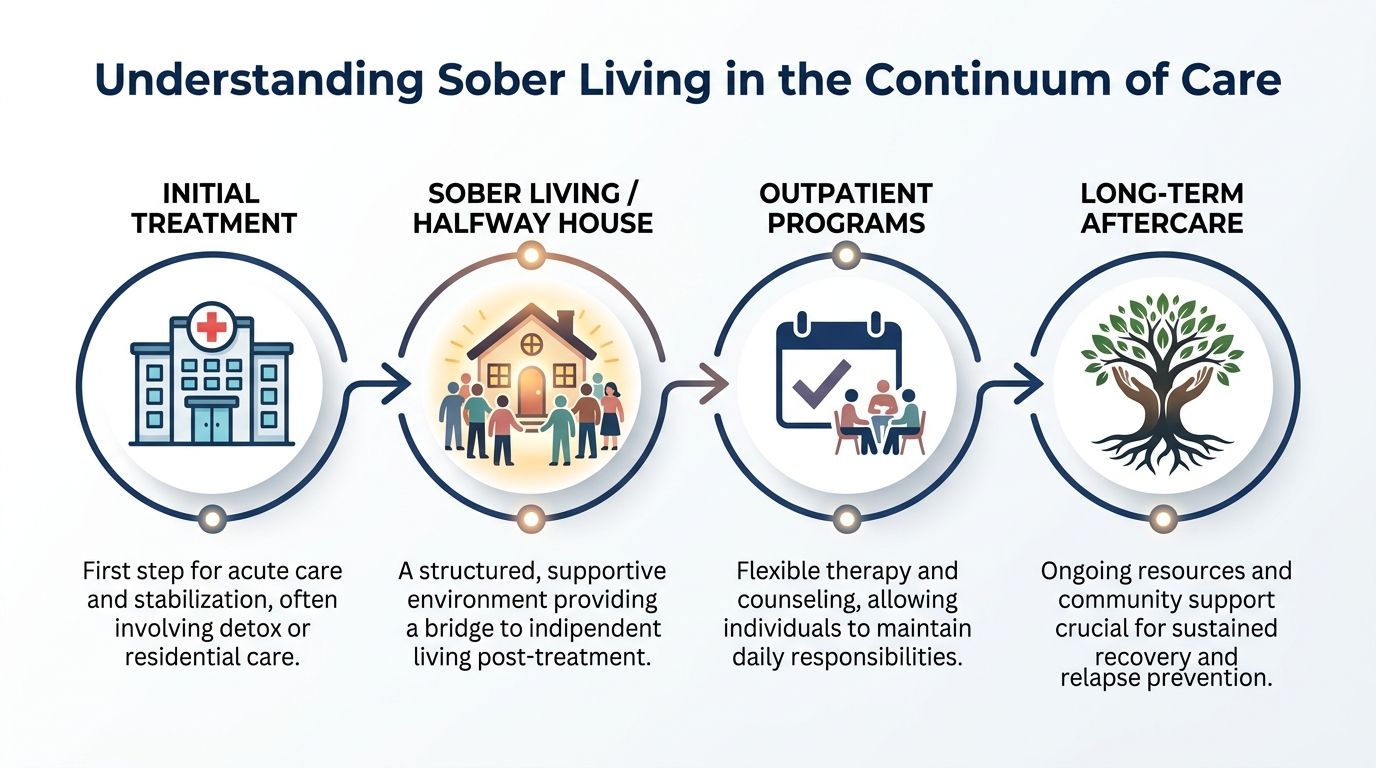
Understanding Sober Living in the Continuum of Care
A halfway house is best understood as a step-down living environment.
It isn’t detox. It isn’t residential treatment. It usually isn’t the place where the deepest clinical work begins. It’s the setting where a person starts proving they can live sober outside a locked schedule while still staying close to support.
What sober living is
The simplest way to explain it is this. A sober living home is like a recovery apartment with supervision and rules.
Residents usually sleep there, share common areas, follow house expectations, attend recovery meetings or treatment, and remain substance-free. Some homes are looser than they should be. The good ones aren’t.
San Diego’s housing pressure is one reason these homes matter so much. The City of San Diego’s Housing Element demographics appendix shows a for-rent vacancy rate under 2% along with rising overcrowding. In plain terms, a person leaving treatment isn’t stepping into an easy rental market. A sober home can provide a stable landing spot when regular housing is hard to secure.
For readers comparing options, this overview of sober living helps clarify how recovery housing fits into a broader aftercare plan.
How sober living compares with higher levels of care
People often confuse all post-treatment services into one category. That leads to bad placement decisions.
Here’s the difference:
| Level of care | Where the person lives | Clinical intensity | Best fit |
|---|---|---|---|
| Residential treatment | On-site at the program | High | Acute instability, relapse risk, need for round-the-clock structure |
| PHP | At home or in supportive housing | High daytime structure | A person who needs strong clinical support without full residential care |
| IOP | At home or in supportive housing | Moderate | A person who can manage more independence while attending regular therapy |
| Sober living / halfway house | In a recovery residence | Usually low clinical care on-site, but high accountability if run well | A person who needs a sober environment while practicing daily life |
That distinction matters. A halfway house doesn’t replace therapy. It supports therapy.
When sober living is the right next move
A sober living home is a strong recommendation when any of these are true:
- Home is unsafe: Substance use is active in the household, or conflict is constant.
- Relapse happened after prior discharge: The person has already shown they need more structure.
- Mental health symptoms still interfere: Anxiety, trauma reactions, or depression make independent living shaky.
- The client is stepping down from residential care: Too much freedom too soon often backfires.
- The person needs a buffer while starting work or outpatient treatment: Recovery routines need time to stick.
A weak discharge plan usually fails in ordinary ways. Missed rides. Missed groups. Isolation. One bad night. Then the spiral starts.
What sober living is not
Families should stay alert for programs that blur the line.
A halfway house is not the same thing as licensed residential treatment if it isn’t providing that level of clinical care. It also shouldn’t be sold as a cure-all. Housing helps. Accountability helps. But the best outcomes come when sober living is paired with outpatient treatment, medication support when needed, and steady case planning.
That’s why halfway houses in San Diego should be judged by how well they support the full continuum, not by how polished the website looks.
How to Evaluate and Choose a Quality San Diego Halfway House
A bad sober living home can waste precious time. A good one can protect recovery when motivation is still fragile.
Families shouldn’t choose based on location alone. They should choose based on how the house operates every day.

Start with key requirements
San Diego’s Network of Care highlights quality markers like supportive staff oversight, peer support meetings, and a drug-free environment. In the same resource, RAND analysis is cited as showing homes with these features can improve retention rates by 50 to 70 percent and reduce environmental relapse triggers by 40 percent. That benchmark appears in the county’s recovery homes and halfway houses directory.
Those numbers tell families something simple. Structure isn’t cosmetic. It changes outcomes.
A practical way to screen quality is to review standards associated with a sober housing network and then compare each home against those expectations.
Questions that deserve direct answers
A phone call should feel like an interview, not a favor. If the staff can’t answer basic questions clearly, that’s a warning.
Ask these:
- What does a normal weekday look like? A good operator should explain wake-up times, meeting expectations, chores, curfew, and transportation routines.
- How is sobriety monitored? Drug and alcohol testing policies should be clear.
- Who is on-site or on-call? Families need to know whether there is real supervision or just a landlord collecting rent.
- What happens after a rule violation or relapse? Evasive answers usually mean inconsistent enforcement.
- How are residents matched? Age, recovery stage, legal history, and mental health all affect fit.
- Can residents attend outside therapy, PHP, or IOP? The answer should be yes, and the house should be used to coordinating that schedule.
What to look for during a tour
A strong home doesn’t need luxury. It needs order.
Look for these details:
- Clean common areas: Not perfection. Basic maintenance, sanitary bathrooms, and a kitchen people can use.
- Visible house rules: Residents should know the expectations.
- A calm tone: The house should feel active but not chaotic.
- Real peer culture: Residents should seem engaged, not checked out and drifting.
- A manager with boundaries: The role is support plus accountability, not friendship without rules.
If a house says it’s recovery-focused but can’t explain its enforcement process, it’s selling atmosphere instead of structure.
Red flags families should take seriously
Some warning signs are subtle. Others are obvious.
| Red flag | Why it matters |
|---|---|
| No clear daily routine | Unstructured time is a major relapse risk |
| No testing policy | Accountability becomes optional |
| Staff avoid questions | Weak management usually hides behind vague language |
| Residents appear unsupervised | The house may be little more than shared rent |
| No connection to outpatient care | Recovery housing without treatment linkage often leaves gaps |
What quality feels like in practice
The best halfway houses in San Diego do a few things consistently well.
They protect the sobriety of the home. They communicate clearly with families when appropriate. They expect residents to work a program, not just occupy a bed. They understand that boredom, conflict, and untreated mental health symptoms can knock someone off course fast.
Families don’t need a perfect house. They need a serious one.
The Critical Need for Dual Diagnosis Sober Living
A standard sober living home is not enough for every client.
If a person is dealing with addiction plus PTSD, anxiety, depression, bipolar disorder, or another mental health condition, the wrong housing can unravel progress quickly. Sobriety and psychiatric stability affect each other every day. Treating only one side is a weak plan.
Why generic sober housing often misses the mark
Some homes understand addiction but don’t understand mental health. That gap shows up fast.
A resident may be sober but still have panic attacks, nightmares, mood swings, medication needs, or a hard time tolerating group conflict. In a house that treats every issue as a discipline problem, the resident gets labeled difficult instead of getting the right support.
That’s why dual-diagnosis-capable housing matters. It doesn’t need to turn into a hospital. It does need to work with treatment providers, support therapy attendance, respect medication plans, and create a culture that isn’t dismissive about symptoms.
The local gap is real
San Diego has a serious shortage of sober living options built for people with co-occurring disorders. That concern is reflected in this discussion of the shortage of specialized halfway house beds for co-occurring disorders in San Diego, which notes that dedicated programs are scarce even though the need is high.
That shortage creates a practical problem for families. A loved one may be ready to leave detox or residential care, but the available houses may not be equipped for the mental health side of recovery.
For families trying to understand whether co-occurring care is needed, this overview of dual diagnosis is useful because it explains why addiction treatment has to address both conditions together.
What dual-diagnosis support should include
A halfway house doesn’t need to provide all clinical care on-site to be useful. But it should support it in obvious ways.
A strong fit usually includes:
- Medication stability support: Residents can store and manage prescribed medications safely under clear house expectations.
- Access to therapy and psychiatry: The home allows scheduling for appointments and doesn’t treat them as secondary.
- Staff who understand symptoms: Trauma responses, depression, and anxiety shouldn’t be mistaken for laziness or defiance.
- Low-chaos environment: Constant conflict is bad for everyone, especially people with mental health vulnerabilities.
- Coordination with outpatient care: Housing and clinical treatment should reinforce each other.
The wrong house asks, “Can this person follow rules?” The right house also asks, “What support helps this person stay regulated enough to follow them?”
When families should insist on specialized support
Families should push for dual-diagnosis-aware sober living if the person has:
- a history of psychiatric hospitalization
- ongoing anxiety or depression that affects daily functioning
- trauma symptoms
- self-harm history
- unstable mood despite sobriety
- repeated relapse tied to emotional distress
This isn’t overcomplicating discharge. It’s making it honest.
Navigating Admissions Payment and Insurance
Money discussions often decide the placement, even when everyone agrees sober living is needed.
That’s why families should get practical fast. Hope without financial clarity leads to rushed decisions, surprise bills, and premature move-outs.
What families should expect to ask about cost
One of the biggest problems in this space is poor transparency. Many online listings don’t explain real pricing, whether a home is private pay, or whether any part of the care around the housing can be billed. A discussion of this issue on Second Chance housing notes that costs for halfway houses can range from $1,500 to over $3,000 per month, and that the lack of clear pricing or insurance information creates barriers for families.
That range is wide enough to change the whole decision.
When a family calls a home, they should ask for a plain breakdown of:
- Monthly housing fee: What the resident pays each month for the bed.
- Deposit requirements: Whether there’s a move-in fee, hold fee, or refundable deposit.
- What’s included: Food, utilities, drug testing, transportation, linens, and household supplies vary by home.
- Extra charges: Late fees, missed test fees, ride fees, and mandatory program costs should be discussed up front.
- Refund policies: Families need to know what happens if the resident leaves early.
What insurance usually does and doesn’t do
This part confuses families because sober living sits near treatment but isn’t always billed like treatment.
In many cases, the housing itself is self-pay. But related clinical services may be covered if the resident is also attending PHP, IOP, therapy, psychiatry, or medication management through an eligible provider. The exact answer depends on the plan and the service.
A helpful starting point is understanding what insurance is generally required to cover under essential health benefits. That gives families a better framework for asking what parts of mental health and substance use treatment may fall under covered care, even when room and board do not.
Questions that prevent ugly surprises
Families should ask these before committing:
- Is the house fee separate from outpatient treatment fees?
- If insurance covers therapy, who verifies benefits?
- Are there in-network and out-of-network differences?
- What happens if authorization for clinical care changes?
- Is payment weekly or monthly?
- What is due on move-in day?
The smartest way to think about affordability
The cheapest bed is not always the most affordable choice.
A poorly run house can lead to relapse, discharge, lost work, another treatment admission, or legal trouble. Families should focus on value, structure, and continuity of care. A home that supports outpatient treatment and stable recovery may cost more up front and still save money by preventing chaos.
That doesn’t mean families should accept vague pricing. They shouldn’t. It means they should compare total stability, not just monthly rent.
Your Path Forward to a San Diego Sober Living Home
Families usually feel better once the decision gets broken into steps.
Not because the process becomes easy, but because it becomes manageable. A good placement comes from the right sequence. Match the level of care, screen the house carefully, confirm mental health support, and get the payment details in writing.

The clearest path is usually the best one
For many people leaving treatment in Orange County or elsewhere in Southern California, the practical sequence looks like this:
- Confirm discharge readiness: Not everyone belongs in sober living. Some still need residential care.
- Choose housing based on clinical reality: If mental health symptoms are active, generic housing may not hold.
- Verify how outpatient care will continue: Transportation, scheduling, and accountability all matter.
- Get the financial terms clearly stated: Never rely on verbal summaries.
- Move quickly once the right fit appears: Good beds don’t stay open long.
Families also benefit from understanding the administrative side of behavioral health claims, especially when multiple services are involved. This plain-language overview of medical billing for mental health helps explain why coverage, authorizations, and billing categories can feel so confusing during discharge planning.
When outside guidance helps
A family in crisis doesn’t need to become an expert in recovery housing overnight.
The better option is to work with an admissions team that can help assess the right level of care, identify sober living options in San Diego and across Southern California, and verify insurance for the treatment services that may accompany housing. That kind of guidance reduces mistakes at the exact moment mistakes are most expensive.
A strong transition plan removes guesswork. It doesn’t leave families chasing calls, comparing vague promises, and hoping for the best.
Frequently Asked Questions About San Diego Halfway Houses
What’s the difference between a halfway house and sober living?
In everyday conversation, families often use the terms interchangeably.
Some programs use “halfway house” for more formal or justice-related transitional settings, while “sober living” may sound more like recovery housing for people stepping down from treatment. In practice, what matters most is not the label. It’s the structure, rules, supervision, and connection to recovery support.
How long should someone stay in a halfway house?
There isn’t one perfect timeline.
The right stay depends on housing stability, relapse history, employment readiness, mental health, family dynamics, and how well the person is doing in outpatient care. A rushed exit is a common mistake. If the person is only sober because the environment is doing all the work, more time in structured housing is usually smarter.
Are halfway houses in San Diego only for people leaving rehab?
No.
Many residents enter from rehab, but some come from detox, hospitalization, court involvement, unstable home environments, or repeated relapse patterns. What matters is whether the person needs a sober place with accountability while building daily-life stability.
Can someone work while living in sober housing?
Usually yes, and that’s often part of the plan.
A quality home should support work, school, outpatient treatment, and recovery meetings in a way that creates routine instead of chaos. Families should still ask how employment is handled. Some homes require residents to focus on stabilization first. Others expect job searching quickly.
What house rules matter most?
The basic rules tend to matter more than fancy extras.
The most important areas are sobriety expectations, testing, curfew, guest policies, chore participation, attendance requirements, and consequences for violations. A home that acts casual about these topics usually creates confusion later.
What should a family ask before move-in day?
A focused list helps:
- Who supervises the home daily
- How residents are screened
- What transportation options exist
- Whether medications are allowed and how they’re handled
- What outpatient participation is expected
- What happens during conflict, noncompliance, or relapse
- What the resident needs to bring
This conversation should be clear enough that no one feels surprised on day one.
Are residents allowed to take prescribed psychiatric medications?
Many are, but the answer depends on house policy and clinical fit.
A dual-diagnosis-aware home should have a rational approach to prescribed medication, especially when the resident is under medical supervision. Families should ask direct questions and make sure the house can support the treatment plan instead of undermining it.
What if a loved one doesn’t want sober living?
That resistance is common.
A person may say they’re fine, promise they’ll attend meetings, or insist they can go straight home. Families should focus on patterns, not promises. If prior discharges failed, if the home environment is unstable, or if mental health remains active, sober living is often the safer recommendation even when the person resists it.
This conversation goes better when families stay calm and specific. Arguing in general terms usually leads nowhere. A better approach is to say exactly what problem the housing solves: transportation gaps, relapse triggers, unsafe roommates, no structure, or no support for follow-up care.
“The goal isn’t to control the person. The goal is to stop sending them back into the exact conditions that fed the addiction.”
Can families stay involved after admission?
Usually yes, within appropriate boundaries.
Healthy family involvement can help with accountability, transportation planning, financial coordination, and discharge planning. The home should also protect resident privacy and independence. Families should ask what communication looks like and when staff will reach out if there’s a serious issue.
Do all homes support people with anxiety, depression, or trauma?
No, and families shouldn’t assume they do.
That’s one of the biggest mistakes in this process. Some homes are comfortable with co-occurring issues. Others are not. If the person has a mental health history, the family should ask pointed questions about therapy attendance, medication support, psychiatric follow-up, and how staff respond when symptoms flare up.
Is location in San Diego the main thing to focus on?
It matters, but it shouldn’t dominate the decision.
A convenient neighborhood helps with treatment attendance, work, and family support. But a nearby house with weak structure is still a bad choice. Families should rank quality first, then logistics.
What if there’s a waiting list?
That doesn’t always mean the home is better, but it often means demand is real.
Families should ask whether a short-term bridge option exists, whether another vetted house is available, and whether outpatient treatment can continue smoothly during the wait. Delays are frustrating, but rushing into a poor fit can create larger problems.
Can insurance verification still help even if housing is self-pay?
Yes.
Even when the bed itself is not covered, insurance verification can still matter for PHP, IOP, therapy, psychiatry, and medication management tied to the resident’s continuing care plan. That’s why families should never stop at asking, “Is sober living covered?” They should also ask, “What parts of ongoing treatment are covered while the person is in sober living?”
What makes a house feel safe?
Families usually recognize it quickly.
The place feels orderly. Staff answer questions directly. Rules exist and are enforced. Residents don’t seem frightened, intoxicated, or unmanaged. The environment feels steady enough that a person can sleep, show up, and rebuild trust with themselves.
That’s the standard worth holding.
Still Water Wellness Group helps individuals and families sort through the hardest part of recovery planning. The team can help determine the right level of care, coordinate transitions from detox, residential, PHP, or IOP, connect clients with appropriate sober living options in San Diego and across Southern California, and verify insurance for eligible treatment services. For a confidential consultation, visit Still Water Wellness Group or call (866) 450-0391 today.