It is 2 a.m. Your phone lights up. A loved one is high again, refusing help again, and the family is asking the same desperate question: can anyone make them go to rehab before someone gets hurt?
The legal answer is yes, sometimes. The practical answer is harder. For adults, families usually cannot admit someone to treatment by force just because the person is using drugs and saying no. The law generally requires an emergency psychiatric hold, a court order, or another state-authorized process tied to immediate danger or severe inability to care for basic needs.
That distinction matters. Families often assume forced rehab means getting someone into a program and fixing the problem. In reality, involuntary treatment has limits from the first day. A person may still keep important legal rights, may be held only briefly, and may not qualify for long-term treatment unless the facts meet a specific legal standard. In California, those limits are especially important because 5150 holds and conservatorships are built around safety, grave disability, and due process, not family frustration alone.
You need a plan for what happens after the hold starts, not just whether a hold is possible.
That includes understanding how to talk to someone before the crisis gets worse. A clear, structured conversation often works better than another argument, especially if your family learns how to talk to a family member about checking in to residential drug treatment. If you are exhausted, scared, and running out of ideas, it also helps to read what to do when hopeless, because families in this position need support too.
This article explains both sides of the issue. Yes, there are situations where the law can intervene. Just as important, you need to know what rights your loved one still has, how short an involuntary hold may be, and what your family can do now if legal action is not yet available.
Watching a Loved One Struggle and Wondering What You Can Do
When a parent, spouse, sibling, or adult child is deep in addiction, the family often cycles through the same pattern. They plead. They bargain. They threaten. They rescue. Then they wonder if the law can step in where love hasn't worked.
That question usually comes after the family has already seen too much. Missed work. Pills gone from the medicine cabinet. Hallucinations. Car accidents. A child left unsupervised. Rent unpaid again. At that point, asking whether someone can be forced into treatment isn't controlling. It's often an act of desperation.
What the family needs to know first
For adults, the legal system doesn't usually allow rehab by simple family consent. A court or designated crisis process typically needs evidence that substance use has created a serious safety issue, severe incapacity, or a situation where the person can't care for basic needs. For minors, parents generally have more authority.
That doesn't mean the family is powerless before a legal crisis unfolds. Conversations still matter. Boundaries matter. Timing matters. A practical starting point is learning how to talk to a family member about checking in to residential drug treatment so the family doesn't turn every discussion into a fight.
Hard truth: Waiting for “rock bottom” is not a plan. Families often confuse patience with passivity.
The emotional toll on relatives is severe. Some family members stop sleeping. Others become hypervigilant, monitoring every text, every bank charge, every social media post. When the household starts collapsing under fear and exhaustion, it can help to read something grounded and stabilizing, even if it's not addiction-specific, such as this piece on what to do when hopeless. Families need support too.
The right mindset
A strong family response is not about punishment. It is about safety, clarity, and documented action. That includes three priorities:
- Protect immediate safety: If there is overdose risk, violence, medical instability, or psychosis, the family should treat it as an emergency.
- Stop guessing about the law: California rules are specific, and assumptions lead families in the wrong direction.
- Use force only when necessary: If persuasion, intervention, and structure still fail, then legal pathways become relevant.
Understanding Involuntary Commitment for Substance Abuse
A family usually reaches this point after months, sometimes years, of chaos. The question shifts from “How do we convince them?” to “Can the court step in?” That is a legal question, not a parenting question, and the answer depends on evidence.
Involuntary commitment is a civil legal process that can place someone in evaluation or treatment without full consent when their substance use has created a serious safety risk or severe incapacity. A relative cannot admit an adult into rehab by signing paperwork. The court or crisis system has to see specific facts, and the person still keeps legal rights during that process.
About 38 states plus the District of Columbia allow some form of civil commitment for adults with substance use disorder under defined standards, as outlined in this state involuntary commitment overview.
What courts generally look for
Courts want proof, not family frustration. Daily drug use, broken promises, lost jobs, and constant lying are painful, but those facts alone often do not meet the standard. Judges usually look for documented danger, grave disability, repeated overdose events, psychosis, inability to care for basic needs, threats, medical collapse, or a pattern of crisis that shows the person cannot stay safe without intervention.
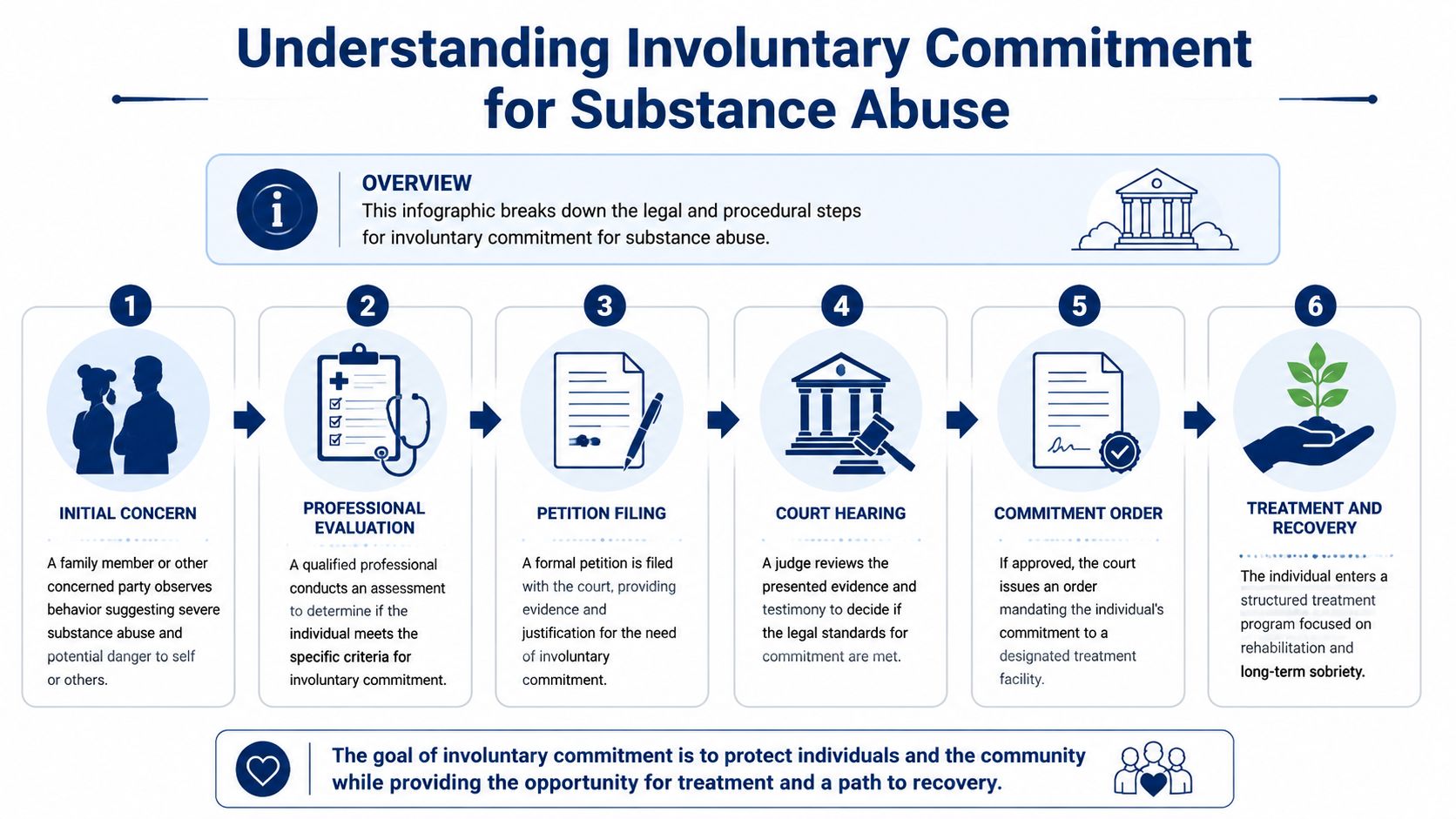
The process usually follows the same broad path, even though deadlines and forms change by state.
- A credible concern is reported. A family member, clinician, or officer reports facts showing serious impairment or danger tied to substance use.
- A professional assessment happens. Records, observations, toxicology findings, and mental health screening may be reviewed.
- A petition is filed. The filing states the legal basis for forced evaluation or treatment.
- A hearing is held. A judge reviews whether the legal standard has been met.
- An order may be entered. If the evidence is strong enough, the court can require evaluation, short-term placement, or treatment.
- The person enters care under legal supervision.
What families need to understand before filing
Forced rehab is narrower than families expect. It is designed for dangerous impairment, not general noncompliance. If you walk into court saying, “She uses every day and refuses help,” that may not be enough. If you walk in with dates of overdoses, ER discharges, police contacts, suicidal statements, neglect of children, wandering, or inability to secure food and shelter, you are speaking the court's language.
That difference matters.
It also matters what happens after an order is issued. Involuntary treatment does not erase a person's rights, and it does not guarantee long-term recovery. Depending on the state, the person may have the right to notice, counsel, a hearing, and the chance to challenge the evidence. They may be released quickly if the legal threshold is no longer met. They may receive evaluation and stabilization without being kept in residential addiction treatment for very long. Families need to plan for that reality instead of treating a court order as a final answer.
The strongest family role is to act like a careful witness. Write down dates, incidents, hospital visits, overdose reversals, threats, missing-person episodes, and failures to meet basic needs. Specific facts carry weight. General statements do not.
For readers comparing how these rules work outside California, this explainer on Texas involuntary commitment law shows how much standards and procedure can differ across states.
Terms that matter
| Term | Plain meaning |
|---|---|
| Petitioner | The person asking the court or crisis system to intervene |
| Respondent | The person the petition concerns |
| Evaluation | A professional assessment of danger, impairment, or incapacity |
| Hearing | The court review where legal standards are tested |
| Commitment order | The judge's authorization for involuntary placement or continued hold |
Navigating California's 5150 Holds and Conservatorship Laws
California families often hear “5150” and assume it means a direct path to rehab. It doesn't. A 5150 hold is an emergency mental health hold for up to 72 hours when a person appears to be a danger to self, a danger to others, or gravely disabled. Substance use can be part of the picture, but the hold is tied to the immediate crisis and functional impairment, not addiction alone.
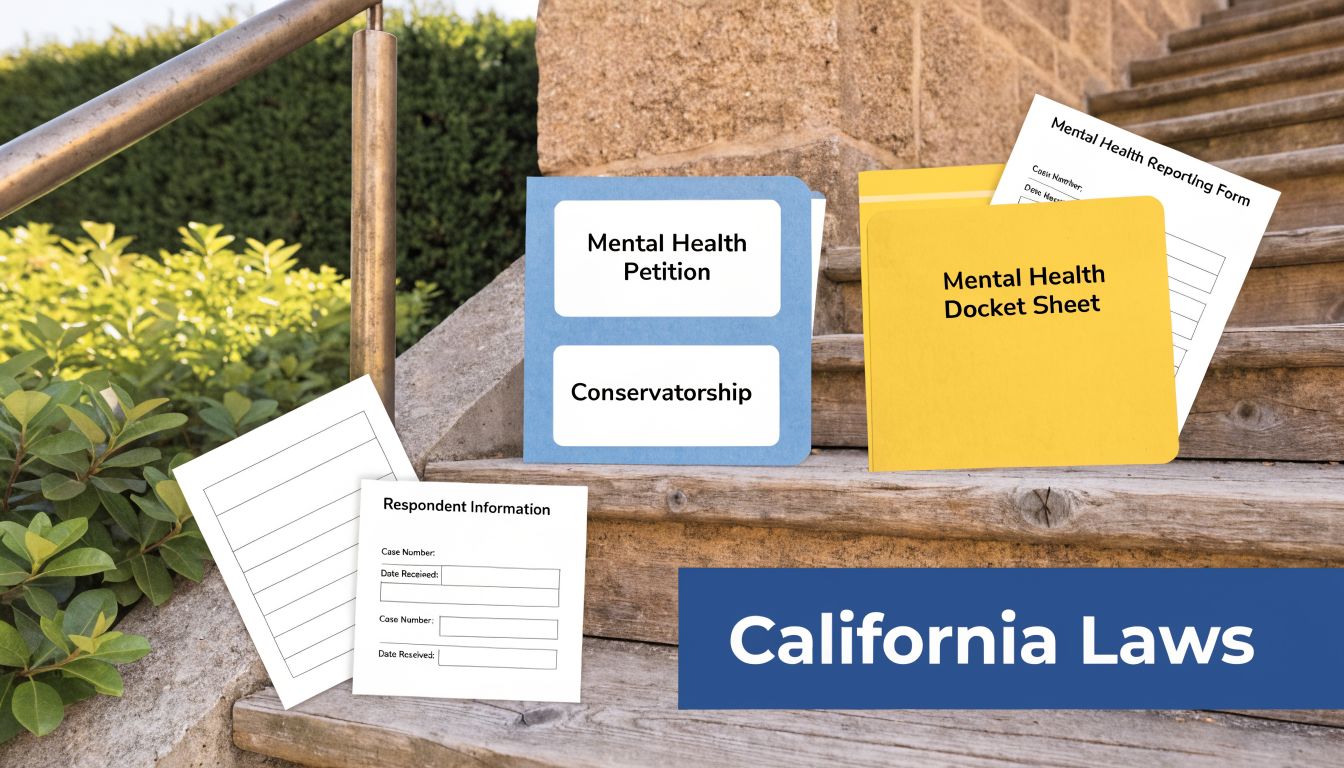
For families in Orange County, that distinction matters. If a person is intoxicated, disoriented, suicidal, violent, or unable to provide for basic survival because of a substance-related crisis, emergency evaluation may become possible. If the issue is chronic refusal of treatment without immediate crisis facts, the family may not meet the threshold for a hold.
What a 5150 is and what it is not
A 5150 is designed for short-term assessment and stabilization. It is not a family-controlled admissions shortcut. It is also not a guarantee that the person will be transferred directly into long-term addiction treatment.
If clinicians determine that the person still meets criteria after the first emergency period, a 5250 can extend the hold for up to 14 days. That extension still depends on legal and clinical review.
When conservatorship enters the conversation
A much more serious and longer-term tool is an LPS conservatorship. Families should treat this as a separate category, not just a longer 5150. Conservatorship is generally used in severe cases involving grave disability tied to mental illness, sometimes worsened by substance use, where the person cannot safely provide for basic needs and the impairment is ongoing.
This is a high bar. It usually involves repeated crises, failed stabilization, and substantial documentation. Families in Irvine, Lake Forest, Mission Viejo, Huntington Beach, and elsewhere in Orange County often assume a conservatorship can be obtained merely because addiction has become devastating. California law asks a narrower question: is the person so impaired that they cannot function safely at a basic level?
Practical distinction: A hold addresses immediate crisis. A conservatorship addresses sustained incapacity.
A simple comparison
| California tool | Main purpose | Typical use |
|---|---|---|
| 5150 | Emergency evaluation | Immediate danger or grave disability during acute crisis |
| 5250 | Short extension of hold | Continued risk after initial evaluation |
| LPS conservatorship | Longer-term legal oversight | Severe, ongoing inability to care for basic needs |
Families should also know what these tools do not solve. They do not guarantee insight. They do not guarantee cooperation. They do not guarantee a bed in the exact program the family wants. California law can open a door. It cannot force lasting motivation.
The Limits and Ethical Questions of Forced Rehab
It is 2 a.m. Your son is high again, your spouse wants to call the police, and you are asking the question families ask in panic: Can we force rehab and finally make this stop?
Ask a harder question first. If you use legal force, what will it accomplish by tomorrow, by discharge, and a month later?
Forced treatment can interrupt a crisis. It can buy time for detox, evaluation, and short-term safety. It does not create insight on command, repair trust, or guarantee that the person will stay engaged once the immediate pressure is gone.
Coercion can help, but it does not solve the whole problem
Outside pressure matters. Family pressure, court pressure, and emergency psychiatric intervention can get a person through the door and keep them there long enough to stabilize. That matters. Many people enter treatment before they feel fully ready, and some do improve once care begins.
Families should still keep their expectations strict and realistic. A forced admission is a starting point, not a cure. If the person leaves with the same denial, the same trauma untreated, and the same people, places, and routines waiting at home, the legal action may amount to a pause rather than a turning point.
That is the part many articles skip.
What a person still controls during involuntary treatment
Being placed on a hold does not erase a person's rights. It does not give the family unlimited authority. It does not let a program impose every treatment decision the family wants.
In California, those limits matter. A person may still have legal rights tied to informed consent, communication, hearings, and in some settings the ability to object to parts of treatment. The exact boundaries depend on the type of hold, the setting, and whether there is a separate court order or conservatorship in place. Families need to understand this before they promise each other that a hold will force detox medication, medication-assisted treatment, group participation, or every part of an experiential or complementary treatment plan.
Legal force can compel evaluation and short-term containment. It does not hand the family total control over the person's body, medications, or long-term recovery choices.
This is also why discharge can feel so jarring. Families assume the system will keep the person until they are "fixed." The system is usually deciding something narrower: whether the legal basis for holding them still exists.
The ethical problem is real, and families should face it directly
Addiction wrecks judgment. Adults still have rights. Both statements are true.
If your loved one is at immediate risk of overdose, psychosis, self-harm, violence, or profound inability to care for basic needs, waiting around for perfect consent is not compassion. It is avoidance dressed up as respect. In that situation, use the legal tools available.
If the risk is serious but not at that threshold, forced treatment can backfire. It can harden resistance, fracture the family further, and distract everyone from the work that changes outcomes: boundaries, consequences, treatment planning, and sustained follow-up after the crisis passes.
A few principles keep families grounded:
- Use force for immediate safety, not for convenience: Legal action is justified to stop acute danger, not to end family conflict faster.
- Expect partial cooperation: A person may accept detox and reject therapy, or accept residential care and refuse medication. Partial engagement still gives clinicians something to build on.
- Do not confuse placement with recovery: Getting someone into a bed is one event. Recovery depends on what happens after stabilization.
- Protect dignity where you can: Even in crisis, speak clearly, tell the truth, and avoid humiliating tactics that make later trust harder to rebuild.
The strongest position is this: use involuntary treatment when the danger is real and the legal standard is met. Then prepare for what comes next, because the person still has rights, the hold still has limits, and your family will still need a plan after the legal process ends.
Alternatives to Legal Action Your Family Can Take First
Most families move toward legal action too late or too early. Too late means after multiple emergencies. Too early means before they have tried organized, strategic pressure that still respects dignity. In many cases, the strongest move is not court first. It is structure first.

A professional intervention is often the better opening move
A well-run intervention is not a family ambush. It is a planned conversation with clear roles, a firm treatment option ready, and consequences the family is prepared to follow through on. The goal is to break through denial without turning the room into a courtroom.
A strong intervention usually includes:
- One clear ask: The family asks for treatment now, not “sometime soon.”
- Prepared statements: Each participant sticks to facts and impact, not insults or old resentments.
- A real admissions path: Transportation, insurance questions, and next steps are lined up in advance.
- Unified consequences: If treatment is refused, enabling stops.
Boundaries often work better than threats
Families routinely sabotage themselves by making dramatic warnings they never enforce. That teaches the addicted person that resistance works.
Better boundaries are plain, specific, and enforceable:
- Housing boundary: No staying in the home while using, threatening others, or stealing.
- Money boundary: No cash, no debt rescue, no paying legal fines created by active use.
- Child safety boundary: No unsupervised contact if the person is intoxicated or unstable.
- Communication boundary: No abusive calls, no midnight chaos, no manipulative bargaining.
Boundaries are not punishments. They are the family's refusal to participate in the addiction.
Family therapy can reset the entire system
Addiction rarely lives in isolation. The family adapts around it. One person covers for work absences. Another hands over money “just this once.” Someone else becomes the angry enforcer. Family therapy helps expose those roles and replace panic-driven reactions with consistent strategy.
That matters because many loved ones finally accept treatment when the family stops cushioning every consequence. Legal action may still become necessary later. But a family that has already stopped enabling, documented danger, and presented treatment clearly is in a much stronger position, both emotionally and legally.
How to Prepare if Legal Steps Become Necessary
If the family has reached the point where legal intervention seems unavoidable, the next move should be disciplined, not frantic. Courts and crisis teams respond to evidence. Families should build a record that shows danger, severe impairment, and failed attempts to secure voluntary help.

What to document
A strong file is concrete. It should include dates, observed behavior, and supporting records where available.
- Specific incidents: Overdose scares, threats, hallucinations, wandering, self-neglect, driving while impaired, or violence.
- Functional collapse: Inability to maintain hygiene, food, shelter, medication, or childcare responsibilities.
- Medical or law enforcement contact: Discharge papers, police reports, welfare checks, or clinician notes when the family has them.
- Refusals of help: Prior offers of treatment, intervention attempts, and the person's responses.
A practical family guide to treatment basics can also reduce confusion before any formal process starts. Reviewing how rehab works helps families understand the levels of care that may come after a hold or court order.
Who the family should speak with
Legal preparation is not just about talking to a judge. It usually means assembling the right support around the family.
| Person | Why they matter |
|---|---|
| Mental health or addiction professional | Helps assess severity and document risk |
| Attorney familiar with these cases | Explains state procedures, rights, and filing standards |
| Hospital or crisis team | May initiate emergency evaluation in acute situations |
| Organized legal support staff | Helps gather records, timelines, and filing materials |
For families trying to organize records efficiently before speaking with counsel, resources on working with Legal assistants can help clarify the kind of document support that often makes these cases more manageable.
Why this effort is worth it
A landmark study affirmed by NIDA found that mandated addiction treatment can be as effective as voluntary treatment for long-term recovery, and one study of 2,653 participants found 12.5% experienced formal coercion into treatment with no significant difference in substance use outcomes compared with voluntary or untreated groups. That doesn't mean courts are a cure. It means families should not assume that a person must enthusiastically choose treatment on day one for treatment to help.
Action rule: If legal action becomes necessary, the family should prepare as if every unsupported claim will be challenged. Because it may be.
The families who handle this best are calm, organized, and persistent. They don't rely on emotional speeches. They bring dates, records, and credible witnesses.
Guiding Your Loved One Toward Voluntary Healing
Even when the question is can you force someone into drug rehab, the healthiest end goal is still voluntary participation. Courts can create pressure. Emergency holds can interrupt chaos. Families can set boundaries that change the emotional weather in the home. But sustainable recovery usually gets stronger when the person begins to participate, even reluctantly, in a real treatment process.
That shift often happens in stages. First comes crisis. Then brief stabilization. Then the person becomes just clear enough to hear options again. That moment matters. Families should be ready with a calm plan, not a lecture.
What families should aim for
Voluntary healing doesn't require perfect motivation. It requires enough openness to accept the next step. That may mean detox first, then residential care. It may mean dual-diagnosis treatment when substance use is tangled with depression, anxiety, trauma, or another mental health condition. It may mean continuing into PHP, IOP, and sober living rather than expecting one short stay to fix everything.
A family can help by doing three things well:
- Stay consistent: No mixed messages, no rescuing after clear boundaries were set.
- Keep the invitation open: Treatment remains available without endless argument.
- Move fast when willingness appears: A short window of readiness can close quickly.
When a loved one is finally willing to talk, it helps to use a focused approach such as the guidance in how to convince someone to go to rehab. The family does not need to become legal experts, clinical experts, and crisis managers all at once. It needs a plan, a calm voice, and immediate access to care.
Recovery often begins before full hope returns. It begins when the family stops waiting for magic, starts acting on facts, and uses every lawful option in the right order.
Still Water Wellness Group offers compassionate, confidential help for families and adults facing addiction in Orange County and Southern California. Located in Lake Forest, the program provides a full continuum of care, including detox, residential treatment, PHP, IOP, sober living, and dual-diagnosis support in a calm setting designed for real recovery. Families don't have to go through this alone. To speak with the admissions team, verify insurance, or discuss immediate treatment options, call (866) 450-0391 or visit Still Water Wellness Group.